

Verbal tensions between U.S. and Iranian regime officials have sharply escalated, with President Donald Trump warning that “very bad things are going to happen to Iran” if Tehran does not reach an agreement with Washington. Meanwhile, within Iran’s regime, growing dissent among officials and analysts signals increasing frustration with Supreme Leader Ali Khamenei’s policies.
Internal Criticism Against Khamenei’s Policies
Although few within the regime dare to criticize Khamenei directly, many officials have begun issuing veiled warnings about the consequences of the current trajectory. They argue that unless significant policy changes are made, the system is headed toward collapse.
Masoud Roghani Zanjani, a former head of the Planning and Budget Organization, recently made a striking remark in an interview, stating that Khamenei is opposed to the welfare of the Iranian people—a rare and bold statement from within the regime. Similarly, Mohammad Hossein Adeli, former governor of the Central Bank of Iran under President Akbar Hashemi Rafsanjani, has highlighted the severe economic toll of Iran’s tensions with the U.S.
The Economic Cost of Khamenei’s Anti-Americanism
Adeli revealed that Iran is losing at least $50 billion annually due to the impact of sanctions and restrictions on imports and exports. He estimated that the country’s total foreign trade volume last year stood at approximately $150 billion, with trade costs increasing by 30% due to the need to circumvent sanctions.
He further emphasized that these losses are equivalent to the entire government budget and that each Iranian lost an average of 53 million tomans last year due to the regime’s anti-American policies. “If these policies were reversed,” he said, “Iran’s income could potentially double.”
Warnings from Regime Loyalists
A growing number of officials who wish to preserve the regime now acknowledge the critical state of affairs. They warn that public discontent has reached unprecedented levels and that maintaining current policies could lead to the regime’s downfall. However, their primary concern remains the survival of the system, rather than the well-being of the people. Their opposition stems from fears of losing political and economic privileges rather than a commitment to reform.
Morteza Alviri, a former high-ranking official, has also voiced concerns about Iran’s macroeconomic policies. Without directly naming Khamenei, he criticized the policy of self-sufficiency in agriculture, particularly in wheat production. According to Alviri, this approach has significantly contributed to Iran’s worsening water crisis.
Khamenei has long defended self-sufficiency as a safeguard against dependence on foreign imports, believing that Iran must avoid the mistakes of the Soviet Union in securing food supplies. However, critics argue that this outdated strategy exacerbates Iran’s economic and environmental challenges.
A Bleak Economic Outlook
Economist Vahid Shaghaghi has expressed deep pessimism about Iran’s economic future. “We can no longer be optimistic or even moderate in our assessments,” he warned. “We must prepare for worst-case scenarios. The government is structurally and institutionally collapsing, and external pressures are mounting. I foresee 2025 as an extremely difficult year.”
Mohammad Daroudian, another economic expert, echoed these concerns, emphasizing that policymakers are focused only on short-term survival rather than addressing long-term structural issues. “Right now, policymakers are only thinking about the next few weeks,” he said. “They are not planning for the long term. Issues like the water crisis and budget shortfalls are casting a dark shadow over the country’s future.”
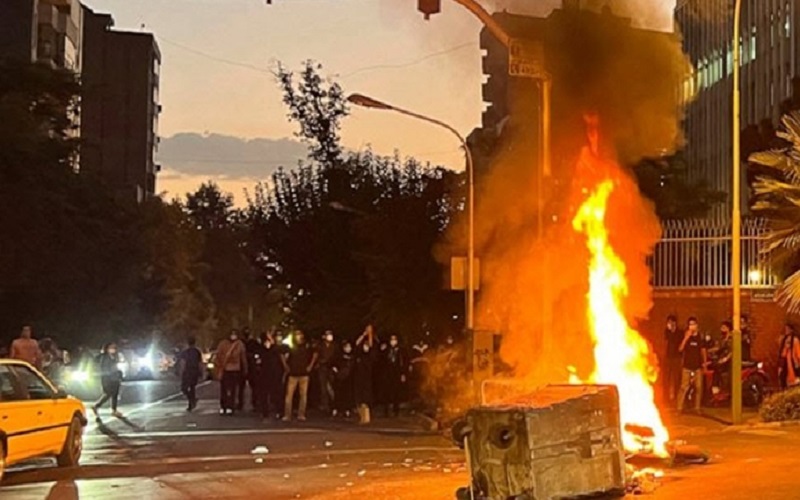
He also warned that Iran’s cycle of frequent protests and uprisings poses a severe threat to the economy. Reflecting on past events such as the November 2019 protests, the assassination of Qassem Soleimani, and the nationwide protests of 2022, he argued that social unrest has been a key driver of economic instability. “If there had been no major protests,” he said, “the exchange rate might have stabilized at 120–130 tomans per dollar. However, if protests continue, the currency could become even more volatile, as we saw in 2022 and 2023.”
Iran’s Dire Global Ranking
Peyman Molavi, an economic analyst within the regime, painted an even bleaker picture, stating that Iran currently ranks 160th out of 165 countries in economic performance. Looking ahead to 2025, he warned that economic solutions alone would no longer be sufficient to address the deepening crisis. “This year,” he said, “we can no longer hope to solve economic problems through economic measures alone.”
Conclusion
Iran’s economic and political landscape is becoming increasingly volatile, with internal dissent and external pressure converging to create a critical situation. While regime insiders are now openly voicing concerns about Khamenei’s policies, their primary motivation remains the survival of the system rather than genuine reform. As economic conditions continue to deteriorate, the potential for social upheaval grows, pushing the regime closer to a moment of reckoning.