



A prolonged digital shutdown is crippling the economy, deepening social fractures, and exposing a crisis of governance
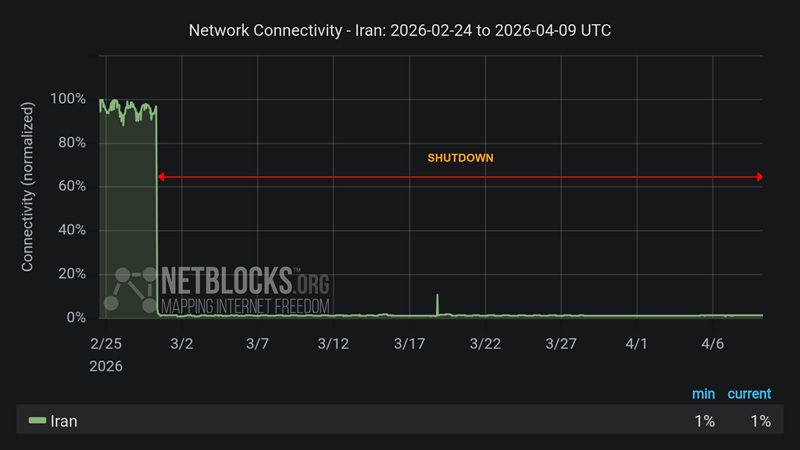
What was once considered an emergency measure has, in Iran, evolved into a defining feature of governance: the systematic restriction of internet access. Recent data suggests that, at certain points—even as recently as early 2026—access to the global internet fell to near-total blackout levels, reaching only a fraction of normal connectivity. This is no temporary disruption. It is a sustained, structural disconnection unprecedented in scale and duration.
Globally, internet shutdowns have typically been associated with acute political crises—coups, mass protests, or brief periods of instability. Even in such cases, disruptions tend to last days or, at most, weeks. Iran now stands apart. Its prolonged and repeated shutdowns, unfolding alongside a deep economic crisis and ongoing regional tensions, mark a new category: disconnection as policy, not reaction.
This distinction matters. The persistence of the blackout indicates that restricting access to information is not merely a tool of crisis management, but a central pillar of state control. By limiting the flow of information, authorities aim to preserve a singular narrative and contain dissent. Yet, in the modern information ecosystem, such strategies are inherently self-defeating.
Experience across multiple contexts has shown that suppressing access to reliable information does not stabilize societies—it erodes trust. When official channels become inaccessible or unreliable, citizens turn to informal and often unverified sources. The result is not control, but fragmentation: a public sphere shaped by rumor, speculation, and deepening mistrust.
The economic consequences are equally severe. Iran’s digital economy—one of the few sectors that had demonstrated resilience and growth in recent years—has been hit with extraordinary force. Reports indicate that many online businesses have experienced revenue declines ranging from 50 to 80 percent. This collapse is not driven by market dynamics alone; it is the direct outcome of severed access to customers, disrupted payment systems, and the loss of essential digital infrastructure.
At the operational level, the disruption is even more acute. Technical teams are cut off from global tools and platforms, customer communication channels are broken, and core business systems are rendered unstable. Productivity has plummeted, and in many cases, entire segments of the workforce have been effectively sidelined.
The downstream effects are predictable but no less alarming. Layoffs are increasing, small businesses are shutting down, and larger firms are beginning to contract. For startups and small enterprises—already operating with limited financial buffers—the blackout has been existential. What begins as a digital disruption quickly cascades into a broader economic contraction.
Investment, both domestic and foreign, is also fleeing. In an environment already characterized by high uncertainty, the additional risk introduced by systemic disconnection is critical. Investors require predictability, access, and integration with global markets—conditions fundamentally incompatible with prolonged internet restrictions. The result is capital flight and a near-total freeze in new investment.
Beyond economics, the social impact is profound. Millions of Iranians whose livelihoods depend on internet access now face sudden income loss. This has intensified public dissatisfaction and widened the gap between society and the governing structure. The blackout, in effect, is not only isolating Iran from the world—it is deepening internal divisions.
There is also a striking policy contradiction at play. On one hand, authorities continue to promote the development of a digital economy. On the other, they are dismantling its foundational infrastructure. This inconsistency reflects a deeper issue: the absence of a coherent economic strategy, replaced instead by a security-first mindset that permeates all aspects of governance.
Ultimately, Iran’s internet blackout is not merely a policy miscalculation. It is a symptom of a broader structural crisis—one in which control is prioritized over competence, and suppression over sustainability. By choosing disconnection as a governing tool, the system is not resolving its challenges; it is compounding them.
The long-term implications are stark. As the blackout persists, it will continue to erode economic capacity, weaken social cohesion, and accelerate systemic decline. At a certain point, the damage may become irreversible—leaving behind not only a disconnected society, but an economy and institutional framework too fragile to rebuild.