Prominent German figures condemn executions, highlight historical parallels, and call for global support of democratic change in Iran
At a conference held in Paris on April 10, organized by the National Council of Resistance of Iran (NCRI), prominent European political figures and legal experts delivered forceful speeches condemning the execution of Iranian dissidents and urging international action.
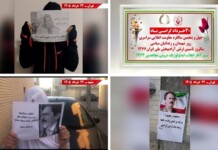
The event, titled “A Call for Immediate Action to Halt the Executions of PMOI and Dissident Political Prisoners, and Courageous Protesters,” honored 13 recently executed individuals—members of the People’s Mojahedin Organization of Iran (PMOI/MEK) and participants in nationwide protests—while emphasizing the broader struggle for freedom in Iran.
Mourning, Justice, and Historical Parallels
Herta Däubler-Gmelin, former German Minister of Justice, opened her remarks by underscoring the emotional weight of the gathering:
“Today my heart is… full of sorrow. We are all mourning the deaths of friends, resistance fighters… young people who had their lives before them, and now it’s gone.”
She stressed that those executed were not criminals, but “freedom fighters” who “died in the struggle for a free and democratic Iran,” adding:
“They have been murdered by the criminal mullahs’ regime.”
Drawing on her legal background, Däubler-Gmelin condemned the systemic abuses inflicted on political prisoners:
“Imprisonment, death cells, solitary confinement, torture, and now being killed by the appalling murder machine.”
She directly attributed responsibility to the Iranian leadership and judiciary:
“They are accountable for this killing machine… cynically call themselves justices… but they are simply agents… of this criminal mullahs’ regime.”
Looking ahead, she expressed confidence in eventual accountability:
“These criminals… will have their trial one day… in a free and just society.”
In a powerful historical comparison, she referenced resistance against Nazi regime, noting that even in its final days, repression intensified:
“In the last days of the criminal Nazi regime… [they] speeded up their killing machine.”
She cited figures such as Dietrich Bonhoeffer, Hans von Dohnanyi, and Georg Elser, drawing parallels to Iranian dissidents:
“They were heroes very similar to those whose pictures we have seen… The murderers are not known anymore; the heroes are.”
She concluded that Iran’s fallen activists would be remembered in the same way:
“I am convinced that your brave heroes… will be remembered and cherished in the exact same way.”
Criticism of Appeasement and Rival Political Narratives
Däubler-Gmelin also addressed contemporary political dynamics, praising Maryam Rajavi for her leadership:
“It was a wise, very balanced, responsible, and prudent statement.”
She described Rajavi’s Ten-Point Plan as:
“A valuable tool for useful and successful negotiations.”
In contrast, she sharply criticized Reza Pahlavi:
“Not a transformation plan but a very conceited document whose political intentions and morals seem to adapt to those of his political backers.”
She urged greater scrutiny within European institutions, stating:
“In Europe, this has to be made a bit more public than it is today.”
Freedom Through Popular Uprising, Not War
Franz Josef Jung, former German Defense Minister, reinforced the central theme that democratic change in Iran must come from within.
Honoring the executed individuals, he stated:
“They lost their lives, but made one thing clear: In Iran, freedom is not granted by a dictatorship, but only through a popular uprising.”
He emphasized that the regime’s actions reveal weakness rather than strength:
“This is not a sign of strength, but rather the regime’s fear of the spread of an organized resistance.”
Jung rejected the notion that external conflict can bring regime change:
“A war does not lead to the overthrow of a dictatorship; rather, a transition to democracy only succeeds if it comes from within the country.”
He highlighted the significance of the Ten-Point Plan:
“This Ten-Point Plan contains… free and secret elections… freedom of speech… separation of religion and state, gender equality… and a non-nuclear Iran.”
Framing the executions as evidence of a broader movement, he added:
“The 13 brave heroes… are living witnesses to the Iranian Resistance.”
His conclusion underscored the central message of the conference:
“The solution and freedom for Iran are not bombs, but the will of the Iranian people for democratic change.”
A Call for International Responsibility
Both speakers converged on a shared message: the international community must move beyond rhetoric and actively support the Iranian people’s aspirations for democracy.
Däubler-Gmelin called on European governments to act:
“We… have to remind our governments… That is what we owe to the brave people in Iran.”
The conference ultimately framed the executions not only as a human rights crisis but as a pivotal moment—one that demands accountability, amplifies the legitimacy of organized resistance, and reinforces the urgency of supporting a democratic alternative for Iran.