


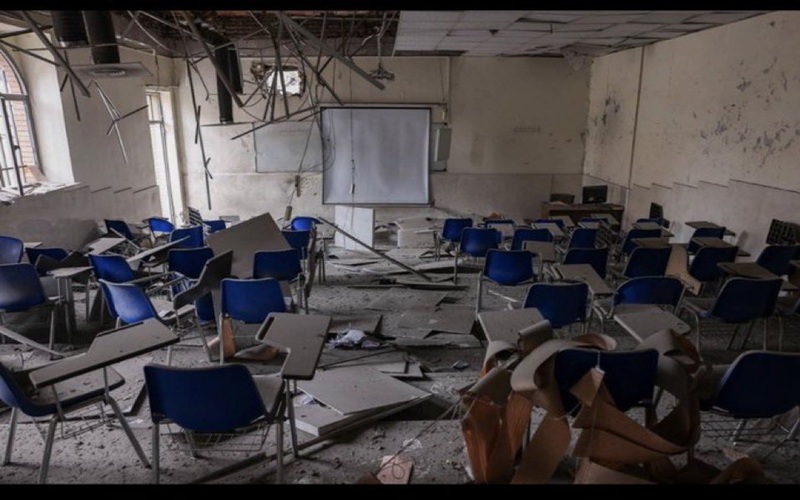

From destroyed schools to deepening digital inequality, Iran’s education crisis reveals structural failures intensified by conflict
The recent U.S. and Israeli strikes on multiple regions across Iran have left visible scars far beyond military or strategic targets. Among the most consequential—and least discussed—casualties is the country’s education system, now grappling with both physical destruction and systemic disruption.
According to official figures released by Iran’s School Renovation, Development, and Equipment Organization, more than 640 educational and administrative facilities across 17 provinces have been damaged. Of these, approximately 250 require major repairs, while at least 15 schools must be completely demolished and rebuilt. These are not isolated incidents—they represent a nationwide blow to already strained infrastructure.
Authorities have responded with familiar promises. Reconstruction projects are reportedly underway, including the planned “Shajareh Tayyebeh” educational complex, intended as a memorial to students killed during the attacks. The project is set to include two 12-classroom schools. Yet such symbolic gestures, while politically resonant, do little to address the scale or urgency of the crisis.
Officials insist that all damaged schools will be restored by the start of the new academic year in October. But this timeline strains credibility. Iran’s long-standing inefficiencies in public infrastructure projects, compounded by economic constraints and the breadth of destruction, make such assurances appear more aspirational than realistic.
In the interim, the government has shifted heavily toward online education. In many regions—particularly in Tehran—schools have suspended in-person classes entirely. Authorities have confirmed that remote learning will continue at least through late April, with universities also operating virtually until further notice.
For Iranian students abroad, including those in the United Arab Emirates, a new offline digital system has been introduced. Lessons are delivered without real-time interaction, and final exams have been replaced with continuous assessment through assignments and projects. While framed as an adaptive measure, this model raises legitimate concerns about academic rigor and educational outcomes.
Yet the deeper issue is not logistical—it is structural.
Online education in Iran has consistently reflected, rather than resolved, entrenched inequalities. The transition to digital learning has exposed a fragmented landscape defined by unequal access to devices, unreliable internet connectivity, and prohibitive costs. In underserved regions such as Sistan and Baluchestan, students often lack basic internet access altogether, sometimes forced to travel distances simply to obtain a signal. In provinces like Khuzestan and Hormozgan, frequent power outages further disrupt any semblance of continuity.
Even the government’s flagship platform, “Shad,” has failed to meet expectations. Persistent technical failures, low bandwidth, and limited interactivity have reduced it to a minimal, often ineffective tool. Rather than bridging educational gaps, it has widened them.
Compounding these challenges is an institutional insistence on maintaining formalities disconnected from reality. Some schools continue to demand assignment submissions and quantitative assessments, even as large numbers of students lack the means to participate meaningfully. The result is a quiet but accelerating exclusion—one that disproportionately affects students in marginalized communities.
Beyond infrastructure and access, there is a human cost. Many students are now navigating not only disrupted education but also psychological strain stemming from insecurity, instability, and sustained social pressure. This cumulative burden risks long-term consequences for an entire generation.
Taken together, the picture that emerges is not merely one of wartime disruption, but of systemic fragility. The destruction of school buildings is only the most visible layer. Beneath it lies a more profound crisis—one rooted in inequality, underinvestment, and institutional inefficiency.
The Iranian regime now faces a dual challenge: rebuilding physical infrastructure while simultaneously addressing the deep inequities embedded in its digital education framework. Neither task is simple, and neither can be resolved through short-term measures or symbolic projects.
Official narratives emphasize continuity and recovery. But on the ground, the path back to normalcy appears far more complex—dependent not only on reconstruction efforts, but on confronting structural deficiencies that long predate the current conflict.
In this sense, the war has not created Iran’s education crisis. It has merely exposed it.