


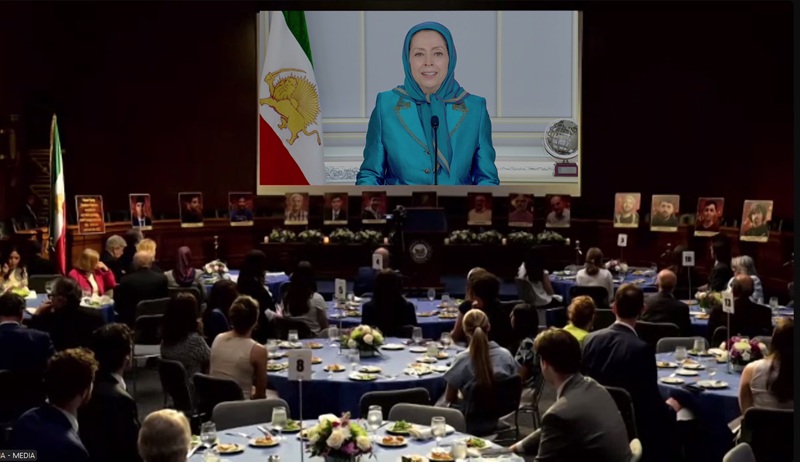

Bipartisan Washington briefing rejects war and appeasement, calls for recognition of organized resistance and a transition to a secular, democratic republic
WASHINGTON, D.C. — April 16, 2026 — A bipartisan coalition of U.S. senators and former senior diplomats convened in Washington for a high-stakes policy briefing titled “Iran: Towards Peace and Freedom,” delivering a unified message: neither military confrontation nor continued appeasement can resolve Iran’s deepening crisis. Instead, participants called for international recognition of the Iranian people’s right to overthrow the ruling theocracy and endorsed the National Council of Resistance of Iran (NCRI) as a viable democratic alternative.
Held against a backdrop of portraits depicting recently executed members of the People’s Mojahedin Organization of Iran (PMOI/MEK) and other protesters, the event underscored both the human cost of repression and the urgency of a strategic shift in Western policy.
A Shift Away from Monarchy and Appeasement
Marc Ginsberg, former U.S. Ambassador to Morocco, opened the session with a forceful rejection of both the current regime and any return to monarchy. Drawing on decades of personal and political engagement, he emphasized that the Iranian people have evolved beyond dynastic rule and are instead aligned with a democratic future driven by internal resistance.
Ginsberg highlighted the growing strength of organized opposition inside Iran, particularly networks affiliated with the MEK, and described NCRI President-elect Maryam Rajavi as a central figure in shaping a post-theocratic future. He pointed to her Ten-Point Plan—advocating secular governance, gender equality, and democratic elections—as a framework consistent with universal democratic principles.
Calling for a decisive overhaul of U.S. policy, Ginsberg proposed a new “Iran Freedom Act” to replace what he described as failed attempts at negotiating a comprehensive deal with Tehran. He urged Washington to formally recognize a provisional government aligned with the resistance and to provide communications and intelligence support to activists on the ground.
Congressional Push for Long-Term Commitment
Senator Thom Tillis, co-chair of the bipartisan Senate Human Rights Caucus, framed the current geopolitical moment as a rare opportunity to achieve lasting change in Iran. Speaking before images of executed activists, he expressed hope that future discussions on Iranian freedom could take place in Tehran itself.
Tillis stressed that while addressing Iran’s nuclear ambitions remains essential, equal priority must be given to establishing a clear pathway toward freedom. He called for any future U.S. policy framework to be codified through Congress, ensuring continuity across administrations and creating a stable foundation for supporting democratic transformation.
Human Rights as a Universal Imperative
Senator Cory Booker focused on the moral dimension of the Iranian struggle, rejecting the notion that democracy is a Western construct. He emphasized that the demand for liberty and justice transcends national boundaries, describing it as a universal human aspiration.
Booker praised the sacrifices made by Iranian protesters and resistance members, as well as the advocacy efforts of supporters abroad. He argued that meaningful solidarity must extend beyond rhetoric, requiring sustained political engagement and policy alignment in Washington.
NCRI Presented as a Prepared Alternative
Former Senator Roy Blunt highlighted the institutional readiness of the NCRI, noting that its Ten-Point Plan has provided a consistent roadmap for democratic transition for over two decades. He argued that this continuity distinguishes the movement as a credible governing alternative rather than a reactive opposition force.
Blunt sharply criticized diplomatic approaches that legitimize the current regime, insisting that no international agreement should implicitly affirm its authority. He called for immediate action to halt executions and state violence, while also supporting the NCRI’s proposal for an interim government leading to free and fair elections.
“The Solution Must Come from Within”
Carla Sands, former U.S. Ambassador to Denmark, reinforced the argument that sustainable change in Iran cannot be imposed externally. She dismissed both military intervention and appeasement as ineffective, asserting that only an internally driven movement can establish legitimate democratic institutions.
Sands identified Iranian women as a central force within the resistance, crediting them with sustaining momentum under intense repression. She rejected any revival of monarchical rule, instead urging formal U.S. recognition of the NCRI and its transitional framework. She described Rajavi’s Ten-Point Plan as the most viable blueprint for a secular, democratic, and non-nuclear Iran.
A “Red Zone” Moment for Change
Ambassador Sam Brownback concluded the briefing with a call for urgency, framing the current moment as a decisive stage in a decades-long struggle. Using a sports analogy, he argued that the opposition is closer than ever to achieving meaningful change.
Brownback emphasized the endurance of the organized resistance, particularly the MEK’s long-term presence inside Iran, and urged the international community to act decisively. He warned that failure to support the movement at this critical juncture could result in far greater instability in the future.
A Unified Message
Across political lines, speakers converged on a clear strategic conclusion: the Iranian regime’s greatest vulnerability lies not in external pressure alone, but in its confrontation with its own population. By recognizing and supporting organized resistance, they argued, the international community can help facilitate a transition to a democratic system grounded in popular sovereignty.
The briefing marked a notable shift in tone within Washington policy circles—away from containment and negotiation, and toward active support for regime change led by the Iranian people themselves.