


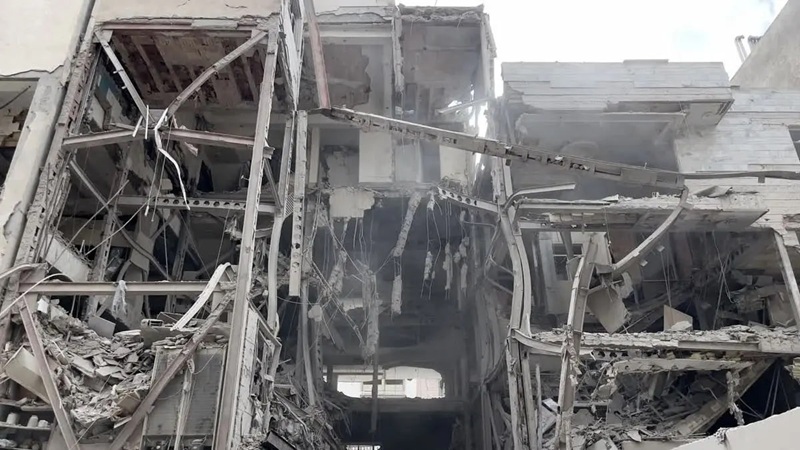

As thousands of homes are damaged in recent attacks, citizens face reconstruction alone—echoing decades of state inaction after past conflicts
As the human and material costs of the recent conflict involving the Iran regime continue to unfold, growing numbers of citizens are voicing frustration over the government’s refusal to provide direct financial support for rebuilding destroyed homes. The situation has reignited criticism of what many see as a longstanding pattern: mobilizing the country into conflict while leaving ordinary people to bear the consequences.
Reports from Tehran indicate that a newly proposed reconstruction plan has deepened a sense of abandonment among residents who expected the state to assume responsibility for damages caused by war. Instead, the government has opted against direct compensation, despite earlier rhetoric suggesting a commitment to recovery and support.
According to official estimates cited by state-affiliated media, tens of thousands of residential units have been affected. One provincial official reported that nearly 40,000 housing units in Tehran province alone sustained damage. Other assessments suggest that around 45,000 residential and non-residential properties were impacted during the conflict, with approximately 1,000 units requiring complete reconstruction.
Promises Without Clear Implementation
Local authorities had previously pledged comprehensive rebuilding efforts. In Tehran, officials stated that destroyed homes would be fully reconstructed and damaged buildings restored. However, there is little clarity on the progress made so far, and no detailed timeline has been provided.
The lack of transparency, combined with inconsistent damage estimates from various government bodies, has fueled public skepticism. Some officials have cited only a few thousand damaged units, while others refer to figures in the tens of thousands, leaving citizens uncertain about the true scale of destruction—and the level of assistance they can realistically expect.
No Direct Compensation, Indirect Incentives
Public discontent intensified after a government spokesperson confirmed that no direct financial aid would be provided to affected households. Instead, authorities plan to rely on a mechanism known as “floating density,” an urban planning tool designed to incentivize private sector participation.
Under this system, developers who agree to rebuild damaged or destroyed properties are granted permits to construct additional floors in new buildings. These extra units can then be sold for profit, theoretically offsetting reconstruction costs.
Critics argue that this approach is detached from economic realities. With construction costs sharply rising, density incentives are unlikely to compensate families who have lost their homes—particularly those without the financial means to engage with private developers.
For displaced households, the absence of direct support raises serious concerns about whether reconstruction will happen at all.
A Repeating Pattern of Post-War Neglect
The current approach is not unprecedented. Following the Iran-Iraq War, many devastated cities were left unreconstructed for years, with residents forced to rebuild their lives and homes largely without state assistance. That experience has become a reference point for many observers who now see a similar trajectory unfolding.
The recurrence of this pattern—state-led escalation followed by limited accountability for civilian losses—has reinforced perceptions that the burden of conflict consistently falls on the public, rather than the institutions that shape policy decisions.
Questions Over Transparency and Accountability
The wide discrepancies in official damage assessments have also raised concerns about transparency. Some analysts suggest that underreporting the scale of destruction may be an attempt to limit the government’s financial obligations, while also controlling public perception.
At the same time, the lack of clear communication during and after the conflict has intensified criticism of the Iran regime’s broader crisis management approach.
As thousands of families remain displaced or uncertain about their future, the absence of a coherent, adequately funded reconstruction strategy underscores a deeper issue: a persistent gap between state policy and public need—one that has resurfaced repeatedly in times of national crisis.