


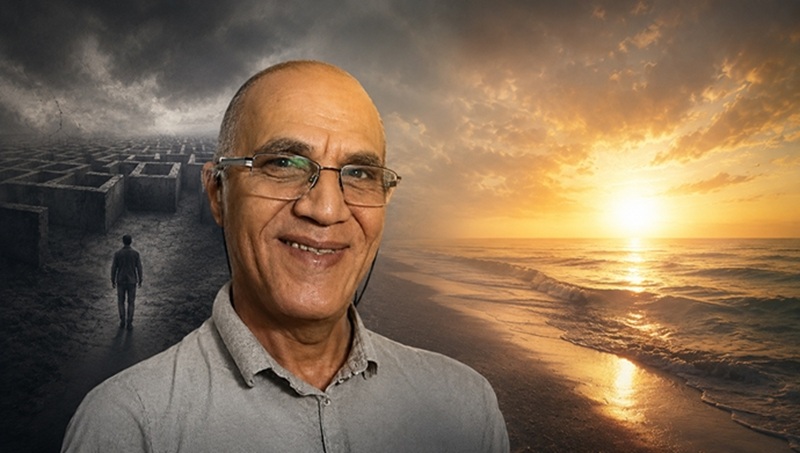

The life and final words of an executed dissident reflect the political awakening of a generation shaped by repression, broken promises, and resistance
In the cold yard of Qezel Hesar Prison, moments before execution, six members of PMOI’s Resistance Units reportedly shouted in unison: “Rise up… I am the storm.” It was more than a final act of defiance. For many observers, it symbolized a deeper political reality unfolding inside Iran — one that extends far beyond a single execution.
Among those prisoners was Akbar Daneshvarkar, a civil engineer from the deprived province of Sistan and Baluchestan, whose life story reflects the trajectory of many Iranians who spent decades searching for reform, only to conclude that meaningful change within the existing system was impossible.
Daneshvarkar was not born into political militancy or revolutionary mythology. By all accounts, he emerged from ordinary social conditions shaped by poverty, frustration, and political uncertainty. His transformation was gradual — formed not through ideology alone, but through lived experience inside a system that repeatedly crushed hopes for reform while demanding silence and obedience.
A Generation Raised on Promises of Change
Like many Iranians of his generation, Daneshvarkar initially sought change through paths presented as peaceful, gradual, and “cost-free.” After witnessing the conduct of Revolutionary Guard forces during the Iran-Iraq war, he reportedly distanced himself from the battlefield and turned toward political reform movements.
For a period, he placed hope in the reformist discourse associated with former president Mohammad Khatami and the promise of a “Dialogue of Civilizations.” But after years of political stagnation and institutional resistance, he came to a conclusion shared by many former reform supporters: that the structure of the Iranian regime itself prevented meaningful reform within the framework of the doctrine of Velayat-e Faqih.
That realization, however, did not immediately provide clarity. It led instead to a new period of uncertainty.
Like many Iranians exposed for years to state propaganda against opposition movements, Daneshvarkar reportedly feared even approaching the People’s Mojahedin Organization of Iran (PMOI/MEK). He later acknowledged that he had heard so many negative portrayals about the group that he was deeply reluctant to engage with it.
The Turning Point After November 2019
According to accounts surrounding his political evolution, the decisive turning point came after the November 2019 nationwide protests and the mass killing of demonstrators by regime security forces.
The crackdown, in which hundreds — and according to some reports more than 1,500 — protesters were killed, shattered lingering illusions for many Iranians across different political tendencies.
For Daneshvarkar, the aftermath exposed what he viewed as the inadequacy of political currents advocating purely symbolic or risk-free opposition. Reports describing his views say he reacted sharply to calls for exclusively nonviolent strategies while state violence intensified against protesters.
But beyond immediate anger, he also arrived at a broader political question — one that increasingly shaped his thinking.
Why, he asked, did so many political currents that ultimately accommodated or compromised with the regime share one common feature: hostility toward the MEK?
That question reportedly pushed him toward reexamining narratives he had previously accepted without scrutiny.
From Skepticism to Organized Resistance
As Daneshvarkar moved closer to the ideology and structure of the resistance movement, he concluded that the regime’s greatest fear was not rhetorical opposition, but organized sacrifice and disciplined resistance.
According to accounts from those familiar with his views, he came to believe that the opposition movement he had once feared was fundamentally centered not on personal power, but on returning political sovereignty to the Iranian people — a goal its members pursued at enormous personal cost.
For Daneshvarkar, this realization emerged not in isolation, but against the backdrop of deep social inequality and deprivation. Coming from one of Iran’s poorest regions, he had witnessed firsthand both economic hardship and what critics describe as the hypocrisy of political elites claiming to represent the people while remaining detached from their suffering.
Rather than retreating into cynicism, he chose direct involvement.
Supporters now portray him as part of a broader generation that concluded there were no shortcuts to confronting authoritarian rule. In their view, his life reflects the political journey of many Iranians who moved from reformist hopes to outright opposition after years of repression and disappointment.
Final Words Before Execution
In November 2025, after reportedly receiving confirmation that his execution sentence would be carried out, Daneshvarkar wrote words that supporters now circulate widely as a testament to his convictions.
“If fate decrees that I must give my life completely for freedom and for securing the future of my country’s children,” he wrote, “what could be more beautiful than that? What greater honor could there be than having my name placed beside those who preserved Iran through sacrifice and gave their lives for their homeland?”
For supporters of the resistance movement, those words transformed him from an anonymous prisoner into a symbol of political commitment and sacrifice.
For the regime authorities, however, such figures represent something more dangerous: individuals whose political evolution reflects a widening collapse of faith in reform, compromise, and gradual change inside the existing system.
That may explain why stories like Daneshvarkar’s continue to resonate far beyond prison walls — not simply because of how his life ended, but because of the political questions his journey continues to raise for a generation still searching for a path forward.