
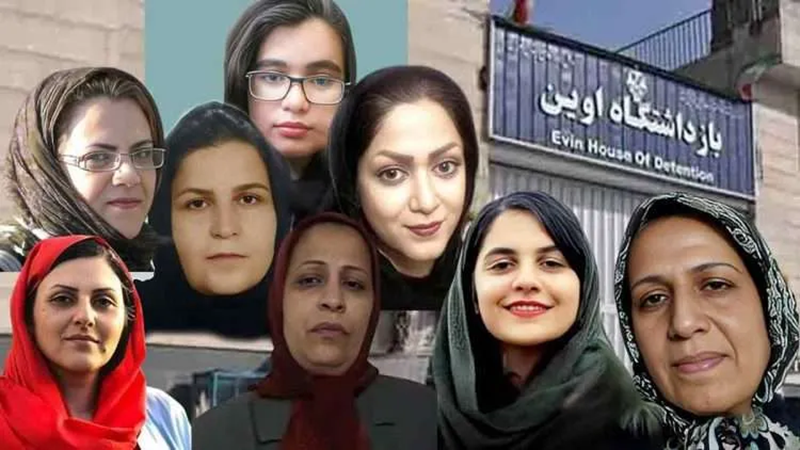

New sentences, medical deprivation, and family visitation bans reveal an intensifying crackdown on women accused of supporting the Iranian opposition.
The Iranian regime’s pressure campaign against female political prisoners appears to be entering a more aggressive phase, particularly against women accused of supporting the People’s Mojahedin Organization of Iran. Recent reports from inside Iranian prisons point to a growing pattern of punitive measures that includes new criminal cases, additional prison sentences, denial of medical treatment, and restrictions on family visits.
The developments highlight the regime’s continuing reliance on the prison system not merely as a tool of detention, but as a mechanism for psychological punishment and political intimidation. In recent weeks, several imprisoned women have reportedly faced retaliatory actions for protesting prison conditions and opposing executions.
Among the latest cases are Shiva Esmaeili and Elaheh Fooladi, two political prisoners held in Evin Prison. According to reports, both women received new legal cases and were each sentenced to an additional six months in prison on charges of “insulting the leadership” after protesting the death of Somayeh Rashidi.
Rashidi, a 42-year-old political prisoner, reportedly died in October 2025 inside Qarchak Prison under circumstances that triggered strong reactions among fellow prisoners. Her death became another symbol of the worsening conditions faced by female detainees in Iran’s prison system, where allegations of medical neglect, abuse, and mistreatment have become increasingly common.
Punishment for Protest Inside Prison
Reports also indicate that at least seven female political prisoners — including Zahra Safaei, Forough Taghipour, Marzieh Farsi, Elaheh Fooladi, Arghavan Fallahi, Shiva Esmaeili, and Golrokh Iraee — have been denied family visitation rights because of their participation in protest activities inside prison.
Their alleged “offenses” reportedly included singing protest songs, chanting slogans such as “No to Executions,” and participating in the “No to Execution Tuesday” campaign, a growing movement opposing the Iranian regime’s extensive use of capital punishment.
The punishment imposed on these prisoners reflects a broader strategy frequently employed by Iranian regime authorities: transforming even peaceful acts of protest inside prisons into grounds for additional repression. Family visits, access to communication, and medical care are routinely used as leverage against detainees who refuse to remain silent.
Medical Neglect as a Tool of Pressure
Concerns are also growing over the condition of Parisa Kamali, another female political prisoner reportedly affiliated with the opposition, currently held in Yazd Prison.
According to informed sources, prison authorities have refused to provide her with necessary medication and blocked her transfer to medical facilities despite concerns regarding her health condition. Reports further indicate that Kamali may face transfer to Khash Prison, a move that could further isolate her from family support and legal assistance.
Human rights advocates have long argued that denial of medical care inside Iranian prisons functions as a deliberate instrument of coercion. Political prisoners are often forced to choose between silence and access to treatment, while prison transfers are frequently used to increase psychological pressure and deepen isolation.
A Growing International Responsibility
The recent escalation against female political prisoners has once again prompted calls from human rights organizations for greater international attention to conditions inside Iranian regime prisons. Rights advocates argue that women detainees have become particular targets of retaliation because of their visible role in prison protests and anti-execution campaigns.
The pattern emerging from these cases suggests a regime increasingly concerned not only with suppressing dissent on the streets, but also with silencing resistance behind prison walls. Women who continue protesting despite imprisonment are being met with harsher punishments designed to break morale and discourage collective action.
Yet the continued activism of these prisoners also reflects another reality: even under extreme repression, opposition voices inside Iran’s prisons remain active. The regime may control the prison walls, but it has not fully silenced those imprisoned behind them.