The 1999 attack on Tehran University students was not merely a dark chapter in Iran’s history. It established a model of repression that the regime has repeatedly applied—from the 2009 protests to the 2022 uprising and the ongoing crackdown on university campuses.
Twenty-seven years after the violent assault on Tehran University’s student dormitories, the events of 18 Tir (7–13 July) 1999 remain far more than an unresolved historical injustice. They represent the moment when Iran’s ruling establishment demonstrated that it would respond to peaceful demands for reform not through dialogue, but through organized violence, intimidation, and impunity. More importantly, the attack became a template—a model that has shaped the regime’s response to virtually every major protest movement that followed.
As Iran marks another anniversary of the dormitory raid, the questions raised by that night remain unanswered. Those responsible were never held accountable, the victims were denied justice, and the culture of impunity that emerged from 18 Tir has continued to define the regime’s treatment of students and political dissent ever since.
A Turning Point in Modern Iranian Politics
The protests began after the closure of the reformist newspaper Salam and proposed legislation further restricting press freedom. Students at the University of Tehran organized peaceful demonstrations against the growing assault on civil liberties.
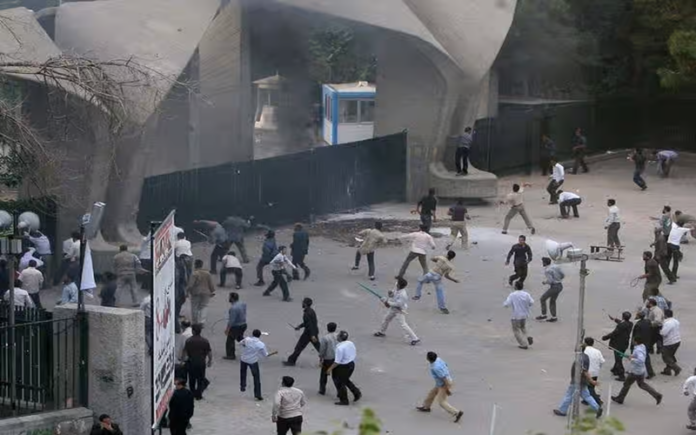
Before dawn on July 9, 1999 (18 Tir 1378), security forces and members of the paramilitary Ansar-e Hezbollah stormed the university dormitories. Students were beaten, rooms were ransacked, and hundreds were arrested. Human rights organizations later documented widespread abuses, while estimates suggested that between 1,200 and 1,400 people were detained during the subsequent nationwide protests.
The exact death toll remains disputed. While authorities acknowledged only a handful of fatalities, human rights organizations reported that at least four students were killed, hundreds were injured, and hundreds more were imprisoned.
The violence quickly spread beyond Tehran, transforming what began as a campus protest into one of the largest political crises of Mohammad Khatami’s presidency.
The Real Legacy Was Impunity
The most enduring consequence of 18 Tir was not only the brutality itself but the state’s refusal to hold senior officials accountable.
Although students and victims’ families pursued legal action, judicial proceedings ultimately targeted only a few lower-ranking personnel. Those believed to have planned, ordered, or coordinated the assault escaped prosecution altogether.
This pattern would become familiar.
The regime learned that violent suppression carried little political or legal cost. The absence of accountability in 1999 encouraged an increasingly aggressive security doctrine that would later be deployed against protesters across the country.
From 1999 to Today: One Continuous Policy
The attack on Tehran University’s dormitories was never an isolated incident. It marked the beginning of a systematic policy toward Iran’s universities.
Over the next two decades, every major wave of student activism encountered the same methods: surveillance, arbitrary arrests, disciplinary expulsions, forced confessions, intimidation of families, and heavy security presence on campuses.
During the 2009 protests, universities again became primary targets as students demanding electoral accountability faced mass arrests and violent crackdowns.
The nationwide protests of 2017–2018 and 2019 saw similar tactics, with security forces rapidly moving to prevent campuses from becoming centers of organized dissent.
Following the 2022 uprising, repression reached another level. Universities across Iran experienced widespread arrests, expulsions, suspension of students, dismissal of professors, deployment of security agents inside campuses, and increasing ideological oversight of academic institutions. Many universities effectively became militarized spaces where independent student organizations were dismantled and peaceful activism criminalized.
Rather than learning from the failures of 18 Tir, the regime institutionalized its methods.
Students Remain the Regime’s Greatest Concern
There is a reason Iranian regime authorities continue to devote enormous resources to controlling universities.
Historically, student movements have served as catalysts for broader political mobilization. Universities connect educated youth, civil society, labor activists, women’s rights advocates, and other social movements. For authoritarian governments, they represent not merely educational institutions but potential centers of political organization.
This explains why every new generation of Iranian students has encountered remarkably similar patterns of repression regardless of changing presidents or political slogans.
The continuity reveals an important reality: while governments have changed, the security state’s approach has remained fundamentally unchanged.
The Beginning of an Open Challenge to Supreme Leader Rule
The 18 Tir protests also marked another historic shift.
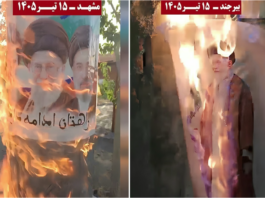
For the first time since the 1979 revolution, demonstrations openly targeted then-Supreme Leader Ali Khamenei. Protesters chanted directly against him, and in some gatherings his portraits were torn apart—a symbolic act that broke one of the regime’s most rigid political taboos.
What was once almost unimaginable would later become commonplace.
By the nationwide uprisings of 2009, 2019, 2022, and the massive protests that erupted in 2026, direct criticism of the Supreme Leader had become a defining feature of anti-government demonstrations.
The barrier first breached in 18 Tir was never fully restored.
Justice Deferred, Repression Repeated
The tragedy of 18 Tir lies not only in what happened during those days but in what followed.
Independent investigations never took place. Senior officials were never prosecuted. Victims and their families received neither justice nor truth.
That impunity sent a dangerous message throughout the state apparatus: force could replace accountability.
The consequences have echoed through every subsequent protest movement. Each new crackdown has built upon the precedent established in 1999, reinforcing the belief that security forces can suppress dissent without meaningful consequences.
History Has Not Ended
This year’s anniversary carries an additional historical symbolism.
It comes as Ali Khamenei is being buried under extraordinary security measures, with an extensive deployment of security forces surrounding his funeral. For many Iranians, the contrast is striking. The leader whose rule became synonymous with the systematic repression of student movements leaves behind a political system that continues to rely on the same methods first displayed so visibly during the assault on Tehran University’s dormitories.
Yet history also suggests another continuity.
Every attempt to silence Iranian students has ultimately produced new generations of activists determined to reclaim freedoms denied to those before them. The faces have changed, but the demands—for freedom of expression, university independence, peaceful assembly, and accountable government—remain remarkably consistent.
Twenty-seven years after 18 Tir, the anniversary is no longer simply about remembering one night of violence. It is about recognizing that the dormitory raid inaugurated a governing strategy built on repression and impunity—one that still shapes the regime’s treatment of students today.
Until those responsible are held accountable and universities are allowed to function free from political coercion, 18 Tir will remain not only a memory of past injustice but a reminder of a policy that never truly ended.