


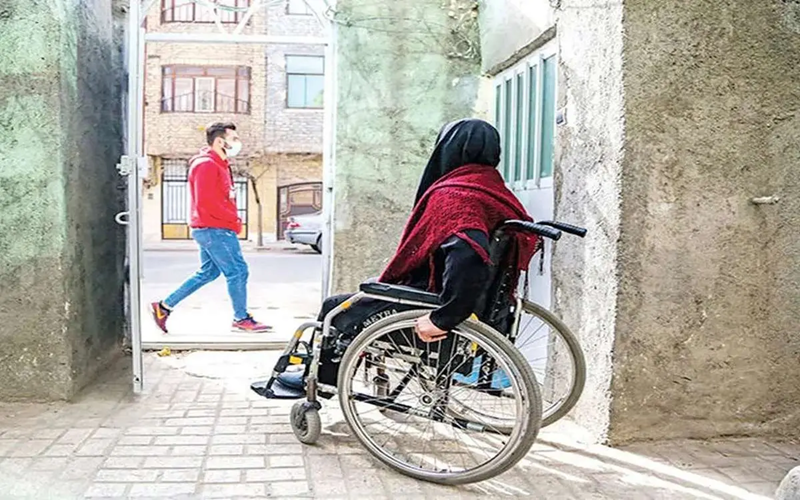

As inflation and healthcare costs soar, the Iran regime has suspended livelihood payments for many people with disabilities, exposing one of the country’s most vulnerable communities to deepening poverty.
Iran’s worsening economic crisis is taking an increasingly severe toll on one of the country’s most vulnerable populations. According to a report by the Iranian Labor News Agency (ILNA), the regime has suspended livelihood assistance payments for many people with disabilities since June, citing a lack of funding within the State Welfare Organization.
The report also states that payments for nursing allowances and subsidies for essential hygiene supplies have been delayed, leaving thousands struggling to cover even their most basic daily needs.
The cuts come as soaring inflation, rising healthcare costs, and the continued deterioration of living standards push vulnerable families deeper into poverty.
Budget Shortages Leave Vulnerable Citizens Behind
ILNA attributed the current crisis to the regime’s long-standing neglect of those under the Welfare Organization’s care, particularly people with disabilities.
The report argued that the worsening conditions are the result of ineffective government policies and the absence of equal social, economic, and political opportunities. It also warned that the situation becomes even more severe in provinces farther from Tehran, where access to services is often more limited.
For many disabled citizens, government assistance represents their only source of income. The suspension of these payments therefore has immediate and devastating consequences.
Rising Medical Costs Deepen the Crisis
The economic downturn has coincided with a sharp increase in the cost of medical treatment, rehabilitation services, and essential medications across Iran.
For people with disabilities who depend on continuous medical care, these price increases have become especially burdensome.
A 44-year-old man identified as Hossein, whose livelihood allowance was cut last month, described the hardship in an interview with Iranian media.
Despite being classified by the Welfare Organization as having a severe disability and suffering from pressure ulcers, he said his financial assistance was abruptly terminated.
Hossein also complained that the Welfare Organization refused to reimburse his surgical expenses because the operation had taken place during the previous Iranian calendar year. He added that charitable organizations, which once helped cover some of his costs, are now struggling themselves as the country’s economic crisis has reduced donations.
According to ILNA, many people with disabilities, including Hossein, are unable to work and survive almost entirely on modest welfare payments that are now proving increasingly unreliable.
Essential Supplies Become Unaffordable
The financial burden extends beyond monthly income.
Earlier this year, Iranian media reported that soaring prices for hygiene and medical supplies had dramatically affected the lives of approximately 45,000 people living with spinal cord injuries.
The cost of daily necessities—including sterile gauze, specialized wound dressings, catheters, catheter bags, medical gels, syringes, tissues, and medications for treating pressure sores—has reportedly doubled or even tripled in price.
These are not optional items but essential supplies required every day to maintain health and prevent life-threatening complications.
Welfare Payments Cover Only Days, Not Months
Raheleh, a 45-year-old woman living with a spinal cord injury, told ILNA that the Welfare Organization pays approximately 1.5 million tomans per month to cover hygiene supplies.
She said the amount is sufficient for only one week to ten days of disposable catheters and falls far short of meeting her monthly medical needs.
Because she has never been given meaningful employment opportunities, she has no salary to supplement the government assistance.
Raheleh also criticized the monthly nursing allowance of 4.2 million tomans, describing it as “close to nothing” when compared with the actual costs of healthcare.
She explained that regular doctor visits, diagnostic procedures, treatment expenses, medications, and transportation costs consume nearly all of her income before the middle of each month, leaving her unable to meet even her basic needs.
Economic Mismanagement Hits the Most Vulnerable
Even officials within the Welfare Organization have acknowledged the growing hardship.
Earlier this year, the organization’s deputy for rehabilitation services announced that it had requested an 80 to 90 percent increase in nursing allowances compared to the previous year, arguing that existing payments no longer reflect economic realities. However, implementation of any increase remains dependent on government approval.
The delay illustrates the widening gap between the rapidly rising cost of living and the regime’s limited support for vulnerable citizens.
As Iran’s economic crisis deepens, people with disabilities are increasingly paying the highest price. The suspension of essential assistance, combined with soaring inflation and inadequate healthcare support, highlights the regime’s inability—or unwillingness—to protect those most dependent on public assistance. For many disabled Iranians, survival has become a daily struggle against poverty, neglect, and an ever-expanding cost of living.