


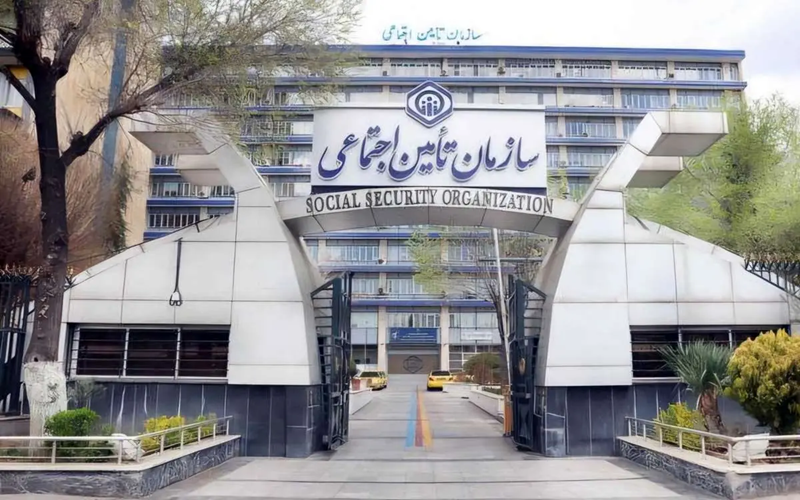

A new report detailing massive financial irregularities within Iran’s Social Security Organization highlights how systemic corruption has drained resources intended for millions of workers and retirees while exposing the regime’s lack of transparency and accountability.
A new investigation into corruption within Iran’s Social Security Organization (SSO) has once again exposed the scale of financial misconduct embedded in the regime’s institutions. The report, published by the Iranian Labor News Agency (ILNA), documents billions of dollars’ worth of financial irregularities, embezzlement, and questionable transactions, underscoring what many observers describe as systemic corruption rather than isolated misconduct.
The figures are staggering. According to the report, documented embezzlement and financial violations involving cash transactions total more than 18.5 trillion tomans. When the reported losses from the alleged undervalued sale of a company worth 50 trillion tomans are included, the total financial damage exceeds 51.8 trillion tomans.
These figures do not include an additional €4.002 billion and $59 million in alleged foreign currency violations linked to the organization.
But beyond the enormous sums involved lies a far more significant issue: whose money was lost.
Workers and Retirees Pay the Price
Unlike many government institutions, the Social Security Organization is funded primarily through insurance contributions paid by millions of Iranian workers and employers.
These contributions are intended to provide financial protection during retirement, unemployment, disability, illness, and workplace injuries.
Every case of corruption therefore represents more than financial mismanagement. It directly affects the economic security of millions of citizens who spent years contributing to the system with the expectation that it would support them when they needed it most.
Instead, the organization’s resources have repeatedly become the subject of corruption investigations.
A Pattern That Spans Governments
Perhaps the most revealing aspect of the latest report is that the alleged misconduct cannot be attributed to a single administration or individual official.
Over the years, investigations have repeatedly uncovered irregularities involving the Social Security Organization and its investment arm, Shasta, including controversial contracts, unauthorized payments, preferential treatment, and financial abuses.
While governments and managers have changed, the pattern has remained remarkably consistent.
That continuity suggests the problem is structural rather than personal.
When identical forms of corruption continue across multiple administrations, responsibility extends beyond individual officials to the political and institutional framework that enables such abuses.
The repeated scandals point to chronic weaknesses in oversight, limited transparency, and the absence of meaningful accountability within the regime’s governing institutions.
Corruption Extends Beyond Embezzlement
Public discussions of corruption often focus on outright theft or bribery.
The Social Security cases reveal another form of institutional abuse: the misuse of public resources through unauthorized bonuses, gifts, preferential privileges, and discretionary payments benefiting a limited group of officials.
This type of corruption can be particularly damaging because it creates the perception that those in positions of power are distributing wealth that does not belong to them.
The resources involved are not government assets in the ordinary sense. They belong to millions of workers and retirees whose mandatory contributions finance the system.
When those funds are diverted for managerial privileges or questionable financial decisions, public confidence in the entire institution is undermined.
The damage is therefore measured not only in lost money but also in the erosion of trust.
Weak Oversight Enables Repeated Abuse
Another striking feature of the reported cases is that many surfaced only years after the alleged violations occurred.
Most became public through parliamentary investigations, legal complaints, or changes in management rather than through effective internal oversight.
This raises an obvious question: if meaningful supervision had existed, could financial violations of this magnitude have continued for so long?
In countries with effective governance, transparency, independent oversight, and institutional accountability serve as the primary safeguards protecting public funds.
When those safeguards are weakened or absent, corruption becomes increasingly difficult to detect and even harder to prevent.
The repeated scandals within Iran’s Social Security Organization illustrate precisely this pattern.
A Structural Crisis, Not an Isolated Scandal
The latest corruption report is significant not simply because of the enormous financial losses it documents, but because it reinforces a broader reality about governance in Iran.
Successive investigations have exposed similar practices across different administrations, suggesting that corruption is embedded within the regime’s institutional framework rather than confined to individual officials.
As long as the political system lacks independent oversight, judicial accountability, and genuine transparency, the conditions that enable such abuses remain intact.
The central question is therefore not whether another corruption case will emerge, but whether a structure that has repeatedly produced such scandals can reform itself. Based on decades of recurring financial misconduct across the regime’s institutions, there is little evidence to suggest that meaningful reform is possible under the current system.