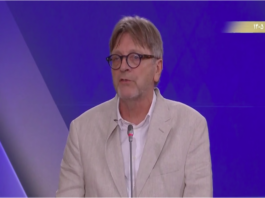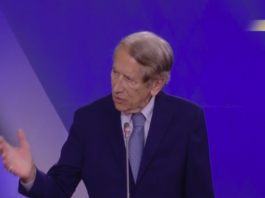
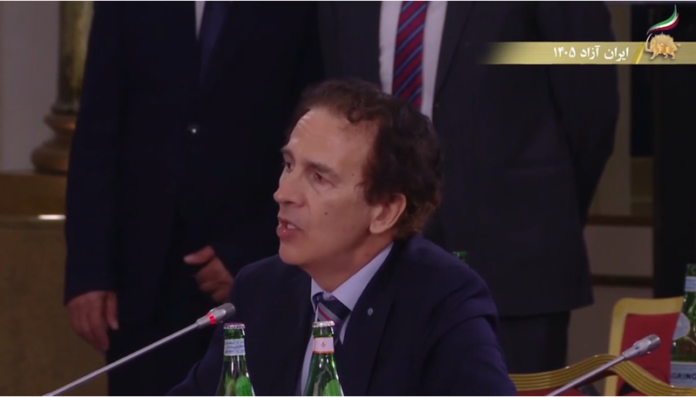
Italian political scientist Antonio Stango tells the Rome conference that Iran’s future belongs to its people, rejecting both dictatorship and monarchy while endorsing a secular democratic republic.
Antonio Stango, Italian political scientist and human rights advocate, concluded the international conference “Iran Beyond War – Human Rights and the Power of the People as the Solution” in Rome with a message centered on democracy, secularism, and the Iranian people’s right to determine their own future.
Addressing an audience of international dignitaries, lawmakers, and supporters of the Iranian Resistance, Stango thanked the participants for focusing not only on the current crisis in Iran but also on the country’s democratic future. He expressed confidence that, when given the opportunity to choose freely, Iranians would reject dictatorship and embrace a secular democratic republic.
The Iranian People Must Decide Their Future
Stango emphasized that the future of Iran should be determined solely by its people through free expression of their democratic will.
“The people of Iran, when they have the possibility to freely express their will, will want a future of freedom, democracy in a republican Iran—a secular republic.”
He argued that the aspirations of the Iranian people point toward a political system founded on democratic principles rather than authoritarian rule.
Rejecting a Return to Monarchy
During his remarks, Stango also addressed proposals advocating a return to monarchy, dismissing them as incompatible with Iran’s democratic future.
Referring to statements made by the son of the late Shah expressing pride in his father’s rule and suggesting a return to power, Stango rejected that vision.
“We know that there is somebody who has been completely silent for decades and who recently spoke about returning to power. He even said that he is proud of what his father and his regime did.”
He concluded that such a path does not represent the future desired by the Iranian people.
“I’m sure this is not the future for Iran.”
A Vision for a Democratic Republic
Stango outlined what he described as the shared vision emerging from the conference: a democratic republic that respects human rights, rejects violence, and promotes peace.
“We all share a vision for a free democratic republic of Iran without the death penalty, without the export of war and terrorism, in peace, without nuclear weapons.”
His remarks echoed many of the themes raised throughout the conference, including the abolition of capital punishment, the separation of religion and state, peaceful relations with the international community, and the establishment of democratic institutions.
Tribute to the Iranian Resistance
Concluding the event, Stango thanked Maryam Rajavi for her leadership and expressed appreciation for the work of the National Council of Resistance of Iran (NCRI) in advocating democratic change.
“Thank you, Maryam Rajavi, for your leadership.”
He ended his address by expressing solidarity with the Iranian Resistance and the people inside Iran who continue to struggle for freedom despite ongoing repression.
“Long live the Iranian Resistance and the people who are struggling for freedom.”
A Closing Message of Democratic Hope
Although brief, Stango’s closing remarks encapsulated the central message of the Rome conference: that Iran’s future should be shaped neither by war nor by authoritarian alternatives, but by the freely expressed will of its people. He reaffirmed support for a secular democratic republic founded on human rights, peace, and the rule of law, presenting it as the path toward lasting freedom and stability for Iran.