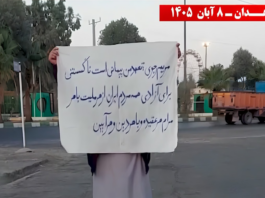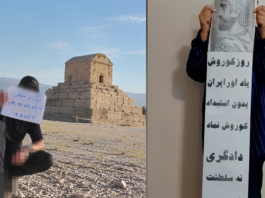
Human rights organizations, UN special rapporteurs, and international legal figures are backing Iranian political prisoners as the campaign reaches its 144th consecutive week across 66 prisons.
International support for Iran’s No to Execution Tuesdays campaign is growing, with human rights organizations, United Nations experts, and legal figures joining the solidarity movement against the Iranian regime’s escalating use of capital punishment.
In statements published on October 27 and 28, the Center for Civil Liberties in Ukraine, UN human rights experts, and international advocates expressed solidarity with Iranian political prisoners who have maintained weekly hunger strikes for 144 consecutive Tuesdays. Their actions come amid mounting concern over the execution of political prisoners and protesters and the growing number of detainees facing death sentences.
Launched by political prisoners in January 2024, the No to Execution Tuesdays campaign has expanded to 66 prisons across Iran. Every Tuesday, participating prisoners refuse food to protest executions, demand an end to capital punishment, and challenge the regime’s systematic use of death sentences to suppress dissent.
Ukrainian Center for Civil Liberties: Solidarity knows no borders
On October 27, Ukraine’s Center for Civil Liberties (CCL) publicly declared its support for Iranian political prisoners, drawing a connection between the struggle against political persecution in Iran and Ukraine’s own experience of defending human rights.
The organization highlighted the scale of executions in Iran, citing figures indicating that at least 46 political prisoners and protesters had been executed since mid-March 2026, while more than 100 others remained at imminent risk of execution.
The Center also recalled that Amnesty International recorded 2,159 executions in Iran in 2025, the country’s highest annual total since 1981.
Avalaina, head of the Center for Civil Liberties, stated:
“We Ukrainians know how important it is for the world not to remain silent when people are persecuted for their beliefs. Solidarity knows no borders. And today, we raise our voices in support of those fighting for freedom in Iran.”
The organization emphasized that the prisoners’ resistance represents a defense of fundamental human dignity, even under the most difficult conditions of imprisonment.
It declared:
“Even behind bars, they continue to stand up for human dignity and the right to life.”
The Center also called on the international community to press for the abolition of the death penalty and an end to persecution based on political beliefs.
Solidarity knows no borders.
The Center for Civil Liberties stands with Iranian political prisoners who have been protesting against the death penalty every Tuesday for 144 consecutive weeks.
🔴 According to UN Special Rapporteur Leopoldo Maldonado, at least 46 political… pic.twitter.com/aQBqbdAEN9
— Center for Civil Liberties (@ccl_ua) October 27, 2026
UN special rapporteurs join the solidarity hunger strikes
The campaign has also received direct support from UN human rights experts.
On October 20, Leopoldo Maldonado, UN Special Rapporteur on freedom of opinion and expression, undertook a 24-hour hunger strike in solidarity with Iranian political prisoners. A week earlier, Gina Romero, UN Special Rapporteur on the rights to freedom of peaceful assembly and of association, had undertaken a similar action.
On October 27, Andrea Bolaños Vargas also announced her participation in the solidarity hunger strike, specifically highlighting the persecution of human rights defenders in Iran.
In her statement, Bolaños Vargas wrote:
“I join #NoToExecutionTuesdays in the solidarity hunger strike for the human rights defenders that are being jailed and threatened with death for their work.”
She reiterated the figures concerning executions and the danger facing prisoners, stressing:
“The executions should end and those detained released.”
Her intervention underscores the international concern that the Iranian regime is using imprisonment and the death penalty not simply as instruments of punishment but as weapons against those defending fundamental rights and freedoms.
🇮🇷 #Iran [ESP abajo]
💪 I join #NoToExecutionTuesdays in the solidarity hunger strike for the human rights defenders that are being jailed and threatened with death for their work. At least 46 political prisoners and protesters have been executed in Iran since March 2026. More… pic.twitter.com/mNSMFQHJGx
— Andrea Bolaños Vargas (@AndreaBV_SR_HRD) October 27, 2026
On October 28, the UN Working Group on Enforced or Involuntary Disappearances (WGEID) also announced its participation in the campaign. It stated that Ana Lorena, a member of the Working Group, would join the following week’s solidarity action in support of Iranian victims of enforced disappearances and executions.
The Working Group delivered a direct message to the Iranian authorities:
“Iran must stop enforced disappearances and executions.”
Its intervention adds another dimension to international concern, linking the regime’s use of executions with the broader pattern of enforced disappearances and the lack of accountability for those responsible.
Next week, @analorenadp from the @WGEID, will join the campaign #NoToExecutionsTuesday in solidarity with Iranian victims of enforced disappearances and executions. Iran must stop enforced disappearances and executions. pic.twitter.com/3mdz8QnQR4
— UN Working Group on Enforced Disappearances (@WGEID) October 28, 2026
International legal figures warn against a repeat of past atrocities
Alexis Anagnostakis, an international legal advocate, also announced his participation in the campaign, emphasizing the extraordinary determination of prisoners who have continued their weekly hunger strikes despite the risks they face.
In a statement published on October 27, Anagnostakis described the campaign as a sustained act of resistance originating inside Iran’s prisons.
He wrote:
“Every Tuesday for almost three years, prisoners in Iran have gone hungry to ask the world one thing: stop the executions.”
He stressed that the initiative is being sustained by political prisoners themselves, despite the enormous pressure exerted by the authorities.
Anagnostakis also drew attention to the significance of the participation of UN special rapporteurs Leopoldo Maldonado and Gina Romero, alongside the warnings issued by UN Special Rapporteur on Iran Mai Sato.
He observed:
“Three mandates are saying the same thing. That does not happen by accident.”
One of the most serious aspects of his intervention concerned the warning that the current pattern of executions and death sentences bears disturbing similarities to the circumstances preceding the 1988 massacre of political prisoners in Iran.
Anagnostakis also challenged the regime’s use of the charge of moharebeh (waging war on God) against protesters, dissidents, and individuals accused of political affiliations.
Referring to Article 6(2) of the International Covenant on Civil and Political Rights (ICCPR), which restricts the death penalty in countries that retain it to the most serious crimes, he emphasized that peaceful political dissent cannot legitimately be treated as grounds for execution.
He warned:
“Protest is not one of them. When a charge turns dissent into war on God, it stops being criminal law. It becomes a verdict waiting for a defendant.”
Announcing his own participation in the 24-hour hunger strike, Anagnostakis added:
“Twenty-four hours without food is nothing beside a cell on death row. That is the point. Solidarity costs us very little, and for the people inside, it shows they have not been forgotten.”
A growing international response to Iran’s execution crisis
The latest expressions of solidarity demonstrate that the No to Execution Tuesdays campaign is increasingly connecting the resistance of political prisoners inside Iran with international human rights advocacy.
The participation of UN special rapporteurs, the Center for Civil Liberties, the UN Working Group on Enforced Disappearances, and international legal advocates gives the campaign a broader international platform.
Their interventions also come against the backdrop of grave warnings about the scale and pace of executions in Iran. With at least 46 political prisoners and protesters reportedly executed since March 2026 and more than 100 others facing the death penalty, the danger extends far beyond individual prison cases.
For the prisoners participating in the campaign, every Tuesday’s hunger strike is an act of defiance against a system that seeks to silence dissent through imprisonment, intimidation, and execution.
The growing international response sends a clear message: their struggle has not gone unnoticed, and the Iranian regime cannot be allowed to carry out executions behind prison walls without international scrutiny and pressure.
The campaign’s central demand remains unchanged: No to executions, an end to political persecution, and the defense of the right to life.