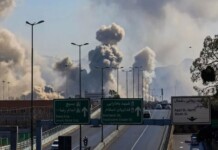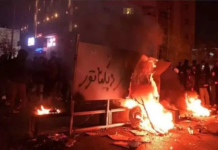
Targeted strikes on energy, industry, and logistics have triggered a structural crisis that could take over $100 billion—and years—to repair
As the dust settles from weeks of intense U.S. and Israeli strikes on Iran, a fragile ceasefire has revealed a reality far more consequential than the immediate destruction. What has emerged is not a conventional post-war recovery scenario, but a structural economic rupture—one that distinguishes this conflict sharply from Iran’s past wartime experiences.
Unlike the Iran-Iraq War, where destruction was largely concentrated along border regions and front-line cities, the recent campaign targeted the core of Iran’s economic and industrial architecture. Analysts have described it as a deliberate effort to neutralize critical infrastructure—an approach that prioritizes systemic disruption over territorial damage.
Initial figures released by organizations such as the Iranian Red Crescent Society indicate that more than 93,000 residential and commercial units were destroyed or severely damaged. Yet this visible destruction represents only a fraction of the overall impact. The deeper crisis lies within the country’s foundational industries—where the cost, complexity, and geopolitical constraints of reconstruction far exceed anything seen in recent decades.
Nowhere is this more evident than in the petrochemical hub of Mahshahr. The region, which includes the strategically vital Bandar Imam Petrochemical Complex and several surrounding facilities, accounted for roughly 60 percent of Iran’s petrochemical capacity. Prior to the conflict, these complexes produced approximately 21 million tons annually and generated around $13 billion in exports.
Today, that capacity is at risk of collapse. If the damage has rendered these facilities inoperable, Iran’s petrochemical exports could fall below $6 billion—effectively cutting one of the government’s primary sources of foreign currency in half. The implications are immediate: reduced capacity to import essential goods such as medicine, wheat, and construction materials. Rebuilding just these major complexes could cost upwards of $20 billion.
Compounding the crisis is the damage to critical energy infrastructure, including the Fajr power plants that supply electricity to petrochemical operations in Mahshahr. Without reliable power, even undamaged facilities remain functionally idle. The challenge is not merely physical reconstruction, but technological replacement—much of the specialized equipment destroyed is difficult to procure under existing sanctions.
A different but equally disruptive pattern has unfolded in Asaluyeh, home to the massive South Pars Gas Field. Here, rather than targeting primary industrial structures, strikes focused on auxiliary systems—electricity networks, oxygen supply units, and water infrastructure. The result is a form of operational paralysis: production facilities remain intact, but cannot function due to missing inputs. This “silent shutdown” underscores the systemic vulnerability of interconnected industrial processes.
The damage extends further. Gas processing facilities in multiple phases of South Pars, with a combined capacity of 100 million cubic meters per day, have been affected. While the full extent remains unclear, worst-case scenarios suggest reconstruction costs could exceed $5 billion.
Beyond energy and industry, one of the most consequential yet underreported impacts is the fragmentation of Iran’s logistics network. Targeted strikes on bridges, railways, and key transit corridors have disrupted the country’s transportation backbone. According to technical assessments aligned with benchmarks such as the World Bank Logistics Performance Index, Iran’s logistical efficiency has deteriorated to levels even below those of Afghanistan.
This breakdown has far-reaching implications. Even where financial resources and materials are available, the absence of functional transport routes prevents the movement of heavy equipment and industrial components. Reconstruction, in effect, becomes logistically infeasible.
The steel industry—another pillar of Iran’s economy—has also sustained significant damage. Major producers, including Mobarakeh Steel Company and Khuzestan Steel Company, which together account for approximately 70 percent of national output, have been impacted. Prior to the conflict, Iran exported around 11 million tons of steel annually, generating $6 billion in revenue.
The consequences of this disruption are paradoxical and severe. As reconstruction demand surges, domestic steel shortages will force Iran to import between $8 and $10 billion worth of steel annually—transforming the country from a net exporter into a major importer almost overnight.
Even smaller but strategically important facilities have not been spared. The Lavan Refinery, which plays a key role in supplying fuel to southern regions, has been damaged, with estimated repair costs of at least $700 million.
Taken together, these losses point to a reconstruction burden of staggering proportions. Estimates suggest that restoring and modernizing the damaged infrastructure across key industrial hubs—Mahshahr, Asaluyeh, Isfahan, and Ahvaz—will require more than $100 billion over the next five years.
This figure would be daunting under any circumstances. Under current conditions—marked by constrained foreign reserves, restricted access to international financial systems, and disrupted trade routes—it may be prohibitive.
The ceasefire, therefore, marks not an end, but a transition—from kinetic conflict to economic crisis. The destruction of infrastructure has not only reduced Iran’s productive capacity; it has fundamentally altered the country’s economic trajectory. Recovery, if it is to occur, will demand not just resources, but a reconfiguration of the very systems that once sustained the economy.