
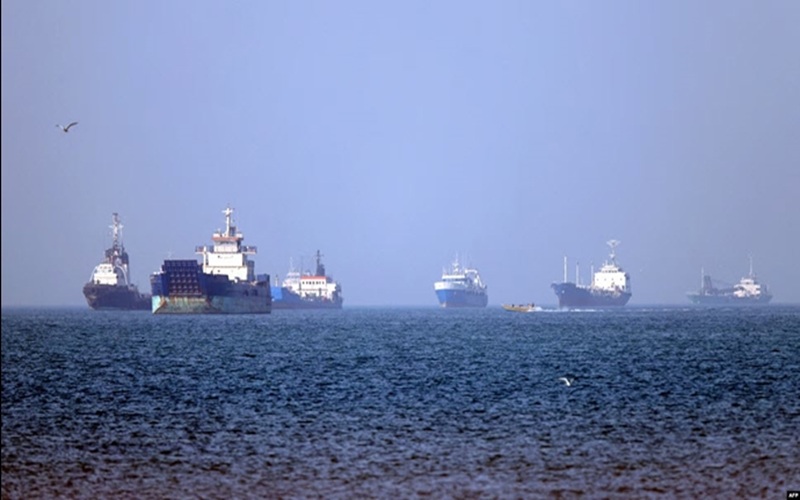

While ordinary businesses struggle with banking restrictions, currency shortages, and disrupted trade, military-linked networks continue moving billions of dollars through overseas intermediaries, cryptocurrency exchanges, and clandestine procurement channels.
War and economic restrictions have sharply increased operating costs for Iranian businesses and disrupted the country’s foreign trade. Yet the impact is far from equal across the economy. While ordinary companies face difficulties accessing foreign currency, banking services, and international transportation, networks connected to the Islamic Revolutionary Guard Corps (IRGC) and other military institutions continue operating through alternative financial and commercial channels.
This disparity has renewed questions about the economic interests tied to the continuation of war and the persistence of sanctions. The IRGC is not merely a military organization. Through affiliated companies, commercial intermediaries, and economic conglomerates, it maintains a substantial presence in sectors ranging from energy and foreign trade to construction and industrial infrastructure.
As conventional trade becomes more difficult, the relative importance of networks capable of circumventing restrictions increases. Companies with access to unofficial financial channels, overseas intermediaries, and state-backed logistical infrastructure can continue conducting transactions under conditions that increasingly constrain independent businesses.
The economic interests behind the continuation of war
The political debate over the beneficiaries of prolonged conflict and sanctions has also emerged within Iran’s own political circles.
Mohammad Mohajeri, a conservative political activist, previously criticized factions that he said would lose economically and politically if the war ended and an agreement were reached. He described them as “war profiteers” and “sanctions profiteers,” arguing that an end to hostilities could undermine both their financial interests and their political influence.
The structure of Iran’s sanctioned economy helps explain this criticism.
Restrictions on official oil exports and international financial transfers have increased the government’s dependence on commercial intermediaries and unofficial payment systems. When conventional channels for selling oil and receiving revenues become restricted, networks with access to offshore companies, alternative banking arrangements, and transportation infrastructure become more valuable.
The IRGC and affiliated economic networks are among the actors positioned to benefit from these arrangements. Their involvement extends beyond domestic commerce to oil transactions, financial transfers, and the procurement of military equipment.
Investigations by international media and financial intelligence firms have documented the scale and complexity of these operations.
Reuters exposes a vast military procurement network
A major Reuters investigation published on October 29, based on banking documents, import records, corporate registrations, and shipping data, revealed a network of more than 5,000 entities linked to Iran’s Ministry of Defense.
The investigation identified a complex procurement system that has continued supplying military-related goods despite international sanctions and maritime restrictions.
One entity alone, identified as MOD 346428, imported approximately $2.3 billion worth of goods between January 2025 and June 2026.
The shipments included materials used in missile and drone production, rocket propellants, explosives, detonators, industrial machinery, and heavy-duty vehicles that could be adapted for military purposes.
The goods reached Iran through land, sea, and air routes, with China and Russia among the reported sources of supply. The investigation also identified shipments originating in other countries.
The distinction between the Ministry of Defense network and the IRGC is important. The identified entities are primarily associated with the Ministry of Defense, although some have connections to the IRGC, missile and drone programs, and powerful economic foundations. The entire value of the documented transactions therefore cannot be attributed directly to the IRGC.
Nevertheless, the findings demonstrate that even wartime restrictions and maritime enforcement have not completely halted the regime’s military procurement operations.
The network’s ability to maintain international supply chains highlights the advantages enjoyed by military-linked institutions over ordinary Iranian businesses, which lack comparable access to financial and logistical infrastructure.
Cryptocurrency provides another channel for financial transactions
Cryptocurrency has also become an important instrument in the financial networks associated with the IRGC.
In a January 9, 2026 investigation, blockchain intelligence company TRM Labs reported that two UK-registered cryptocurrency exchanges, Zedcex and Zedxion, had processed approximately $1 billion in transactions linked to IRGC-associated addresses between 2023 and 2025.
According to the investigation, the exchanges operated as part of a broader financial network rather than as independent conventional trading platforms.
Most of the identified transactions involved Tether (USDT), a dollar-pegged stablecoin. Such digital assets can facilitate the transfer of value across borders without relying directly on conventional international banking channels.
The $1 billion figure represents the value of transactions identified by TRM Labs, not $1 billion in revenue or profit received by the IRGC. Nor does it establish how much of the money was ultimately spent on procurement, retained by intermediaries, or collected as transaction fees.
Nevertheless, the findings illustrate how digital financial infrastructure can help sanctioned networks maintain cross-border operations.
The involvement of intermediaries also creates opportunities for additional costs and commissions. As transactions become more complicated and require multiple layers of intermediaries, those with access to established networks can charge for facilitating payments, procurement, and transportation.
There is, however, no reliable public information establishing how much individual IRGC commanders may receive in commissions from arms-related transactions.
Some estimates have placed the annual value of smuggling activities associated with networks close to the IRGC at as much as $9 billion. However, no publicly available official data independently confirms this figure or establishes what proportion, if any, represents direct IRGC revenue.
The broader economic mechanism is clearer: the more difficult legitimate trade becomes, the greater the value of alternative channels. Businesses with access to offshore financial infrastructure, international transportation networks, and connections within the regime operate under fundamentally different conditions from independent companies.
US sanctions target oil intermediaries and financial networks
Recent US sanctions have also focused on intermediaries responsible for collecting and transferring revenues from Iranian oil sales.
On November 20, the US Treasury Department announced sanctions against four Iranian nationals accused of participating in networks that collected and managed proceeds from overseas oil sales on behalf of the regime.
According to Washington, these individuals acted as trusted intermediaries in handling oil revenues intended to help Tehran circumvent sanctions. The Treasury Department said some of them had retained portions of the proceeds for personal benefit.
Among those designated was Mohammad Javad Bavand, a former IRGC intelligence officer. The list also included Majid Taj, the brother of Iranian Football Federation president Mehdi Taj; Mohammad Hossein Servati, the son of an IRGC brigadier general; and Mojtaba Arabnejad, the son of Mahan Air’s chief executive.
The US Treasury linked Servati to companies involved in brokering and receiving Iranian oil shipments destined for independent Chinese refineries. It also accused Arabnejad of purchasing aircraft parts for Mahan Air and overseeing oil sales that partly supported the airline.
The measures illustrate Washington’s focus on the intermediaries, commercial structures, and financial channels that allow the regime to continue generating and transferring revenue despite restrictions.
A parallel economy insulated from the costs borne by ordinary Iranians
The evidence from military procurement, cryptocurrency transactions, and oil-revenue networks points to a complex economic system operating alongside Iran’s conventional economy.
For independent businesses, restrictions mean reduced access to international markets, more expensive transactions, difficulties obtaining foreign currency, and uncertainty over transportation and supplies. For military-linked networks, the same restrictions increase the importance of established intermediaries and alternative financial channels.
This does not mean that every military-linked company benefits from war or that all sanctions-related transactions generate profits for the IRGC. However, the documented procurement and financial networks demonstrate that institutions connected to the regime retain commercial capabilities unavailable to most ordinary businesses.
The central issue is therefore not simply whether sanctions and war have damaged Iran’s economy. It is also how the costs and opportunities created by these conditions are distributed.
While Iranian households and independent businesses absorb the consequences of economic isolation, military-linked networks continue to secure supplies, facilitate financial transfers, and maintain access to international commercial channels.
The result is an increasingly unequal economic structure in which access to political power, military institutions, and offshore networks can determine who remains able to trade and who is pushed out of the market.