From unpaid wages and violent employers to broken pension promises, Iran’s workers and retirees remain trapped in poverty as the regime prioritizes war and repression.
The beating of a worker at the Damash mineral water factory in Gilan Province has once again exposed the grim reality of working-class life in Iran—a reality where demanding delayed wages can result in violence, threats, and dismissal.
Local reports confirm that workers at the Damash factory have gone without paid insurance for more than five months. When one employee pursued the matter, his employer first threatened him, then physically assaulted him, and finally barred him from returning to work. “We are all prisoners of a piece of bread,” other workers at the factory said, describing their desperation.
Authorities Side with Employers
Instead of defending workers’ rights, provincial officials sought to minimize the incident. The Director General of Cooperatives, Labor, and Social Welfare of Gilan Province spoke vaguely of the “need to investigate” but went further, suggesting that the workers seek alternative jobs through the labor office. Such remarks reflect a broader reality: labor laws in Iran are effectively unenforceable, and government institutions routinely side with employers rather than with the workforce.
Protests by Workers and Retirees
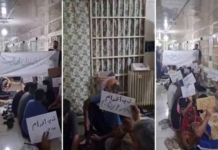
The assault in Gilan comes as protests by workers and retirees continue across the country. In Tehran, employees of the Iranian Marine Engineering and Construction Company gathered outside the National Oil Company’s new building, demanding three months of unpaid wages, insurance, and benefits.
Retirees from the Social Security Organization also staged demonstrations in cities including Rasht, Shush, and Ahvaz, demanding arrears, full implementation of rights equalization, and organizational independence. In Isfahan, steel industry retirees protested outside the Pension Center, calling for free healthcare and timely payments. As usual, the regime responded with empty promises rather than concrete action.
Mohammad Asadi, head of the Supreme Council of Iranian Pensioners, confirmed that the government had broken its pledge to pay arrears. Payments due in June were postponed under the excuse of “resource imbalances after the recent war,” he said—proof that the burden of the regime’s political crises and militarism continues to fall on impoverished pensioners.
Rising Fatalities and Worsening Conditions
As the livelihood crisis worsens, Iran’s workers face another danger: unsafe conditions. Alireza Raisi, Deputy Minister of Health, admitted that around 10,000 Iranian workers die each year from work-related accidents, underscoring the lack of protections in industries ranging from construction to mining.
Meanwhile, the country’s economic crisis—intensified by Western sanctions, the recent 12-Day War, and billions spent on missiles, nuclear projects, and proxy militias—has only deepened unemployment. In Lorestan, 150 contract workers at Azna Ferroalloy Company were dismissed due to “power imbalances.” Truck drivers in Behbahan lost their income after a cement factory shut down during outages. In Abhar, 20 contract workers at Siyaden Steel were denied contract renewals despite years of service. In Gachsaran, oil and gas workers protested against discriminatory wage practices.
Inflation Crushing Workers’ Lives
For many Iranian households, the struggle to survive is worsening by the day. “Red meat has long been removed from workers’ tables,” said Parviz Zaimi, a labor representative at Iran Poplin Rasht, noting that food and bread prices have jumped more than 50 percent in 2025.
Housing costs are also devastating workers. In Gilan Province, Zaimi explained, renting even a modest home in poor neighborhoods requires a deposit of 50–100 million tomans and a monthly rent of 5–10 million—completely incompatible with workers’ meager salaries. Many now juggle multiple jobs or resort to borrowing just to survive.
A Systematic Attack on Workers
From delayed wages and mass layoffs to rising prices and fatal workplace accidents, workers and retirees in Iran are caught in an endless cycle of poverty and insecurity. Every day brings new reports of deaths in mines and construction sites, or protests crushed by repression and neglect.
Instead of providing relief, the regime exacerbates the crisis through destructive policies: power shortages that trigger mass unemployment, refusal to equalize pensions, and denial of even basic rights such as health insurance.
In a system where the ruling elite prioritize war, missiles, and foreign militias over the well-being of their own citizens, Iran’s workers remain both the engine of the economy and the chief victims of its collapse.