


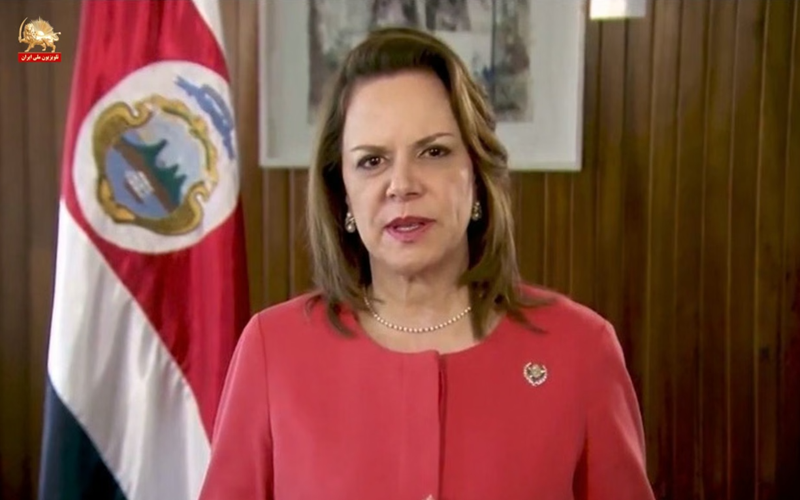

Ana Elena Chacón Echeverría rejects both clerical rule and a return to monarchy, backs Maryam Rajavi’s Ten-Point Plan, and urges international action against executions and repression in Iran.
Chacón emphasized that executions, mass arrests, torture, and expedited trials are not isolated human rights abuses but instruments used by an increasingly vulnerable dictatorship to maintain power and intimidate a society that has repeatedly demonstrated its determination for change.
Drawing on Costa Rica’s abolition of the death penalty in the nineteenth century, she underscored the country’s longstanding opposition to capital punishment and called for a firm international response to the Iranian regime’s escalating use of executions.
International Accountability for Repression in Iran
Chacón pointed to the sharp rise in executions documented in recent years and cited reports of thousands of protesters killed and at least 50,000 people arrested following Iran’s January 2026 uprising. She stressed that behind every statistic are individuals, families, and communities forced to live under fear and repression.
She called on governments to make an end to executions a fundamental condition of their political and economic relations with Tehran. Political prisoners and detained protesters must be released, she argued, while independent international monitors should be granted access to Iranian prisons.
Those responsible for crimes against humanity must also face justice, including, where legally applicable, through the principle of universal jurisdiction. Her position reinforces calls for an international accountability mechanism capable of addressing systematic human rights violations and ending impunity for senior Iranian officials.
Maryam Rajavi’s Ten-Point Plan as a Democratic Framework
Chacón highlighted the particular burden of repression on Iranian women, while recognizing their central role in the struggle for change. A democratic future, she argued, must go beyond repealing discriminatory laws and guarantee women equal participation and the freedom to choose their own way of life.
She expressed support for Maryam Rajavi’s Ten-Point Plan, describing its principles as an important democratic framework for Iran’s future. The plan calls for popular sovereignty, pluralism, separation of religion and state, gender equality, minority rights, an independent judiciary, and the abolition of the death penalty.
These principles, she maintained, offer a vision of Iran founded on democratic institutions and individual freedoms rather than another system of authoritarian rule.
Rejecting Both Monarchy and Clerical Dictatorship
Chacón challenged the argument that Iran faces only two political alternatives: the current religious dictatorship or a return to monarchy. The Iranian people overthrew the Shah’s dictatorship in February 1979 and have subsequently rejected clerical rule through repeated uprisings, she noted. Their demand for freedom and a democratic republic remains an active political aspiration.
She also criticized Reza Pahlavi’s approach to Iran’s political future, arguing that praising the former monarchy while avoiding a reckoning with its legacy and proposing a role for elements associated with it undermines claims to represent a democratic future. Replacing one authoritarian structure with another, she warned, would betray the sacrifices of generations of Iranians.
A Transitional Roadmap to Popular Sovereignty
As an alternative, Chacón pointed to the National Council of Resistance of Iran (NCRI) and its proposed transition: a time-limited provisional government followed by elections for a constituent and legislative assembly, ultimately transferring sovereignty to elected representatives.
This roadmap, she argued, provides a democratic process for political transition and addresses concerns that the end of the current system would necessarily produce a power vacuum.
Chacón concluded that the international community’s responsibility is not to choose Iran’s rulers but to defend the Iranian people’s right to choose their own government freely. Democracy, equality, and accountable governance, she stressed, are not unattainable ideals but essential responses to Iran’s political crisis.