



Amid a record surge in executions, the “No to Execution” movement calls on the UN and EU to hold Tehran’s leaders accountable for crimes against humanity.
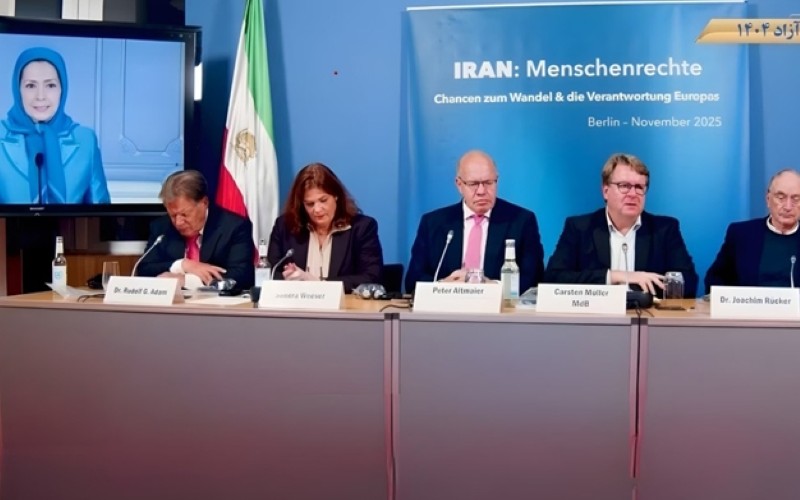
One of the key moments in mobilizing global public opinion came at the Human Rights Conference in Berlin, titled “Iran: Human Rights – Opportunities for Change & Europe’s Responsibility”
In her speech, Mrs. Maryam Rajavi, the President-elect of the National Council of Resistance of Iran (NCRI), detailed the regime’s crimes, including the execution of at least 285 prisoners in October 2025, among them seven women and one minor.
She declared:
“In response to the clerical regime’s increasing executions to counter the people’s uprising and terrorize the public, the Iranian Resistance has since long ago called for an international campaign against executions.
Prisoners in 54 prisons have been going on hunger strike for 93 weeks on ‘No to Execution Tuesdays.’
Teachers, workers, nurses, retirees, and other sectors of our compatriots hold placards of ‘No to Death Penalty’ in their protests. They say, ‘Do not try to scare us by executing prisoners before our eyes.’
We call on the international community to support this movement.
Terrorizing the public with the hanging noose must be stopped.”
In her address, Rajavi presented a clear plan of action, urging European Union member states, including Germany, to refer Iran’s human rights dossier to the UN Security Council and to prosecute the regime’s leaders for crimes against humanity under universal jurisdiction.
Global Echo: The Case of Mohammad Javad Vafaei Sani
The impact of the Resistance’s campaign has been particularly visible in the case of Mohammad Javad Vafaei Sani, a 30-year-old boxing champion sentenced to death for supporting the MEK and participating in the 2019 nationwide protests.
After more than five years of imprisonment, torture, and solitary confinement, his death sentence drew worldwide outrage. On October 4, 2025, a coalition of international athletes released a joint statement condemning his execution, calling it a direct assault on the values of sports—hope, unity, and courage and a warning to every athlete who dares to stand up to injustice.
Among the signatories were global sports icons such as Martina Navratilova, former Olympic medalists including Nancy Hogshead, and several former national team captains. The statement urged the United Nations and international sports federations to act immediately to save Vafaei Sani’s life.
This unprecedented response underscores the strategic reach of the Iranian Resistance, transforming a domestic human rights struggle into a moral imperative for the global community.
UN Experts Condemn Regime’s Executions of MEK Supporters
At the same time, efforts to expose the regime’s atrocities against MEK-affiliated political prisoners have gained international traction. Five United Nations Special Rapporteurs, including those on the situation of human rights in Iran, extrajudicial executions, and torture, issued a joint letter expressing deep concern over the planned execution of six MEK supporters.
The six men—Babak Alipour, Vahid Bani-Amarian, Akbar Daneshvarkar, Pouya Ghobadi, Abolhassan Montazer, and Seyed Mohammad Taghavi Sangdehi—were sentenced to death on charges of “baghi” (armed rebellion). The experts noted that they had been subjected to severe physical and psychological torture, ill-treatment, and threats of summary execution.
They also highlighted the blatant lack of due process, stating that their trials were extremely brief, defendants were given only minutes to defend themselves, and at least three met their lawyers for the first time on the day of trial. The UN experts concluded that such proceedings rendered the death sentences “unjust and unlawful” under international law.
From National Resistance to Global Movement
Through consistent international advocacy, documentation of abuses, and strategic engagement with global civil society—including the sports and human rights communities—the Iranian Resistance has succeeded in turning the “No to Execution” movement into a worldwide human rights cause.
By spotlighting emblematic cases like those of Vafaei Sani and the six MEK-affiliated prisoners, and by raising these issues in major conferences such as those held in Berlin and London, the Resistance has opened a moral and diplomatic rift that challenges the regime’s impunity.
As the wave of executions continues, the growing chorus of solidarity suggests that the world can no longer remain silent in the face of one of the most egregious human rights crises of our time.