


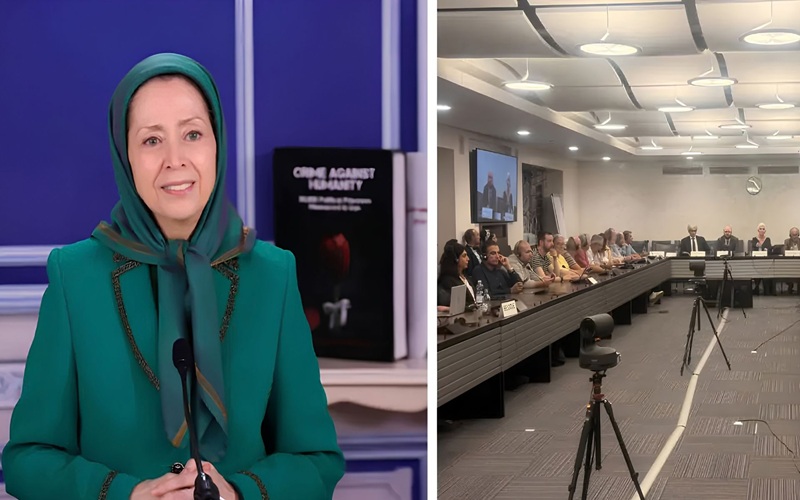

Addressing a UN human rights conference in Geneva, Maryam Rajavi highlighted the escalating use of executions and repression in Iran and called for Security Council action, international prison inspections, universal jurisdiction, and an end to executions.
The escalating use of executions, mass arrests, torture, and other forms of repression in Iran demonstrates the urgent need for an international mechanism to hold the regime accountable, Maryam Rajavi said in a message to a human rights conference in Geneva on September 28.
Addressing human rights defenders and participants at the conference, the President-elect of the National Council of Resistance of Iran (NCRI) said violations had intensified in recent months, particularly against political prisoners, members of the People’s Mojahedin Organization of Iran (PMOI/MEK), and people arrested during the January 2026 uprising.
Her message comes amid renewed international scrutiny of the regime’s human rights record. The UN Independent International Fact-Finding Mission on Iran reported in September that serious violations committed during the suppression of the nationwide protests that began in December 2025 included unlawful killings, arbitrary detention, torture, and other abuses that amounted to crimes against humanity.
Maryam Rajavi’s Message to the UN Human Rights Conference, Geneva
Executions as an Instrument of Repression
Rajavi highlighted the dramatic increase in executions over recent years, citing at least 646 executions in 2022, 864 in 2023, more than 1,000 in 2024, and 2,200 in 2025.
Independent documentation confirms that 2025 witnessed an extraordinary escalation, although estimates differ because the regime does not publish comprehensive execution data. Human Rights Watch reported that more than 2,000 executions were carried out by the end of 2025, while Iran Human Rights and Together Against the Death Penalty documented at least 1,639 executions. The UN had already recorded more than 1,000 executions during the first nine months of 2025.
The significance of the escalation goes beyond the sheer number of executions. Human Rights Watch reported in September 2026 that Iranian authorities had executed at least 59 men on politically motivated or vaguely worded national-security charges between March 18 and the end of August, including at least 29 people arrested in connection with the December 2025–January 2026 protests.
Rajavi said that more than 50 people had been executed on political grounds in recent months and that more than 100 remained on death row.
She linked the escalation directly to the regime’s confrontation with a society that has repeatedly challenged its rule.
The pattern is familiar: when protests expand, repression intensifies; when resistance continues, the regime increasingly turns to executions and harsh prison sentences to create fear.
Yet the repeated uprisings demonstrate that executions have failed to extinguish dissent.
From the 2019 Uprising to January 2026
Rajavi placed the current wave of repression within a broader history of uprisings.
She cited dozens killed and at least 8,000 arrests during the 2017–2018 uprising; approximately 1,500 people killed and more than 12,000 arrested during the November 2019 uprising; more than 750 killed and 90,000 arrested during the 2022 uprising; and several thousand killed and at least 50,000 arrested during the January 2026 uprising.
The precise figures surrounding the latest uprising remain contested because of the regime’s restrictions on information and communications. However, the scale of the crackdown has been independently documented. The UN Fact-Finding Mission’s September report found that the response to the protests beginning December 28, 2025 involved widespread killings, mass arrests, torture and ill-treatment, and other serious violations. The Mission concluded that many of these violations amounted to crimes against humanity.
This distinction is important. The regime’s control over information makes comprehensive casualty figures difficult to establish, but the existence of systematic repression is no longer dependent on opposition documentation alone.
International investigators have now documented it.
The Cost of International Impunity
A central theme of Rajavi’s message was the role of international inaction in allowing repression to continue.
She recalled remarks attributed to Marc Trévidic, a former French anti-terrorism investigating judge, concerning relations between France and Iran in the early 2000s. According to the account cited by Rajavi, Trévidic described pressure to arrest PMOI members in France in the context of political and economic relations with the Iranian regime, characterizing the episode as a misuse of the judicial system for political purposes.
For Rajavi, the episode illustrates a broader historical problem: the regime has repeatedly benefited when governments have placed political or economic considerations ahead of accountability for its human rights violations.
The argument is particularly relevant to the present situation.
International institutions have increasingly moved from documenting individual abuses to examining whether the regime’s conduct constitutes systematic international crimes. The UN Fact-Finding Mission’s 2026 findings concluded that violations committed during the suppression of the 2025–26 protests included murder, imprisonment or other severe deprivation of liberty, torture, and other inhumane acts amounting to crimes against humanity.
Human Rights Watch has likewise documented politically motivated executions and called for coordinated international action, including the use of universal jurisdiction against officials responsible for serious international crimes.
The question is therefore no longer simply how to document abuses. It is how to end impunity.
From Documentation to Accountability
Rajavi pointed to growing international recognition of the systematic nature of the regime’s violations, including findings concerning the 1988 massacre of political prisoners and more recent repression.
The UN Fact-Finding Mission’s work has strengthened the evidentiary basis for international accountability. Its September 2026 report was based on interviews with victims and witnesses as well as satellite imagery, photographs, videos, medical records, and material from credible human-rights organizations and experts.
This creates a different environment from previous decades, when documentation of abuses often failed to produce meaningful consequences for those responsible.
The challenge now is translating documentation into legal and political mechanisms capable of imposing consequences on perpetrators.
Four Measures Proposed by the NCRI
Against this backdrop, Rajavi presented four proposals on behalf of the NCRI.
First, refer Iran’s human-rights situation, including the case of the 1988 massacre of political prisoners, to the UN Security Council and take measures to end impunity for those responsible.
Second, require the Iranian regime to permit independent international visits to its prisons.
Third, prosecute regime officials accused of crimes against humanity through the principle of universal jurisdiction.
Fourth, make an end to executions in Iran a demand in political, economic, and international relations with the regime.
Taken together, the proposals seek to move international policy from condemnation toward accountability.
Independent prison access is particularly significant because Iran’s prison system remains largely inaccessible to international observers. The ability to independently inspect prisons, interview detainees, and investigate allegations of torture would substantially improve the international community’s capacity to establish facts and protect prisoners at risk.
Universal jurisdiction, meanwhile, provides national courts with a potential avenue to prosecute individuals suspected of serious international crimes, even when the crimes were committed outside the prosecuting state’s territory, subject to the applicable domestic and international legal framework.
A Democratic Alternative to Repression
Rajavi also used the Geneva message to outline the political objective of the NCRI’s resistance.
She said the resistance seeks to establish a democratic republic in which no person enjoys privilege because of religion or heritage. She reaffirmed commitments to freedom of expression, assembly and political parties, gender equality, judicial independence, due process, the presumption of innocence, the right to defense, and abolition of the death penalty.
This political program is presented as an alternative to a system in which political dissent can result in imprisonment, torture, or execution.
The contrast has become increasingly stark. On one side is a regime whose response to successive waves of dissent has included mass arrests and lethal repression. On the other is an opposition movement presenting a framework based on political pluralism, equal rights and the abolition of capital punishment.
The International Test
The escalating number of executions and the findings of UN investigators have placed Iran’s human rights crisis before the international community with renewed urgency.
The central issue is no longer whether violations are occurring. Multiple international investigations have documented serious abuses, and the UN Fact-Finding Mission has concluded that many violations connected to the suppression of the 2025–26 protests amount to crimes against humanity.
The unresolved question is whether the perpetrators will continue to operate under a system of impunity.
Rajavi’s message from Geneva therefore framed accountability as an international responsibility rather than an internal Iranian matter. Her four-point proposal calls for the Security Council, international prison inspections, universal jurisdiction, and diplomatic pressure against executions.
For Iran’s political prisoners and those facing execution, the distinction between documentation and accountability is decisive. Documentation establishes what happened. Accountability determines whether those responsible will face consequences.
After decades of executions, massacres, torture, and repression, Rajavi’s message argues that the international community must move from recording the regime’s crimes to establishing mechanisms capable of holding those responsible to account.