


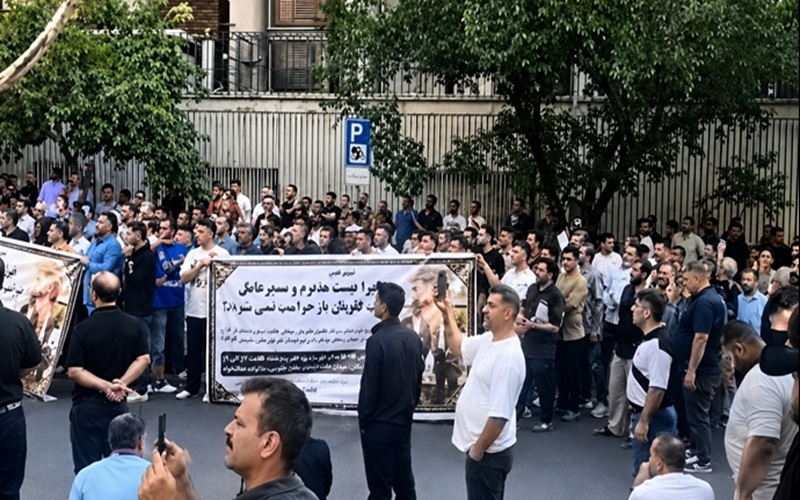

Public admissions by senior regime officials reveal that Tehran views domestic unrest—not foreign pressure—as the greatest threat to its survival, exposing the growing fear of another nationwide uprising.
For years, countless analyses of Iran have focused on geopolitical tensions, nuclear negotiations, sanctions, or regional conflicts. While these factors undoubtedly shape the country’s political landscape, they often overlook the central conflict that has defined Iran for more than four decades: the ongoing confrontation between the Iranian people and the ruling clerical regime.
This omission is particularly striking because the regime itself repeatedly identifies the Iranian people—not foreign governments—as its principal adversary. Recent statements from senior officials provide a revealing glimpse into Tehran’s greatest anxiety: the possibility of another nationwide uprising.
Officials Openly Admit Fear of Public Anger
The regime’s own president, Masoud Pezeshkian, recently acknowledged that worsening public dissatisfaction could quickly translate into mass protests.
“What I fear is that we will fail to properly serve the people, they will become dissatisfied, and they will come into the streets and protest.”
Such remarks are notable because they come not from opposition figures but from the highest levels of the government. They reflect an understanding that Iran’s economic deterioration, declining living standards, and growing public frustration have created conditions that could ignite another wave of unrest.
The regime’s concerns extend beyond economic grievances. State-affiliated political analysts frequently warn of scenarios involving widespread unrest, demonstrating that officials continue to view internal instability as a persistent threat.
One regime commentator, Foad Izadi, claimed that discussions of “riots,” “unrest,” and even “a coup” have long been anticipated, illustrating how deeply security concerns remain embedded in official discourse.
Organized Resistance Remains a Central Obsession
Friday prayer leaders and other regime representatives likewise continue to devote significant attention to the organized opposition, repeatedly accusing the People’s Mojahedin Organization of Iran (PMOI/MEK) of playing a role in domestic unrest.
The frequency of such accusations is telling. Rather than dismissing the opposition as irrelevant, officials consistently portray organized resistance as a major factor behind anti-government demonstrations.
These repeated references reveal that Tehran views organized dissent as an enduring political challenge capable of influencing events inside the country.
The Shadow of Previous Uprisings
The regime’s anxiety is rooted in experience.
Nationwide protests in recent years have demonstrated that demonstrations can spread rapidly across provinces, unite diverse social groups, and evolve from economic complaints into direct political challenges against the ruling establishment.
Each wave of protests has been met with increasingly severe repression, yet none has fully eliminated the underlying causes of public discontent. Economic decline, inflation, unemployment, corruption, and political repression continue to fuel widespread frustration.
Against this backdrop, official warnings about public anger should be understood not as isolated comments but as indicators of a leadership preparing for the possibility of renewed unrest.
Fear Shapes the Regime’s Broader Strategy
The regime’s rhetoric also suggests that concerns about domestic instability influence many of its broader strategic decisions.
Rather than viewing regional tensions solely through the lens of foreign policy, critics argue that Tehran has often sought external confrontation to divert attention from mounting internal crises. By emphasizing external threats, the regime attempts to rally supporters while justifying expanded security measures at home.
Yet the repeated public admissions by officials suggest that these efforts have not erased the leadership’s underlying concern: the unresolved confrontation with its own population.
The Real Battlefield
Much international commentary portrays Iran’s future as primarily dependent on diplomatic negotiations, sanctions, or regional developments. However, the regime’s own statements point in another direction.
Its leaders repeatedly acknowledge that their greatest concern is the possibility that widespread public dissatisfaction could once again spill into the streets.
These admissions underscore a reality often overlooked in external analyses. The defining struggle inside Iran remains the one between an increasingly dissatisfied population seeking fundamental political change and a ruling establishment determined to preserve its grip on power.
As economic and social pressures continue to mount, the regime’s own words suggest that it considers the prospect of another nationwide uprising not a distant possibility, but the most serious challenge to its survival.