


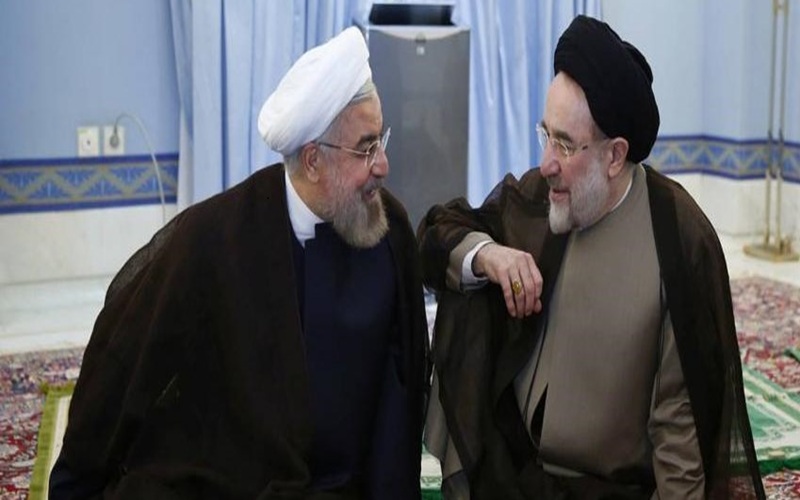

The regime’s so-called reformists once again return with familiar promises, but their latest statement only highlights their role as a survival mechanism for a dying dictatorship.
The Iranian regime’s so-called “reformists” have resurfaced with yet another statement, brimming with recycled slogans and lofty promises. Once again, they speak of “national reconciliation” and “returning to the people”—phrases that sound inspiring until one recalls that they’ve been repeated endlessly over the past four decades without ever being translated into action.
This movement, outwardly branded as “reformist,” has long since shed any credibility. In reality, it is less a political current than a “party of wheelspin,” endlessly turning but never moving forward. The reformists do not aim for genuine change; their function has always been clear—prolong the survival of a regime in which they are full and loyal partners.
On August 17, these regime-aligned figures unveiled their latest masterpiece of déjà vu, a statement titled “National Reconciliation; A Golden Opportunity for Change and Return to the People.” In it, they listed eleven supposed demands: “general amnesty, lifting restrictions, releasing political prisoners, dissolving parallel institutions, withdrawing the military from the economy, ending discrimination against women, freedom of the press, halting enrichment, and even direct negotiations with the United States.”
If this all sounds familiar, it should. Historical experience shows that such lists are not serious programs but tactical maneuvers to buy the regime more time. Over decades, not a single one of these promises has been realized. The “reformists” failed then, and in today’s climate of deepening regime crisis, their latest batch of promises rings hollower than ever.
Perhaps the most telling feature of this new statement is what it avoids. Ali Khamenei’s name is nowhere to be found, nor is there a whisper about the Revolutionary Guards or the Guardian Council—the real levers of power and the true obstacles to any so-called reform. Instead, the authors muster just enough courage to propose “direct talks with America.” As though Iran’s crisis stems from Washington or Donald Trump, and not from the authoritarian structure the reformists themselves helped create and solidify.
The irony is that these reformists are neither a party, nor a movement, nor an opposition force. They cannot even organize a simple gathering without regime approval. Their role has been reduced to that of a useless safety valve, preventing real opposition from gaining ground while offering the regime a façade of “pluralism.” Even this role is increasingly irrelevant, thanks to their own infighting and growing irrelevance in society.
For the Iranian people, the façade has long crumbled. In the public eye, reformists and principlists are cut from the same cloth. The slogan that echoes across Iran—“Reformists, principlists, the game is over”—is not a passing chant but a verdict delivered by lived experience. Decades of failed promises have shown that reforming the Iranian regime is not just improbable, but structurally impossible.
The reformists had years to prove otherwise. They had access to power, but neither the will nor the ability to create meaningful change. Today, as Iranian society looks beyond the regime altogether, these so-called reformists desperately cling to life with repetitive statements and clichéd rhetoric. The truth is simple: just like the principlists, they are part of the problem—never the solution.