


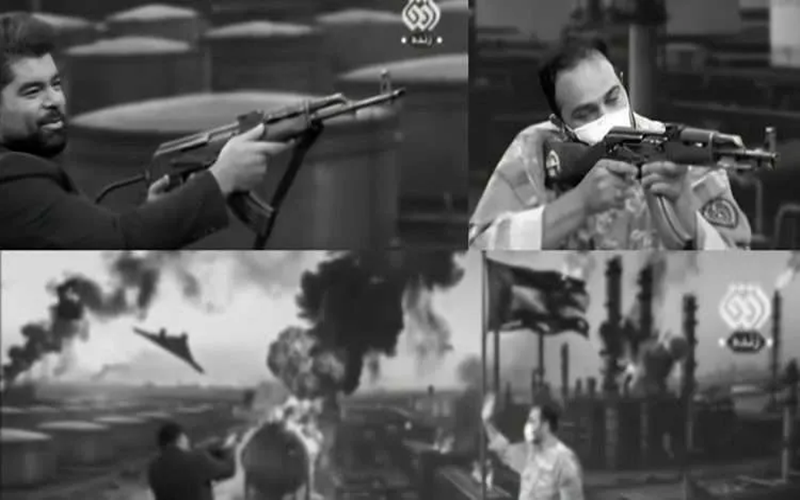

Broadcast of Kalashnikov and Heavy Weapons Training on IRGC-Affiliated TV Sparks Alarm Over Militarization of Society
The Iranian regime’s state broadcaster has once again brought weapons propaganda directly into people’s homes. The airing of Kalashnikov rifle training, machine gun demonstrations, and other weapons instruction on the IRGC-affiliated Ofogh TV channel has triggered widespread political and media backlash inside and outside Iran.
Many observers argue that the broadcast was not merely a military-themed television segment or ideological propaganda. Rather, they believe the regime’s decision to openly air “Kalashnikov training” reflects growing fear within the ruling establishment over the possibility of future nationwide protests and social uprisings.
In the program aired by Ofogh TV, a figure linked to the regime’s military apparatus demonstrated how to operate a Kalashnikov rifle. In one of the most controversial moments of the broadcast, the presenter fired shots toward the flag of the United Arab Emirates. Footage of the incident rapidly spread across social media, provoking intense criticism and condemnation.
Many users described the scene as a clear sign of the regime’s increasing normalization of violence through official state media.
Kalashnikov Training and the Normalization of State Violence
Media analysts and political sociologists note that authoritarian regime’s facing legitimacy crises often attempt to securitize public life. In such circumstances, the public display of firearms and military training on national television becomes part of a broader strategy of intimidation and psychological control.
Over the years, Iran’s state broadcaster has repeatedly functioned as a direct platform for the country’s security and military institutions. However, the open broadcast of “Kalashnikov training” on what the regime calls the “national media” represents a new phase in the militarization of public discourse.
The development comes as Iranian society continues to endure severe economic pressure, political repression, and widening social crises.
The regime appears to be using weapons displays and military rhetoric to send an indirect warning to a restless population. According to many analysts, the emphasis on Kalashnikov training is less a sign of confidence and more an indication of the ruling establishment’s anxiety over the possibility of future large-scale unrest.
Why Has the Regime Turned to Weapons Displays?
Following the nationwide protests of recent years, Iran’s regime entered one of the deepest legitimacy crises in its history. Demonstrations led by women, youth, workers, and various sectors of society revealed an unprecedented divide between the population and the ruling clerical establishment.
Since then, the regime has pursued a dual strategy: intensified repression combined with psychological warfare through state-controlled media.
Many observers now view the broadcast of Kalashnikov training as part of this broader intimidation campaign. They argue that the clerical regime seeks to keep society trapped in an atmosphere of threat and fear. The explicit display of firearms on state television aligns closely with this policy.
At the same time, the presenter’s act of firing at the flag of a foreign country drew additional criticism. Critics described the incident as another example of the regime’s confrontational regional posture and warned that promoting violence through official media could carry dangerous consequences both domestically and internationally.
A Sign of Fear, Not Strength
Governments that enjoy genuine public legitimacy rarely need to constantly showcase military power through public media. In contrast, regimes facing deep public dissatisfaction often rely increasingly on security institutions, intimidation tactics, and militarized propaganda.
In today’s Iran, labor strikes, economic hardship, inflation, and widespread social frustration have placed the regime in an increasingly fragile position. Under such conditions, many Iranians view the broadcast of Kalashnikov training not as a demonstration of strength, but as evidence of the authorities’ fear of potential future unrest and another possible wave of nationwide protests.
The expanding role of military figures in media programming, the growing rhetoric of threats, and the transformation of state television into a security platform all paint a revealing picture of the regime’s current crisis.
Instead of addressing the demands and grievances of the Iranian people, the government has chosen to bring weapons into the television frame.
The broadcast of Kalashnikov and other weapons training programs on IRGC-linked state television once again exposed the security-driven and repressive nature of the Iranian regime. According to many observers, these actions stem not from confidence or stability, but from deep concern over mounting public anger and the possibility of future social uprisings.