How Reza Pahlavi’s nostalgic praise for the last Shah clashes with documented coups, SAVAK repression, and the realities that led to the 1979 revolution.
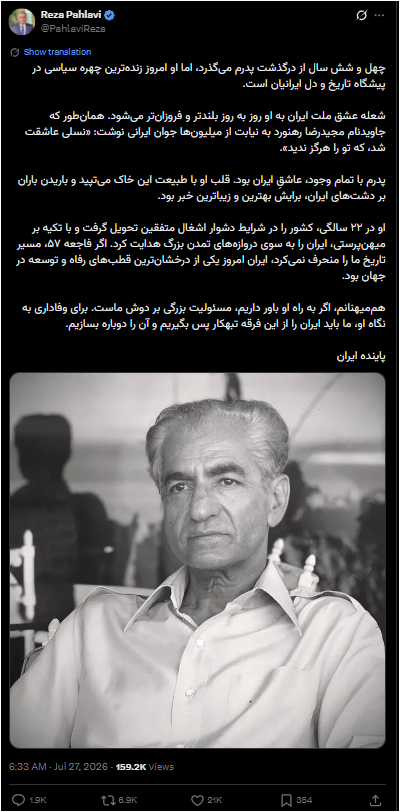
In his recent tweet, Reza Pahlavi attempts a familiar exercise: turning his father, Mohammad Reza Shah, from an authoritarian ruler into a romantic national saint—a man of rain-soaked fields and beating patriotic hearts, rather than of prisons, coups and censorship.
In Reza’s narrative, the Shah is “the most alive political figure in the hearts of Iranians” forty‑six years after his death, and the 1979 revolution is reduced to a mere “disaster” that tragically interrupted Iran’s march to prosperity. The problem is that history stubbornly refuses to cooperate with this storyline.
Let us start with the foundation of this “patriotic” rule: the 1953 coup. The Shah’s restored power did not fall from the sky; it was delivered through Operation Ajax, a joint CIA–MI6 operation that overthrew the democratically elected prime minister Mohammad Mossadegh after he nationalized Iran’s oil industry. Mossadegh was arrested, tried for treason, imprisoned, and then kept under house arrest until his death, while the Shah returned to the throne backed explicitly by foreign intelligence services. Calling this outcome “national sovereignty” requires a very generous imagination.
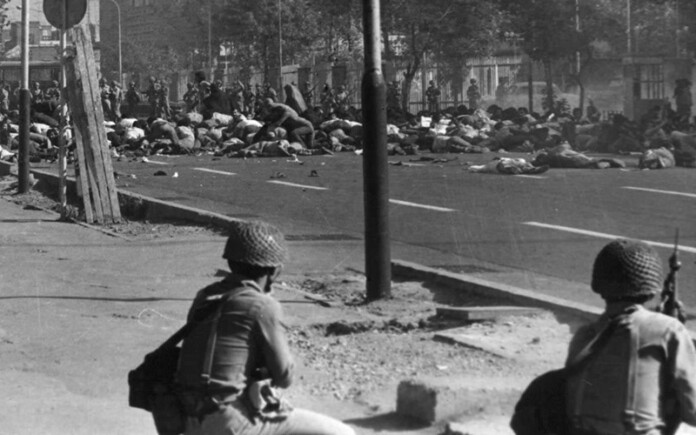
From that point on, the regime built its stability not on consent, but on control. SAVAK, the Shah’s notorious secret police, was established with foreign assistance and became synonymous with surveillance, torture, and the suppression of political dissent. Political opponents, intellectuals, leftists, Islamists, and even moderate critics learned very quickly that the price of “disagreement” could be interrogation, prison, or worse. Reza Pahlavi’s tweet does not mention them; apparently, they do not fit in the romantic picture frame.
Reza also invokes “development” and the Shah’s supposed path toward a “Great Civilization.” Yes, the period saw industrial expansion, urban growth, and rising oil revenues, particularly in the 1960s and 1970s. But the White Revolution’s land reforms, launched in the early 1960s, forcibly broke up large estates and redistributed land in a way that disrupted traditional rural structures while failing to create stable, equitable prosperity. Former landowners were compensated with shares in state‑owned industries, while many small cultivators faced insecurity and dependence on the state. Economic progress existed, but it was deeply uneven—and it came packaged with silenced parties and marginalised opposition.
By the mid‑1970s, the Shah’s search for absolute control produced one of the most revealing symbols of his rule: the Rastakhiz Party. In 1975 he declared Rastakhiz the only legal party, effectively turning Iran into a single‑party state. Membership and financial contributions were pushed aggressively, antagonizing many previously apolitical citizens and intruding into their economic, religious, and social lives. Even academic studies have noted that this one‑party experiment helped fuel public animosity and contributed to the monarchy’s downfall. This is the “path” Reza Pahlavi invites people to “believe” in.
Meanwhile, political freedoms were steadily dismantled. Parties that resisted the Shah’s consolidation of power were silenced or forced to the margins. Independent media faced censorship; critical voices were monitored and punished. The claim that “a generation fell in love” with a leader they never saw curiously omits the many who saw his prisons from the inside.
When Reza Pahlavi describes the 1979 revolution as a “disaster,” he conveniently skips the build‑up: years of mounting protests, strikes, and demonstrations that united secular intellectuals, religious groups, workers, students, and middle‑class citizens against the regime. These uprisings did not appear because people suddenly grew bored with “civilization.” They arose because an oil‑rich, heavily centralized state was governed through repression, foreign‑backed legitimacy, and a refusal to allow genuine political participation.
Of course, what came after 1979 is itself marked by grave violations and tragedies. But acknowledging the failures of the Islamic Republic does not retroactively transform the Shah into a champion of freedom. Both systems have their victims, their exiles, and their dead. Reza’s tweet attempts to use current suffering to erase previous suffering, as if the pain of one era cancels the record of another.
His call to “reclaim Iran” in his father’s spirit raises a blunt question: reclaim it into what, exactly? A system rooted in a foreign‑supported coup, maintained by a secret police notorious for torture, enforced by a single‑party structure that even neutral analysts identify as a factor in the regime’s collapse, and built on economic modernization that magnified inequality and dislocation? If this is the blueprint, Iranians have already given their verdict once.
Reza Pahlavi’s tweet is not merely a personal tribute; it is an attempt to rewrite collective memory by replacing documented facts with sentimental imagery. Rain over plains, a beating heart, a beloved father guiding the nation to “great civilization”—all of this makes for moving prose, but history is written in archives, testimonies and declassified documents, not in poetic tweets.
Iran deserves better than nostalgia marketing. It deserves an honest reckoning with all chapters of its past: Mossadegh and the coup, SAVAK and the prisons, the White Revolution and its consequences, Rastakhiz and the one‑party state, the revolution and what followed. Only that kind of clarity can prevent history from being recycled as propaganda.
Long live Iran—not as a sanitized memory curated in 280 characters, but as a society capable of looking power, past and present, straight in the eye.