


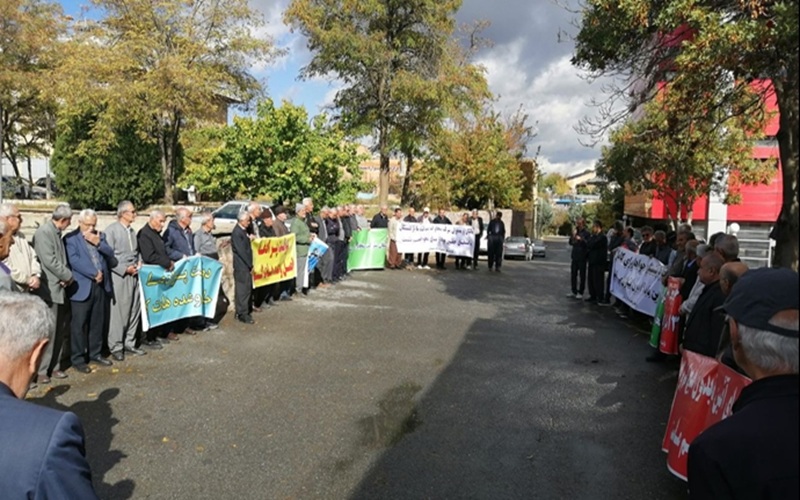

Pensioners accounted for nearly 63 percent of recorded protests, while workers, students, merchants, farmers, drivers, and other groups also took to the streets over unpaid wages, economic hardship, and deteriorating public services.
At least 48 protest actions involving different sectors of Iranian society were recorded across Iran in October 2026, according to a monthly assessment published by the Iran Freedom Association. The figures highlight the persistence of economic and social grievances under Iran’s regime, with pensioners accounting for the largest share of demonstrations.
The protests were driven by a range of unresolved problems, including deteriorating living conditions, unpaid wages and benefits, inadequate healthcare, job insecurity, restricted access to public services, and dissatisfaction with economic and administrative decisions.
Although pensioners were at the forefront, the protests extended well beyond this group, involving workers, university students, merchants, farmers, drivers, and citizens facing various economic and social difficulties.
The monthly assessment acknowledges that it was not possible to monitor every protest and demonstration across the country. Nevertheless, it provides a broad picture of the scale and composition of social protests during October.
Pensioners Account for Nearly Two-Thirds of Recorded Protests
Of the 48 protest actions documented in October, pensioners accounted for 30, representing approximately 62.5 percent of the total.
Workers accounted for three recorded actions, while students and merchants each registered two. Farmers accounted for one protest. Another 10 actions involved other social groups.
| Social group | Recorded protest actions |
|---|---|
| Pensioners | 30 |
| Workers | 3 |
| Students | 2 |
| Merchants | 2 |
| Farmers | 1 |
| Other groups | 10 |
| Total | 48 |
The overwhelming share of pensioner protests points to the depth of the economic crisis facing retired people, many of whom struggle with inadequate incomes, rising living costs, and the failure to meet longstanding legal and financial obligations.
Pensioners Remain at the Center of Social Protests
Retirees from the Social Security Organization, telecommunications sector, and steel industry repeatedly organized demonstrations and protest marches throughout October.
Their demands included the settlement of outstanding financial and livelihood-related claims, improvements in healthcare services, and payment of legally mandated wages and benefits.
The recurrence of these demonstrations indicates that pensioners’ grievances are not temporary disputes. They reflect deeper structural problems involving the pension system, social security institutions, and access to adequate medical care.
For many retirees, the failure to secure basic financial and healthcare entitlements has turned repeated appeals to the authorities into continuing street protests.
Workers Protest Unpaid Wages and Employment Insecurity
Workers also continued to raise concerns over wages and employment conditions. Their protests included demands for direct payment of salaries, proper registration of workers’ names in accordance with directives issued by the Administrative and Employment Organization, and settlement of unpaid wages.
These grievances point to problems extending beyond the low level of workers’ incomes. Even established administrative and legal mechanisms for paying wages are failing to protect sections of the workforce.
The combination of inadequate pay, delayed wages, and uncertainty over employment rights continues to fuel discontent among workers.
Students and Merchants Challenge Restrictions and Economic Pressures
University students and business owners also took part in protests during October.
Students at Khajeh Nasir Toosi University of Technology and Gorgan University of Agricultural Sciences and Natural Resources demonstrated over the denial of educational opportunities and the poor quality and insufficient quantity of university meals.
In the commercial sector, merchants at Tehran’s Jannat Bazaar and shopkeepers in the central market area of Khash staged protests and strikes.
The Tehran merchants objected to the failure to relocate businesses to a designated new site, while shopkeepers in Khash protested the closure of a market street, which affected their commercial activities.
These actions illustrate how administrative decisions, restrictions, and deteriorating economic conditions are affecting both students and small business owners.
Farmers, Drivers, and Other Social Groups Join the Protests
The remaining 10 recorded protest actions involved a diverse range of groups, reflecting the breadth of economic and social grievances across the country.
Among them were greenhouse owners in Mirjaveh, Khash, and Saravan, who protested the failure to allocate fuel quotas and difficulties obtaining fuel.
Nomadic communities in Izeh objected to the removal of their flour subsidies, while instructors at the Institute for the Intellectual Development of Children and Young Adults in Ilam demanded that their outstanding grievances be addressed.
Transportation workers also faced mounting pressures. Drivers on the Minab–Bandar Abbas route protested the shortage of fuel and the lack of access to unsubsidized gasoline. Bus and minibus drivers in Yazd staged a strike over rising prices for engine oil and tires.
In Tehran, a group of citizens demonstrated against the failure to amend the country’s marriage dowry law.
Other reported protests involved disputes over financial claims, housing, and vehicle deliveries. These included customers of OMP Finex in Tehran, vehicle pre-purchasers, members of the municipal employees’ housing cooperative in Islamshahr’s District 1, customers of Farda Motors, and purchasers of Shahin vehicles.
Although the immediate causes differed, these cases shared a common feature: citizens demanding that institutions and businesses fulfill their financial, contractual, and administrative obligations.
October Protests Reveal the Breadth of Iran’s Social Discontent
The October figures highlight three important characteristics of the protest movement.
First, the cost-of-living crisis and the failure to address accumulated social and economic grievances remain central drivers of public discontent. Pensioners’ overwhelming presence is particularly significant, demonstrating how deeply economic hardship has affected people who depend on fixed incomes and social security payments.
Second, the geographical and occupational diversity of the protests shows that dissatisfaction is not confined to a particular province, industry, or social class. From pensioners and workers to students, merchants, farmers, drivers, and local communities, different sections of society are confronting problems that the authorities have failed to resolve.
Third, the persistence of these protests across different sectors points to a broader crisis of governance and accountability. Whether the issue is unpaid wages, inadequate pensions, fuel shortages, healthcare, housing, or commercial restrictions, citizens repeatedly find themselves having to take to the streets to demand basic rights and obligations.
The 48 documented protest actions should not be interpreted as a complete count of all demonstrations in Iran. Rather, they represent a recorded sample of a much wider pattern of social discontent.
The central message of October’s protests is that economic hardship under Iran’s regime is not confined to isolated groups. It is affecting multiple layers of society, while the authorities’ failure to resolve longstanding grievances continues to generate new protests and sustain existing ones.