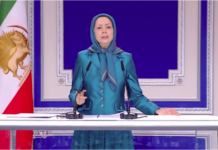
French political and legal figures stress people-led change, denounce disinformation, and vow justice for victims of repression
At the April 10 conference in Paris organized by the National Council of Resistance of Iran (NCRI), French political and legal figures reinforced the central message shared by earlier speakers: the path to freedom in Iran lies in unity, persistence, and accountability.
Jean-Pierre Béquet and Jean-Pierre Spitzer highlighted both the urgency of halting executions and the long-term necessity of a democratic transition driven by the Iranian people.
Executions Reveal Regime Fragility
Béquet opened by aligning himself with previous remarks and emphasizing the significance of the moment:
“The latest executions actually show the fragility of this hyper-repressive regime.”
Rejecting external intervention as a solution, he reiterated a core theme of the conference:
“The only way to bring democracy is not through bombs, but through the daily struggle of the Iranian people.”
He stressed that meaningful change requires both internal resistance and international backing:
“It is the camp of democrats… who will be able to lead the Iranian people to finally see better days.”
Unity to Halt Executions and Support Resistance
Béquet identified two immediate priorities: stopping executions and strengthening support for resistance forces:
“First, to stop the executions… and secondly… to support these resistance fighters… and all the ordinary citizens who rose up.”
He underscored the importance of conditions that allow popular mobilization:
“One cannot rise up when… bombs are falling… We therefore need the ceasefire… then the people must be able to rise up strongly.”
Calling for global solidarity, he declared:
“All the forces of democracy and freedom must stand up.”
Rejection of Both Dictatorships
Béquet framed Iran’s struggle as one against successive forms of authoritarianism:
“To finally emerge from these two dictatorships: that of the Shah and then that of the mullahs.”
Echoing other speakers, he dismissed Reza Pahlavi:
“Let him return to his fortune… and… not concern himself with others.”
He concluded with strong support for Maryam Rajavi’s vision:
“Total support for the people of Iran… [and] the Iranian Resistance’s plan.”
A Legal Battle Against Disinformation
Jean-Pierre Spitzer, a lawyer who has worked with the Iranian Resistance for over two decades, focused on the legal and political struggle against misinformation.
Recalling earlier accusations against the movement, he described how narratives were shaped by false claims:
“Everywhere I went, they told me: ‘They are terrorists.’… I said… ‘The only terrorists… are the mullahs.’”
He highlighted the role of ignorance in shaping policy:
“Ignorance that is unaware of itself invites grand affirmations.”
Spitzer pointed out the contradictions in labeling the opposition:
“They told me: ‘They are communists… they are Islamists!’… ‘It is the Islamists who are killing them!’”
“We Choose the Law”
Spitzer emphasized a defining principle of the Iranian Resistance:
“You told me… ‘We choose the law.’”
As a legal professional, he described this commitment as the foundation of his support:
“Here are people… who want to win through the law, with the law.”
He framed past legal victories as collective achievements:
“The victory that we lawyers won was your victory.”
Martyrs as the “Spearheads” of Change
Reflecting on the executed individuals, Spitzer described their sacrifice in universal terms:
“They die for ideas. They die for democracy. They die for the rule of law.”
He stressed that their legacy strengthens the movement:
“They will always survive… they are the spearheads of what must happen tomorrow.”
Drawing a broader historical perspective, he criticized misconceptions about Iran:
“This great people… deserves… a world of peace and freedom.”
Accountability and the Promise of Justice
Spitzer highlighted what he described as an “irony of fate,” noting that those who once influenced governments to blacklist the opposition are now themselves sanctioned:
“It is the Revolutionary Guards… who today… are on the blacklist.”
He warned against political complacency and appeasement:
“Do not be afraid.”
Referencing foundational human rights principles, he urged action grounded in universal values:
“In the name of ‘never again’… the Universal Declaration of Human Rights.”
A Personal Commitment to Future Justice
In a powerful conclusion, Spitzer pledged to pursue accountability in a future democratic Iran:
“When I go with you to Tehran, I will put on my robes again.”
He envisioned legal proceedings against those responsible for executions:
“I want to plead… against the executioners… the thousands of martyrs deserve that… they be judged and condemned.”
A Unified Call: Law, Unity, and People Power
Both Béquet and Spitzer reinforced a consistent message echoed throughout the conference: the Iranian regime’s repression signals weakness, not strength; disinformation must be confronted; and justice must ultimately prevail.
Their remarks underscored that the path forward lies in a combination of internal resistance, international solidarity, and a firm commitment to legal accountability—aimed at securing a democratic future for Iran.