


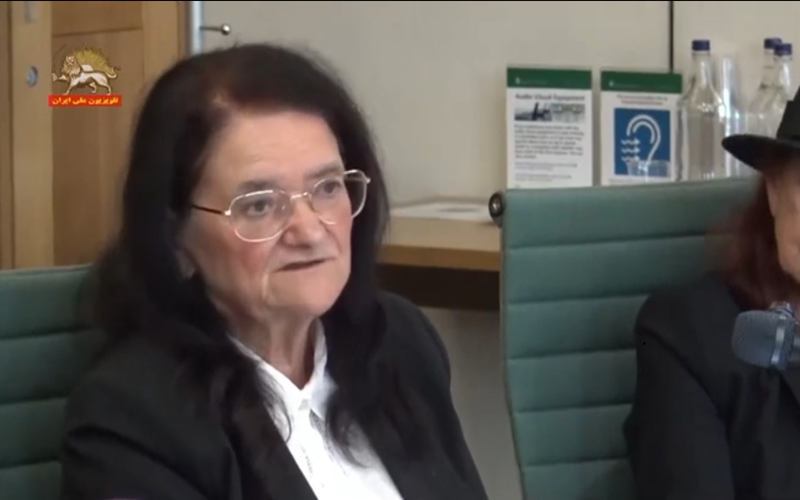

Speaking at the UK Parliament, Professor Sara Chandler highlighted Iran’s executions, persecution of lawyers and prisoners, and the need for international support for democratic change.
Professor Sara Chandler, speaking in her role as Secretary of the Human Rights Committee of the Federation of European Bar Associations (FBE), expressed grave concern over the deteriorating human rights situation in Iran, focusing particularly on executions, political prisoners, attacks on lawyers, and the erosion of judicial independence.
Chandler said the FBE condemns the executions carried out by Iran’s regime and specifically cited 32 documented executions between March 19 and June 3. She also drew attention to political prisoners facing the death penalty, including people she said were supporters of the People’s Mojahedin Organization of Iran (PMOI/MEK) and individuals involved in the January uprising.
She called for an end to torture in prisons, mass arrests of relatives, lengthy prison sentences, and the abuse of political prisoners. Particular concern, she said, should be directed toward women and family members of prisoners who have been executed.
Judicial Independence Under Threat
A central theme of Chandler’s remarks was the condition of Iran’s judicial system. She emphasized that judicial independence is fundamental to the rule of law, arguing that developments in Iran demonstrate serious violations of that principle.
According to Chandler, judges face harassment, while lawyers representing people arrested by the regime are themselves subjected to arrest, detention, and intimidation. She also pointed to the absence of fair trials and adequate access to justice.
For European lawyers, she argued, these developments are not merely individual abuses but attacks on the basic principles underlying the rule of law.
Chandler linked the intensification of repression to the broader crisis facing Iran’s regime. Referring to the ongoing war as part of the backdrop, she argued that the authorities’ actions reflect their fear of organized resistance and political change.
She also identified economic hardship, social frustration, and widespread distrust of state institutions as factors contributing to what she described as a deepening crisis for the regime.
Support for an Organized Democratic Alternative
Chandler said European lawyers have been aware for years of what she described as the PMOI’s objective of establishing a democratic republic through elections.
She also referred to the National Council of Resistance of Iran (NCRI) and Maryam Rajavi’s Ten-Point Plan, describing it as a framework that has been presented internationally for many years.
According to Chandler, the proposed transition framework is intended to prevent a political vacuum following a change in government. She said it provides for the maintenance of public order, preservation of state functions, and the organization of elections for a constituent assembly within six months.
She further argued that the international community could play a verification role during such a transition, potentially through a United Nations mission or through countries committed to supporting what she described as the Iranian people’s right to determine political change.
Women and Diversity in Iran’s Future
Chandler also highlighted what she described as the central role of women in the NCRI’s leadership. She connected this with the importance of respecting Iran’s ethnic, linguistic, and cultural diversity.
Her remarks presented these issues as elements of the political future she believes the resistance movement is seeking to establish.
Speaking as a representative of European lawyers organized through the FBE, Chandler said she supported the NCRI and the prospect of a future democratic Iran. She framed that support in the context of human rights, the rule of law, and the resistance of the Iranian people.
A Call for International Action
Chandler called for an end to human rights violations and to what she described as decades of repression by Iran’s regime. She also emphasized the role of the UK government in supporting the Iranian resistance and advancing international efforts at what she portrayed as a critical moment.
Her remarks underscored the connection between human rights and political accountability. In her view, executions, torture, arbitrary detention, attacks on lawyers, and the denial of fair trials cannot be separated from the broader political crisis in Iran.
Addressing Maryam Rajavi directly at the close of her speech, Chandler expressed solidarity with the resistance and praised its years of organization and activity.
Her intervention at the UK Parliament therefore brought together three closely connected concerns: the immediate human rights crisis in Iran, the erosion of judicial independence, and the question of how the international community should respond to demands for political change.
For Chandler, protecting prisoners, lawyers, judges, and families affected by executions is inseparable from defending the rule of law. She also argued that international engagement should help ensure that any political transition respects the Iranian people’s right to determine their country’s future through elections.