


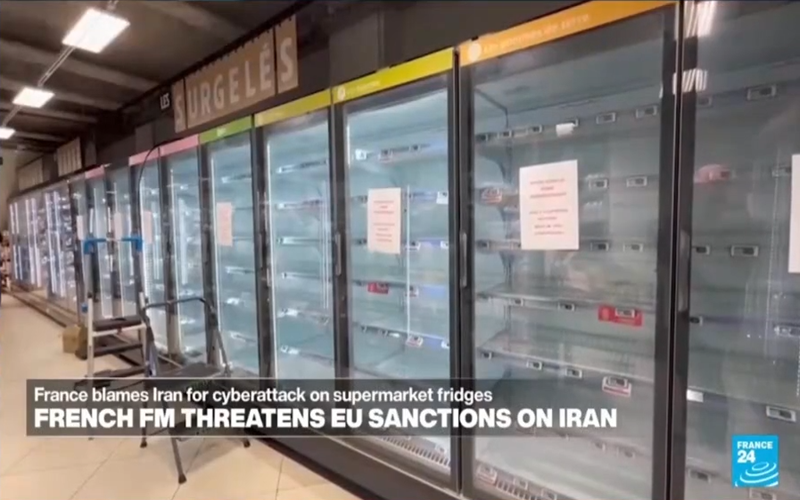

French authorities have traced a series of disruptive cyberattacks against supermarket refrigeration systems and medical facilities to hackers linked to the IRGC, raising the prospect of new European sanctions and further diplomatic confrontation with Tehran.
Cyberattacks on French food stores trigger a new diplomatic confrontation
Tensions between France and Iran’s regime have escalated following a series of cyberattacks targeting commercial refrigeration systems and medical facilities in France. French authorities have pointed to the Islamic Revolutionary Guard Corps (IRGC) as being behind the operations, which reportedly disrupted refrigeration systems in hundreds of food distribution centers and affected critical medical supplies, including blood reserves.
The attacks, which unfolded in two stages in October and November, have prompted a formal French investigation and diplomatic action against Tehran. French officials say they have identified seven hackers affiliated with the IRGC and have warned that the attacks will have consequences.
The case comes amid growing international pressure on Iran’s regime and adds another dimension to its already strained relations with European governments.
From spoiled food to compromised hospital blood supplies
The first wave of cyberattacks occurred in October, targeting supermarket chains as well as smaller food retailers. According to reports, hackers manipulated refrigeration systems, raising temperatures in some units to approximately 50 degrees Celsius.
The disruption reportedly caused fires at several locations and led to the spoilage of substantial quantities of food. Retailers were forced to discard large amounts of contaminated or unusable products, creating disruption across affected distribution networks.
The second wave, reported in November, extended beyond commercial facilities to include blood banks and medical centers.
This phase had particularly serious implications for healthcare services. A significant portion of blood reserves maintained for emergencies and life-saving medical procedures reportedly became unusable after refrigeration systems were compromised.
The reported targeting of both food distribution and medical infrastructure illustrates the potential consequences of cyberattacks against systems that are essential to civilian life.
France identifies seven IRGC-linked hackers
French authorities have reportedly identified seven hackers affiliated with the IRGC in connection with the attacks. Their assessment is based on several technical indicators, including similarities between the operations and the methods previously associated with an IRGC-linked cyber group.
Investigators also examined internet addresses traced to Iran, as well as Persian-language code and other technical markers found in the infrastructure used in the attacks. Additional similarities in the technical characteristics of the operations reportedly strengthened the French assessment.
The French prosecutor’s office has opened legal proceedings in connection with the case. Senior French officials, including the prime minister and foreign minister, have also addressed the matter publicly.
Paris has indicated that it intends to respond through diplomatic measures and potentially additional sanctions. The government’s position signals that the incident is being treated not simply as a criminal cyberattack but as a matter with broader national and international security implications.
European Union considers possible sanctions
The dispute is also attracting attention at the European level. According to statements cited in the reports, the European Union intends to examine the case at its forthcoming meeting.
If the involvement of Iran’s regime is established, additional European sanctions could be considered.
Such measures would add to the existing tensions between Tehran and European capitals. The case also comes at a time when the regime is seeking to exploit differences between European governments and the United States over how to approach Iran.
However, cyber operations targeting civilian infrastructure risk creating further convergence among European governments on the need for a coordinated response.
Cyberattacks add to Iran regime’s international isolation
The latest confrontation highlights the growing range of challenges facing Iran’s regime in its relations with Western governments. Beyond longstanding disputes over regional intervention, security, and other international issues, allegations of cyber operations against civilian infrastructure are adding a new source of diplomatic friction.
The targeting of food distribution systems and medical facilities is particularly consequential because disruptions can directly affect ordinary people, including patients dependent on properly maintained blood supplies.
For France and other European countries, the central issue is not only identifying those responsible but also determining what measures are necessary to prevent similar operations in the future.
The coming response from Paris and Brussels will indicate whether the case leads to further diplomatic measures, coordinated sanctions, or a broader European policy response toward Tehran.
For Iran’s regime, the investigation represents another international dispute with the potential to deepen its diplomatic isolation and increase the economic and political costs of its activities abroad.