


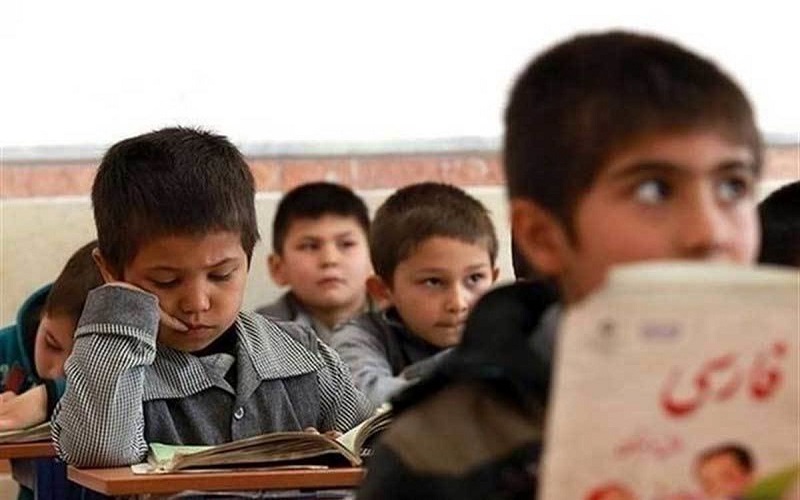

A recent viral video on social media has reignited a long-standing debate about the monetization of public education in Iran. The footage captures a heated exchange between a school principal and a student’s father.
In the video, the principal openly admits to expelling the student, citing poor academic performance as a pretext, while in reality, the true reason was the father’s inability to pay the school’s tuition fees.
The father, visibly frustrated, repeatedly questions the fairness of his child’s expulsion, asking: “Should my child be expelled simply for not paying tuition at a public school?”
The principal, undeterred, boldly states that he manages the school’s expenses through the money collected from families.
He even challenges the father to take the matter to the Ministry of Education, confidently declaring, “I’m not afraid of anyone.”
This phrase—”You can complain to the education department; I’m not afraid of anyone”—resonates with many Iranian families. For years, education officials have insisted that charging tuition fees in public schools is both illegal and a violation of policy. However, the lived reality tells a different story. Public schools routinely demand substantial tuition fees from families, and those who fail to pay often face the threat of expulsion, as demonstrated in the recent video.
It is implausible to believe that such widespread practices occur without the knowledge and tacit approval of the Ministry of Education. By maintaining the official stance that education in public schools is free, the Ministry evades criticism over the increasing commercialization of education.
Simultaneously, it enables schools to charge tuition under the guise of “voluntary contributions” while compelling families to shoulder a significant portion of school expenses.
Reports indicate that some schools even withhold students’ report cards at the end of the academic year as leverage to extract unpaid tuition. In extreme cases, parents unable to afford the fees are asked to provide services to the school instead.
One particularly distressing example involved a single mother who was forced to clean the school premises in lieu of payment.
These practices stand in stark contrast to Article 30 of the Iranian regime Constitution, which unequivocally states: “The state is obliged to provide free education facilities for all people until the end of secondary school and to expand higher education facilities free of charge to the extent of the country’s self-sufficiency.”
Furthermore, according to education regulations, any mandatory collection of tuition fees in public schools is illegal. Yet, in practice, these laws remain unenforced and serve only as empty proclamations.
In late September 2024, Ali Farhadi, Deputy Minister of Planning and Development of Educational Resources, appeared on a television program ahead of the new school year.
He downplayed the issue, asserting that “only a small number of public schools collect money from families,” and that parental contributions are “voluntary.” He further claimed that complaints would be addressed within three days.
However, the ground reality tells a different story. When school administrators dismiss parents’ protests and redirect them to the Ministry of Education for complaints, it becomes evident that the collection of tuition fees is happening with full coordination and endorsement from the authorities.
Meanwhile, substantial portions of Iran’s education budget are diverted to serve the regime’s interests rather than addressing the needs of students.
Thousands of students are forced to drop out each year due to their families’ financial struggles, leading to a tragic loss of talent and potential.
Many bright young minds are denied access to education, not because of academic shortcomings, but simply because they cannot afford to pay.
Adding to the financial burden on public education, the Iranian government employs 20,000 clerics under the “Amin Plan,” using public funds to place them in schools to indoctrinate students with the regime’s ideology.
Furthermore, the Tehran Municipality has allocated 550 billion tomans under the “Arman Plan” to send clerics into schools, prioritizing ideological indoctrination over educational development.
The commercialization of education in Iran has severe consequences, exacerbating inequality and depriving countless children of their right to learn. Until the government takes meaningful action to enforce free education policies and allocate resources responsibly, the dream of accessible education for all will remain just that—a dream.