


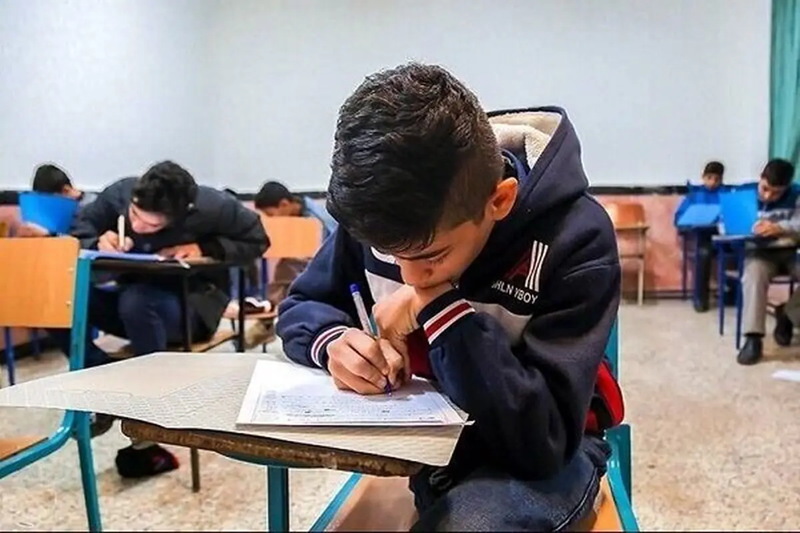

At the heart of this crisis lies a fundamental deprivation: students are being denied their most basic right—the right to consistent, structured education. With authorities openly acknowledging that there is currently no viable plan to resume in-person schooling, millions of children remain trapped in an educational limbo.
The regime has attempted to present alternatives—virtual classrooms, televised lessons, and pre-packaged educational materials—as functional substitutes. In practice, these measures have proven deeply inadequate. Chronic weakness in digital infrastructure has made access to online platforms unreliable at best. The widely promoted “Shad” system, intended as the backbone of remote education, suffers from server limitations and accessibility issues that render it ineffective for large segments of the population.
Televised instruction, often cited as a fallback, is constrained by high costs, limited scheduling flexibility, and a lack of interactivity—key components of effective learning. Meanwhile, offline materials distributed via CDs or flash drives, though theoretically useful in low-connectivity environments, cannot replicate the pedagogical value of a classroom environment where interaction, feedback, and developmental support are integral.
This systemic failure is shifting an impossible burden onto families. Parents—most without pedagogical training—are expected to assume the role of educators. While they may supervise assignments, the transfer of foundational concepts, particularly for first-grade students at the beginning of their academic journey, is far beyond what most households can realistically provide. The result is a widening learning gap that begins at the earliest stages of education.
Educators themselves acknowledge the breakdown. School administrators report that the expansion of virtual learning has hollowed out the very concept of education, reducing it to a fragmented and ineffective process. Beyond academics, the developmental dimension—critical for social and emotional development—has been almost entirely abandoned.
Compounding these issues are broader structural disruptions. Internet shutdowns have eliminated access to global educational resources, while ongoing crises—from air pollution and energy shortages to war—have normalized school closures as a default policy response. Official statements attempt to frame this as preparedness, citing prior experience with closures. In reality, the cumulative effect has been devastating: in some provinces, schools have been closed for over a month at a time, with dozens of closure days recorded even before the war.
The consequences are particularly severe in the context of high-stakes examinations. Reports of irregularities, including the informal grading of exam papers outside official channels, raise serious concerns about the integrity of an evaluation system that directly determines university admissions. When final examinations account for a significant portion of entrance outcomes, such dysfunction undermines not only fairness but the credibility of the entire system.
At its core, this is also a crisis of inequality. Access to digital tools—smartphones, reliable internet, private tutoring—has become the defining factor in educational success. For affluent families, these resources provide a buffer against systemic failure. For low-income households, they are often unattainable. In many families, a single device must be shared, if it exists at all. In multi-child households, this leads to the effective exclusion of one or more children from the learning process.
The result is predictable: declining motivation, academic decline, and ultimately, dropout. The numbers are stark. Over recent years, schools have operated virtually for a cumulative period equivalent to an entire academic year. Dropout figures have surged—from hundreds of thousands to over a million children now outside of the education system. These children are not simply absent from classrooms; they are being pushed into informal labor markets, where exploitation replaces education.
Even among those who remain enrolled, the quality of learning has deteriorated sharply. Reports indicate that students at higher grade levels are performing at competencies expected of much younger children. In some underprivileged regions, basic literacy itself is no longer assured, with a significant proportion of students unable to read or write at a primary level.
This is not merely an educational setback—it is a societal danger. The erosion of literacy, critical thinking, and equal access to knowledge undermines the very foundations of national development. It entrenches class divisions, fuels social frustration, and limits future economic mobility.
What we are witnessing is the convergence of war-driven policy, chronic mismanagement, and structural inequality into a single crisis point. The Iran regime’s prioritization of geopolitical ambitions over domestic infrastructure has come at a direct cost to its youngest citizens. By normalizing disruption and failing to invest in resilient educational systems, it has effectively transformed education from a universal right into a conditional privilege.
The long-term implications are profound. A generation deprived of consistent education is a generation whose potential is systematically diminished. Recovery from such damage is neither quick nor guaranteed.
The question is no longer whether the system is under strain—it is whether it can endure at all.