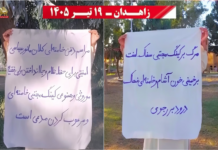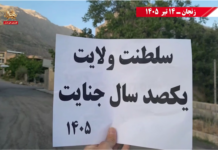
On Tuesday, April 29, 2025, the 66th round of the “No to Execution Tuesdays” campaign will be held in 41 prisons across Iran. This week’s campaign comes at a particularly charged moment, as prisoners issue a statement condemning the Islamic Republic and the Islamic Revolutionary Guard Corps (IRGC) for their role in the deadly explosion at the Bandar Abbas pier. The explosion resulted in dozens of deaths and injured over a thousand, according to early reports.
Prisoners Blame Regime for Bandar Abbas Explosion
In their statement, the prisoners expressed deep sympathy for the victims and their families, while placing the blame squarely on the regime and its military arm.
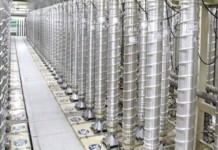
“It is clear to the people of Iran that the main perpetrators of this disaster—whose full human and financial toll remains unclear—are the oppressive rulers and the terrorist IRGC, who are continuously engaged in the production of missile and nuclear weaponry and in warmongering,” the statement reads.
The campaign’s message links the government’s militaristic policies and clandestine operations to the disaster, accusing the IRGC of operating recklessly and with disregard for civilian life.
Solidarity with Iran’s Workers and Teachers
The statement also coincides with International Workers’ Day and National Teachers’ Day, offering a message of solidarity to Iranian laborers and educators—both active and retired—who have long struggled against systemic oppression and discrimination.
“Despite decades of suppression, the working class, educators, and all hard-working people have continued to fight for their rights—many paying with imprisonment or even their lives,” the statement says.
Prisoners participating in the campaign acknowledged and thanked workers, teachers, retirees, artists, writers, and poets who have publicly opposed capital punishment in recent days.
Surge in Executions Sparks Urgent Alarm
The statement warns of a recent surge in executions—particularly of political prisoners. Within just the first month of the Persian calendar year (Ordibehesht), 35 people have reportedly been executed, including one woman and two political prisoners of conscience: Rostam Zeyn al-Din from Zahedan and Hamid Hosseinnezhad Heydaranlou. The latter’s body, the prisoners note, was not even returned to his family—a move they describe as “barbaric” and a blatant violation of human rights.
“Such actions are inhumane, gross violations of human rights, and a clear sign of the regime’s fear of a popular uprising,” the statement declares.
The prisoners also highlighted the case of political detainees Mehdi Hassani and Behrouz Ehsani, whose retrial requests were recently rejected by the Supreme Court, leaving their executions imminent. Another inmate, Mohsen Langarneshin, convicted of espionage, has reportedly been transferred to solitary confinement—often a precursor to execution.
Expanding Resistance Behind Bars
With thousands of prisoners on death row and state violence escalating, resistance inside Iran’s prisons is intensifying. In a notable development, inmates in Sanandaj prison announced they would join the “No to Execution Tuesdays” campaign and launch a hunger strike on April 29, joining other facilities across the country.
The 66th week of this protest campaign includes hunger strikes and symbolic resistance in 41 prisons, including:
-
Evin Prison (Women’s Ward, Wards 4 and 8)
-
Qezel-Hesar (Units 3 and 4)
-
Karaj Central, Greater Tehran, and Khorrin Varamin Prisons
-
Choobindar Qazvin, Arak, Khorramabad, and multiple Isfahan prisons
-
Ahvaz (Sheyban and Sepidar, both Men’s and Women’s Wards)
-
Shiraz Nezam and Adelabad Prisons
-
Zahedan, Borazjan, Behbahan, Ramhormoz, Bam, Kahnooj, and Tabas Prisons
-
Mashhad, Gonbad-e Kavus, Qaemshahr, Rasht, and Roodsar Prisons
-
Haviq Talesh, Azbarom Lahijan, and Dizel Abad Kermanshah Prisons
-
Ardabil, Tabriz, Urmia, Salmas, Khoy, Naqadeh, and Miandoab Prisons
-
Sanandaj, Saqqez, Baneh, Marivan, and Kamyaran Prisons
As the weekly campaign persists, its organizers and participants hope the chant of “No to Execution” will become not just a slogan within prison walls, but a unified national demand against the machinery of state repression.