


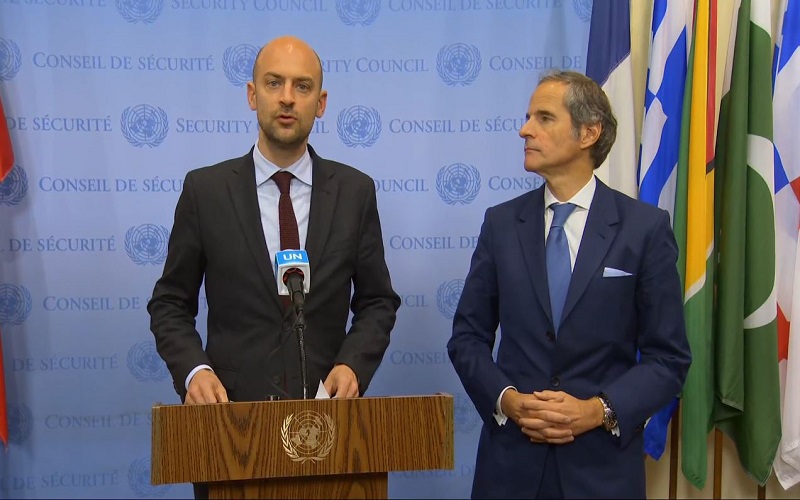

At a media stakeout following a Security Council meeting on non-proliferation and nuclear weapons, French Minister Jean-Noël Barrot and IAEA Director General Rafael Mariano Grossi raised serious concerns about Iran’s accelerating nuclear activities.
Jean-Noël Barrot highlighted that the risk of nuclear proliferation has reached an unprecedented level, citing Iran as a major source of alarm. He recalled that a decade ago, Iran committed to limiting its nuclear program under international agreements.
However, today, according to reports from the International Atomic Energy Agency (IAEA), Iran possesses 6,000 kilograms of enriched uranium — about thirty times the limit set by the 2015 nuclear deal. Moreover, the time required for Iran to further enrich uranium to weapons-grade levels has shrunk dramatically from one year to just a few days.
The French minister also warned about Iran’s development of long-range ballistic missile capabilities and its support for non-state actors that contribute to regional instability in the Middle East. “There is no military solution to the Iranian nuclear issue,” Barrot stated, emphasizing the importance of a diplomatic path while recognizing how precarious that path has become.
He noted that France, along with the United Kingdom, Germany, and in close coordination with U.S. Secretary of State Antony Blinken, supports ongoing diplomatic efforts between the United States and Iran.
However, Barrot made it clear that if negotiations fail and European security interests are not safeguarded after the expiration of the current nuclear agreement, Europe will have no hesitation in reinstating all sanctions that were lifted ten years ago. Such sanctions would significantly cut Iran’s access to technology, investment, and European markets, with devastating effects on the Iranian economy.
In a strong appeal, Barrot urged Iran to take the necessary decisions immediately to avoid further escalation.
IAEA Director General Rafael Grossi confirmed the gravity of the situation. He stated that the IAEA remains deeply engaged with both the United States and Iran and is maintaining constant contact to support diplomatic efforts with a solid technical basis.
Grossi emphasized that the IAEA’s role is crucial in ensuring that technical realities inform political negotiations, expressing hope that the agency can continue to play a constructive part in avoiding further deterioration.
Both leaders concluded by stressing the urgency of decisive international action, warning that failure could have severe consequences for global peace and security.
Transparency and Verification Challenges
The European trio of France, Germany, and the United Kingdom has expressed deep regret over Iran’s recent suspension of the Additional Protocol and transparency measures under the Joint Comprehensive Plan of Action (JCPoA).
These steps significantly reduce the IAEA’s ability to monitor Iran’s nuclear activities and represent a further violation of Iran’s commitments under the deal. The reduction in safeguards oversight constrains the IAEA’s access to sites and critical information, hampering verification efforts and increasing international concern about clandestine nuclear activities.
Despite these challenges, the IAEA and Iran have reached a temporary bilateral understanding preserving limited access to certain information for up to three months, allowing some continuation of monitoring efforts.
The E3 countries have urged Iran to reverse these measures and fully cooperate with the IAEA to preserve the JCPoA and support ongoing diplomatic negotiations aimed at restoring compliance.
Security Council Engagement and Global Non-Proliferation Efforts
The Security Council, under France’s presidency, convened a private meeting on non-proliferation where Jean-Noël Barrot chaired and Rafael Grossi briefed members. The meeting underscored the increasingly serious challenges facing the nuclear non-proliferation regime, which is anchored by the Treaty on the Non-Proliferation of Nuclear Weapons (NPT).
The upcoming 2026 NPT Review Conference looms as a critical moment to renew international commitments to non-proliferation and disarmament, especially amid setbacks such as the failure to reach consensus at recent Review Conferences and the suspension of the New START arms control treaty by Russia.
Council members reaffirmed support for the IAEA’s verification role and called for renewed dialogue and confidence-building measures to reduce nuclear risks globally. They also emphasized the importance of preventing non-state actors from acquiring weapons of mass destruction and addressing emerging technological threats to the non-proliferation regime.
Implications of Potential Sanctions Reinstatement
Barrot warned that if the nuclear deal expires without guarantees for European security, France, Germany, and the UK will promptly reimpose sanctions on Iran. This move would have devastating consequences for the Iranian economy by restricting access to technology, investment, and markets. The option to trigger the “snapback” mechanism under the 2015 agreement, which would automatically reinstate UN sanctions, remains on the table until October 2025.
The French minister stressed that while a military solution is not viable, the diplomatic path is narrow and urgent decisions are needed from Tehran to avoid escalation. Grossi echoed this urgency, noting that the window to reach a feasible agreement that prevents military conflict may be measured in weeks, not months or years.