
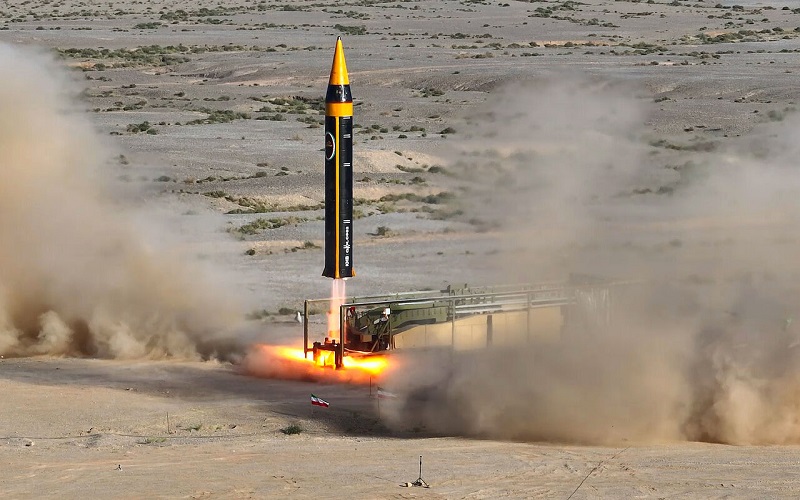

May 15, 2025 | Washington, D.C. – The U.S. Department of the Treasury’s Office of Foreign Assets Control (OFAC) has imposed sanctions on six individuals and 12 entities involved in Iran’s efforts to domestically produce key components for its ballistic missile program. This latest action underscores the Trump administration’s ongoing commitment to prevent the Iranian regime from advancing its intercontinental ballistic missile (ICBM) capabilities.
The entities and individuals targeted are part of a complex procurement and manufacturing network that supports sub-organizations within the Islamic Revolutionary Guard Corps (IRGC), including the IRGC Aerospace Force Research and Self Sufficiency Jihad Organization (IRGC ASF RSSJO) and the IRGC Research and Self Sufficiency Jehad Organization (IRGC RSSJO). These IRGC sub-units are critical to Iran’s ongoing efforts to develop domestic production of carbon fiber—an essential material used in the manufacture of ICBMs.
“The United States cannot allow Iran to develop intercontinental ballistic missiles,” said Secretary of the Treasury Scott Bessent. “Iran’s relentless and irresponsible pursuit of advanced missile capabilities is a threat to the U.S. and regional stability. We are committed to holding accountable those enabling Iran’s military ambitions.”
Targeting the Carbon Fiber Supply Chain
At the center of the procurement network is Advanced Fiber Development Company (AFDCO), an Iran-based company that collaborates directly with the IRGC to supply carbon fiber and related manufacturing equipment. AFDCO is led by Mohammad Rezai, deputy director of IRGC ASF RSSJO, who also represents the OFAC-designated Kish Mechatronics Co. on AFDCO’s board.
Additional key players include:
-
Hamed Dehghan, deputy chairman of AFDCO and head of Pishtazan Kavosh Gostar Boshra LLC (PKGB), both of which are used to procure carbon fiber materials and missile-related components for the IRGC.
-
Sharif Hamrah Science and Technology Researchers (SHSTR), a research organization acting as AFDCO’s board chair.
-
Sarmand Sazeh Sazan Soroush (Sarmand Sazeh), which received carbon fiber shipments from Chinese suppliers.
OFAC also sanctioned Narin Sepehr Mobin Isatis (NSMI), previously designated for its role in procuring materials for the IRGC, and several entities and individuals based in the People’s Republic of China.
Chinese Involvement in Proliferation Activities
Among the most significant international enablers are PRC-based Shanghai Tanchain New Material Technology Co Ltd and its leadership:
-
Qin Jinhua (owner and executive),
-
Qin Dehui (legal representative), and
-
Wang Chao (customer relations lead and spouse of Qin Jinhua).
These individuals and entities are accused of supplying Iran with carbon fiber and precursor materials, including direct exports to NSMI. OFAC has also designated:
-
Super Sources Industrial Co Limited (Hong Kong) and Reso Trading Shanghai Co Ltd, both linked to Wang Chao, for exporting aramid fiber to IRGC-affiliated entities.
-
Nantong Tanchen High Performance Materials Co Ltd, Nantong Yihong New Materials Co Ltd, and Shanghai Ninestex New Material Technology Co Ltd—subsidiaries of Shanghai Tanchain.
-
Qingdao Premier Technology Co Ltd, another PRC firm, for directly exporting carbon fiber fabrics to the IRGC.
Legal and Economic Implications
These designations fall under Executive Order 13382, which targets entities involved in the proliferation of weapons of mass destruction and their delivery systems. As a result, all U.S.-based assets of the designated individuals and entities are blocked, and U.S. persons are prohibited from engaging in transactions with them.
Additionally, foreign financial institutions and companies risk secondary sanctions if they are found to have conducted significant transactions with the designated parties. Violators may be barred from accessing the U.S. financial system or face export restrictions under U.S. export control laws.
This action aligns with National Security Presidential Memorandum-2, which prioritizes preventing Iran from acquiring ICBM capabilities and dismantling networks that sustain the IRGC’s military operations.