


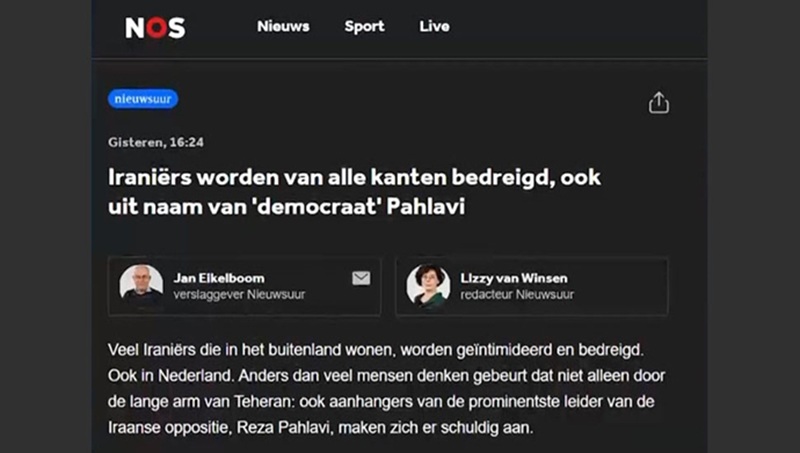

Threats, doxing, and harassment expose a coercive pattern within pro-monarchist circles aligned with Reza Pahlavi
A recent report by Dutch public broadcaster NOS highlights a disturbing trend: Iranian dissidents living in Europe are increasingly subjected to threats, intimidation, and harassment—not only by agents linked to Tehran, but also by networks associated with monarchist factions aligned with Reza Pahlavi.
The investigation documents how a segment of the Iranian diaspora, particularly in countries such as the Netherlands and Belgium, has become the target of coordinated campaigns of intimidation. These actions include online harassment, public defamation, and, in some cases, direct physical threats.
Doxing and Public Targeting of Dissidents
Central to the report is a Telegram channel known as “The Mercenaries,” where more than 170 Iranians residing in the Netherlands and Belgium have reportedly been listed, labeled as “accomplices of the regime.” Those targeted include lawyers, academics, and journalists—individuals with no formal ties to the Iranian government but who are critical of monarchist narratives.
Personal data, including photographs and identifying details, are published on these platforms. Legal experts in the Netherlands classify such actions as doxing, a criminal offense under Dutch law when used to intimidate or threaten individuals.
Professor Joep Lindeman of Utrecht University noted that these activities align with clear patterns of unlawful intimidation. Victims have reported serious consequences, including threats to their safety and livelihoods.
Escalation from Online Abuse to Physical Threats
The harassment has extended beyond the digital sphere. According to lawyer Amin Roozdar, who represents several victims—and is himself among those targeted—some individuals have faced direct attacks.
In one documented case, a woman’s home was vandalized with accusations of “treason.” The perpetrators filmed the act and circulated the footage online, amplifying the intimidation. The victim reportedly went into hiding for weeks, fearing for her safety.
At least twenty formal complaints have been filed with Dutch authorities. However, legal representatives warn that the response has so far been insufficient relative to the severity of the threats.
A Climate of Fear Across Europe
Individuals who refuse to publicly support monarchist slogans—such as endorsing the return of the monarchy—are systematically targeted. Reports also indicate that business owners, including shopkeepers and restaurateurs, have been pressured to display images of the Reza Pahlavi and his father under threat of violence. Such actions point to a broader pattern of coercion aimed at enforcing ideological conformity within diaspora communities.
Denials and Contradictions
Reza Pahlavi has tried publicly to distance himself from these activities. In an earlier interview with journalist Christiane Amanpour, he stated that he does not control the actions of individuals on social media and condemned harassment in principle.
However, the report notes a contradiction: shortly after this statement, Amanpour herself became the target of harassment by Pahlavi supporters, who accused her of bias for posing critical questions.
This pattern raises concerns about the gap between public messaging and the conduct of aligned networks, a pattern that is being followed regularly by fascist currents.
A Troubling Case in Canada
The climate of fear has been further intensified by the killing of Masood Masjoody, an Iranian-born mathematics teacher in Canada known for his criticism of Pahlavi. While investigations are ongoing and details remain unclear, early indications suggest that suspects may have links to pro-Pahlavi circles.
Although definitive conclusions have not yet been established, the case has heightened anxiety among Iranian communities abroad.
Law Enforcement Response Under Scrutiny
Despite multiple complaints, Dutch police have refrained from providing detailed public statements, citing the sensitivity of ongoing investigations. Legal advocates argue that this silence risks underestimating the scale and coordination of the threat.
The absence of a decisive response may embolden further acts of intimidation, particularly as victims report increasing fear and isolation.
Monarchist Networks and the Revival of Authoritarian Practices
The pattern outlined in the NOS report reflects more than isolated incidents—it points to a broader ideological current within monarchist circles. Despite claims of advocating democracy, elements within this movement exhibit behaviors consistent with authoritarian and exclusionary politics, including silencing dissent, enforcing loyalty, and targeting critics.
This dynamic echoes the legacy of the former Shah’s regime, where political pluralism was suppressed and opposition voices were marginalized or eliminated. The persistence of such methods among contemporary monarchist networks raises serious questions about their democratic credibility.
A Movement Without a Base?
The resort to intimidation and coercion suggests a deeper structural issue: the apparent lack of a broad and organic popular base. Rather than building legitimacy through inclusive political engagement, the monarchist current appear to rely on pressure tactics against fellow dissidents.
This approach does not merely fracture the Iranian opposition—it actively poisons the political space, replacing pluralism with intimidation and ideological policing. What is emerging within segments of the monarchist current aligned with Reza Pahlavi is not a democratic alternative, but a reactionary and exclusionary project that mirrors the very authoritarianism it claims to oppose.
Rather than presenting a viable vision rooted in public support, this current increasingly resorts to organized harassment, doxing, and coercion to silence critics and manufacture the illusion of legitimacy. Such tactics are not incidental—they are structurally consistent with a political culture shaped by the legacy of the Shah’s rule, where dissent was suppressed and loyalty was enforced.
In this light, the behavior documented by NOS should be understood as a systemic expression of a current that lacks genuine popular backing. Unable to win broad support among Iranians, it turns inward—targeting fellow dissidents, journalists, and activists—in an attempt to dominate the opposition space through fear rather than persuasion.
This is not the foundation of a democratic movement. It is the continuation of a failed authoritarian paradigm, repackaged under the language of democracy while reproducing the same repressive instincts that Iranians have already rejected.