


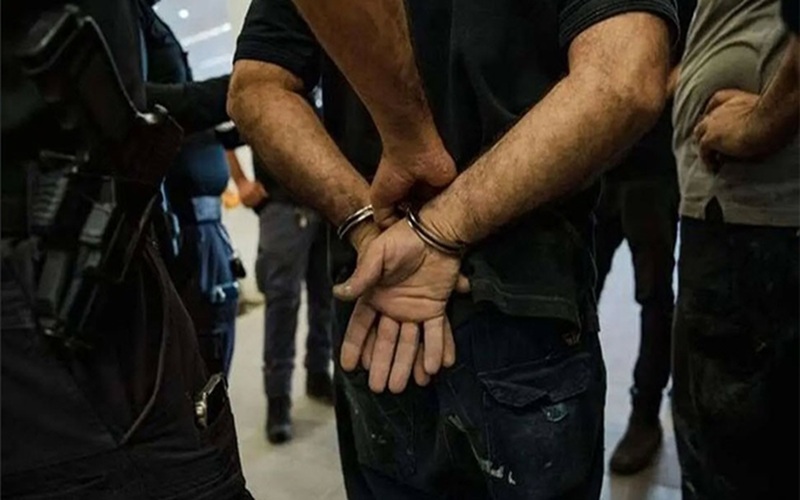

Police spokesperson’s remarks reveal a sweeping crackdown, targeting political prisoners, activists, and ordinary citizens under vague “security” charges.
In a rare admission of the scale of its domestic crackdown, Saeed Montazer al-Mahdi, spokesperson for Iran regime’s Law Enforcement Command (FARAJA), announced on Tuesday that 21,000 people were arrested within the 12-day war. The figures, provided during a media briefing, shed light on the regime’s widespread and systematic human rights violations — including arbitrary arrests, forced disappearances, and the violent suppression of dissent.
Montazer al-Mahdi acknowledged that many arrests had no direct link to the conflict that served as a pretext for the crackdown, noting that “ironically, the situation reduced certain types of crime in Tehran.”
According to his breakdown, 2,774 undocumented foreign nationals were detained, with authorities allegedly finding “location data and images of sensitive sites” on their phones. He further claimed that 261 people were arrested on suspicion of espionage, 172 for “unauthorized filming”, and 30 “special security cases” were identified through searches of confiscated mobile phones.
The police also intensified actions against those it labeled as “thugs,” a term Montazer al-Mahdi appeared to use for citizens who expressed views critical of the regime online or were deemed “likely to commit anti-security acts.”
This included the arrest of 135 such individuals and 147 others detained for “expressing joy” about the events of the 12-day war. No details were provided on how many of the 21,000 detainees have been released, remain in custody, or have been sentenced.
One of the most disturbing revelations concerned political prisoners held in Evin Prison. Montazer al-Mahdi claimed that police units were deployed to prevent escapes, arresting 127 political and security prisoners allegedly “trying to flee” during an attack on the prison. However, no independent source has confirmed any such escape attempt.
In the aftermath, political prisoners were shackled and transferred to other facilities under harsh conditions, facing beatings and mistreatment upon their return to Evin. The judiciary denied the abuse despite multiple testimonies from detainees and evidence that official photographs were taken before the assaults took place.
The arrests announced by the police appear to represent only part of the broader wave of security detentions, with other regime institutions releasing conflicting figures. For example, the state-run Fars News Agency reported over 700 arrests carried out by intelligence and security forces during the same period, excluding foreign nationals.
Judiciary chief Gholamhossein Mohseni Eje’i later put the number of detainees linked to the crackdown at over 2,000, admitting that “many” had no connection to espionage or hostile activities but had still been detained.
Eje’i openly threatened that those accused of “organized cooperation with the enemy” could face lengthy prison terms or even execution. In the weeks following the arrests, over 10 individuals have been executed on charges such as “espionage” and “collaboration with hostile forces.”
This official acknowledgment underscores the regime’s pattern of using national crises as cover for mass arrests, intimidation, and suppression of political dissent, leaving thousands of individuals and their families in uncertainty about their fate.