


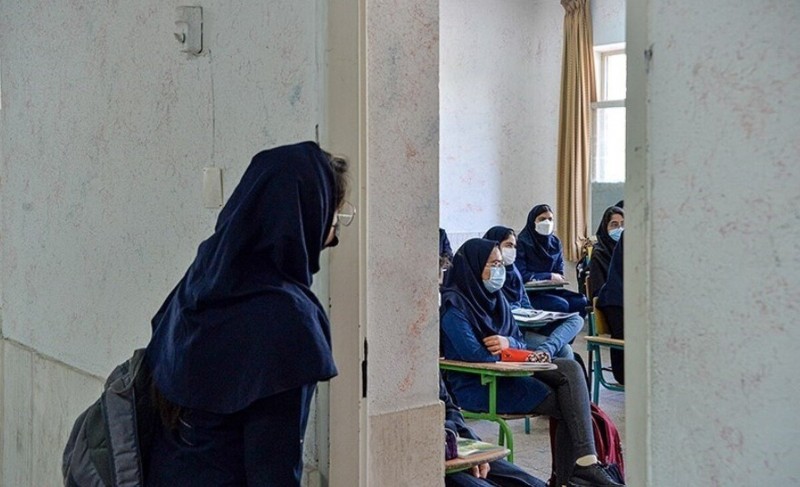

Deepening Education Crisis in Iran
Iran is facing an alarming rise in student dropouts — a growing crisis rooted in deep structural poverty, economic inequality, and chronic underfunding of education. Experts warn that nearly one million children and teenagers have been pushed out of the classroom, jeopardizing the country’s future generation.
According to Education Minister Alireza Kazemi, almost 950,000 students have dropped out of school. He cited economic hardship, illness, migration, and poor school infrastructure as key reasons.
In rural areas, the situation is particularly dire. In four small villages on the outskirts of Ahvaz with over 3,000 residents, there is not a single secondary school. As a result, 42 students were forced to abandon their education simply because no school exists nearby. To attend classes, many children must walk long distances along dangerous roads — a journey parents often refuse to allow for safety reasons.
Poverty and Inequality Driving Students Away
Ali Zarafshan, an advisor to the Ministry of Education, pointed to systemic crises, poverty, inequality, migration, urban marginalization, and lack of funding for school infrastructure as the main drivers of the dropout surge.
Official data from the 2023–2024 Statistical Yearbook shows that Khuzestan Province, with more than 1.08 million students, ranks fourth nationwide by student population. Yet Khuzestan, alongside Sistan and Baluchestan, Tehran, Khorasan Razavi, and suburban Tehran, has the highest dropout rates in the country.
Deputy Education Minister Rezvan Hakimzadeh has acknowledged that economic and cultural hardship, migration, family conservatism, and distance from schools are major contributors. Many families lack proper documentation or live in informal settlements, meaning their children are excluded from official education statistics.
Even in cities, dropout rates are rising. Young people increasingly view education as meaningless after seeing unemployed university graduates around them. Many turn to low-paying jobs to support their families, abandoning education entirely.
Corruption and Ideological Control in Teacher Recruitment
Beyond economic factors, education experts blame non-professional hiring practices for declining school quality. In recent years, the regime has recruited clergymen and politically loyal individuals instead of qualified teachers, eroding the professional standards once maintained by teacher training universities.
Mohammad Davari, spokesman for the Iranian Teachers Organization, revealed that mental health is ignored in teacher selection, while extreme scrutiny is applied to religious and political loyalty. He cited the case of a top-ranked applicant who was rejected because “her hijab was deemed too loose.” Such ideological vetting, Davari argued, has “distorted the balance of teacher recruitment” and degraded classroom standards.
Shocking Numbers and Neglected Children
New data highlight the magnitude of the problem. By May 2025, the Education Ministry had identified 152,287 out-of-school children aged 6–11 in Khuzestan alone, more than 130,000 of whom had never enrolled in any school.
Nationwide, during the 2022–2023 school year, 902,188 children dropped out at various levels. The breakdown:
- 156,835 in elementary school
- 195,568 in lower secondary
- 549,785 in upper secondary
The overall dropout rate reached 1.97%, or 287,617 students, in that year. In 2023–2024, it slightly improved to 1.65%, but the total number of out-of-school children remains staggering.
Religion over Education
Despite this crisis, Education Minister Alireza Kazemi recently announced that the ministry’s main focus is not improving access or quality, but rather “prayer, Quran, and strengthening religious and national identity.” He also unveiled new materials glorifying Iran’s missile program and “fallen commanders,” prepared for distribution in schools.
This ideological agenda has drawn harsh criticism from educators and lawmakers who say it diverts scarce resources from solving urgent structural problems.
Class Divide and Failing Schools
Parliament member Mohammadreza Sabbaghian compared Iran’s current school system to the caste divisions of the Sassanid Empire, condemning how the wealthy and officials’ children attend elite private schools charging hundreds of millions of tomans in tuition, while 80% of students are left in underfunded public schools.
Meanwhile, the best teachers are transferred to these private institutions, leaving public-school students with minimal support and outdated resources.
Declining Performance and Rising Despair
The consequences are visible. Ehsan Azimirad, spokesman for the Parliamentary Education Committee, reported that the average GPA of Iranian students has fallen to between 9 and 12 (out of 20) — a sign of widespread academic decline.
In September, Etemad newspaper reported that many stateless children in Sistan and Baluchestan were denied registration this year. Families that once could enroll their children using self-declaration letters from local authorities were told the policy had been suspended. One father said he was forced to tell his children, in shame, that they could no longer attend school.
A Generation at Risk
Iran’s growing education crisis is not just a symptom of economic decline but a reflection of systemic neglect and ideological mismanagement. With nearly one million children deprived of basic education, the regime’s focus on religious indoctrination and political control has come at the cost of the nation’s future.
If unaddressed, this silent catastrophe could produce a lost generation — trapped in poverty, unskilled, and excluded from any vision of progress.