
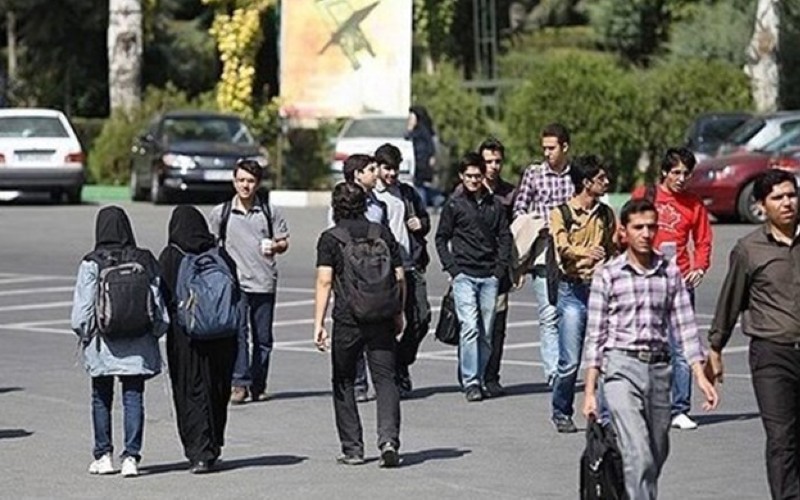

Regime-aligned outlets depict a university system trapped in declining academic quality, economic pressure, and shrinking freedom of expression.
Iran’s state-aligned newspapers have offered a rare and revealing glimpse into the depth of the crisis gripping Iran’s universities on the anniversary of Student Day, portraying a generation struggling under political repression, economic hardship, and a collapsing academic environment. What emerges across these reports is the image of a hollowed-out higher education system in which activism has faded, opportunities have withered, and the prospect of a future inside Iran feels increasingly remote.
According to Ham-Mihan, pressure on the government to intensify the enforcement of compulsory hijab has grown sharply in the days leading up to December 7, and this push is expected to surface in the student discussions surrounding the president’s appearance at Shahid Beheshti University. The paper notes that even supporters of the current administration have become disillusioned, anticipating pointed remarks directed at the president from across the student spectrum. Yet it stresses that the deeper issue is not the ceremony itself but the transformation of the university environment. Years of political pressure, combined with nationwide upheavals, have drastically altered the character of Iranian campuses. Instead of being arenas for critique and civic engagement, universities increasingly allow only expressions aligned with state policies.
The article acknowledges that after the 2022 protests, a profound shift has taken shape among the youth. A student quoted by the outlet describes a generation that has become less engaged with politics and more focused on personal survival, stating that students “no longer show the same sensitivity to political issues” and instead prioritize immediate concerns about life and society. Another student activist from Sharif University explains that the atmosphere for student engagement has shrunk to the point where even campus organizations are no longer enthusiastic about recruiting members. In his words, student interest has redirected toward “applying abroad and migration.”
Jahan-e Sanat reinforces this bleak portrait by describing the “gradual death of the student’s role.” The newspaper argues that campuses have lost their function as spaces for collective identity formation, civic responsibility, and skill development. Universities, it says, have devolved into oversized schools where students attend classes, pass exams, and collect degrees without opportunities to grow, participate, or shape their communities. The paper highlights that the tightening of restrictions has caused every form of student activity to be viewed through a security lens. For students who see no career prospects and no university space for personal or professional development, migration becomes “the only escape from a gradual death,” a death defined as the suppression of needs, abilities, and identity.
In a separate report, Jahan-e Sanat frames the situation as a “triangle of crisis,” with students trapped between deteriorating education, economic pressures, and diminishing freedom of expression. It notes that the expulsion and emigration of professors have eroded educational quality, while soaring tuition fees, housing costs, and the disconnect between academic fields and job markets have left students increasingly hopeless. The paper cites official statistics showing that university graduates make up approximately 43 percent of all unemployed Iranians, with more than 795,000 unemployed graduates nationwide. The weight of these conditions, combined with memories of political repression from 1999 to 2022, has produced a climate of fear that erodes students’ willingness to speak or organize.
The report goes further by emphasizing that academic freedom—supposed to be the defining characteristic of any university—has been systematically undermined. Heavy monitoring and an entrenched security atmosphere make critical engagement risky, encouraging widespread self-censorship. The article quotes experts warning that universities filled with “selectively approved” individuals cannot sustain genuine student advocacy. The cumulative outcome, it argues, is the destruction of the university’s role as a space of inquiry, debate, and social progress.
As experienced scholars, promising researchers, and top students leave the country, the consequences “for both the university and society are devastating.” The loss of human capital, the decline in teaching quality, and the collapse of intellectual debate create what analysts describe as a hostile and uncertain environment that accelerates brain drain and deepens national stagnation.
Across these regime-aligned outlets, a consistent narrative takes shape: Iran’s universities, once a central force in political and social life, are being suffocated by repression, economic stress, and the systematic dismantling of academic freedom. Student Day, once a symbol of activism, now unfolds in an environment defined by fear, disillusionment, and the search for a way out.