
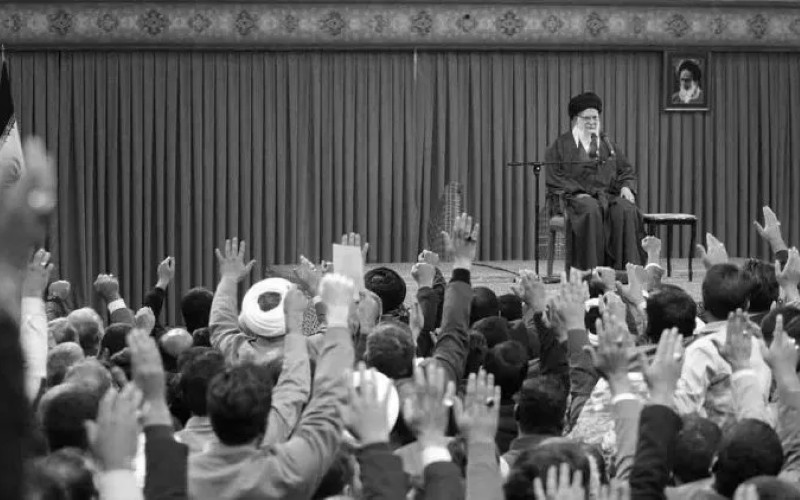

The Supreme Leader’s latest address to regime-affiliated eulogists reveals a system increasingly reliant on propaganda, externalization, and ideological theatrics to mask deep domestic failures.
A Stage-Managed Spectacle Amid National Crisis
Ali Khamenei’s December 11 speech—delivered before a curated audience of state-backed eulogists—was less a policy address than a tightly scripted exercise in political messaging.
The three-hour event, packaged as a celebration of cultural and religious vitality, functioned as another iteration of the regime’s propaganda repertoire: deny structural collapse, reassign blame to “foreign enemies,” and frame dissent as ideological deviation. The disconnect between the Leader’s narrative and the country’s lived reality could not have been starker.
In an environment marked by severe inflation, widespread unemployment, deteriorating social services, and compounding ecological crises, Khamenei chose not to acknowledge the systemic failures driving public discontent.
Instead, he attempted to project an image of national resilience and ideological continuity—an image increasingly at odds with observable conditions.
Manufactured Identity and the Politics of Deflection
Khamenei opened by insisting that Iran has preserved its “religious, historical, and cultural identity” against foreign threats. This framing relies on a longstanding conceptual maneuver: recasting internal grievances as externally engineered challenges. Yet the everyday pressures endured by Iranian citizens—ranging from political repression to economic freefall—reflect endogenous failures, not foreign intervention.
The invocation of catchphrases such as “national resistance” and “resilience” serves an important political function. These terms convert state-imposed hardship into a quasi-spiritual test of endurance, displacing responsibility from governing institutions onto the public. The narrative suggests that suffering strengthens identity, rather than signaling institutional decay.
The Instrumentalization of Religious Rituals
One of the notable components of the speech was Khamenei’s elevation of madāhī (eulogist performance) as a “remarkable phenomenon” and a “bastion of resistance literature.”
This reframing is emblematic of how the state co-opts religious traditions to sustain political legitimacy. Under the regime’s model, ritual becomes apparatus; spirituality becomes a conduit for ideological reinforcement.
Khamenei’s call for eulogists to “attack the enemy’s weak points” and “explain revolutionary teachings” illustrates this conversion of religious platforms into propaganda channels.
These directives further underscore how the state views cultural rituals not as independent social expressions, but as instruments for mobilization, indoctrination, and the preservation of an aging revolutionary mythology.
The External Enemy as Structural Glue
A recurring theme of the speech—repeated across decades of Khamenei’s public statements—is the construction of an omnipresent, omnipotent foreign enemy. His claim that the United States, Europe, and a network of unnamed “mercenaries” deploy writers, artists, filmmakers, and “Hollywood” to erase revolutionary values is deeply characteristic of the regime’s logic of externalization.
This narrative framework performs several political tasks simultaneously:
- It redirects attention away from domestic governance failures by recasting internal discontent as the product of foreign manipulation.
- It reinforces ideological cohesion within regime-aligned constituencies by maintaining a siege mentality.
- It delegitimizes dissent, portraying cultural plurality or critical thought as evidence of infiltration.
- It positions the regime as the final line of defense, thereby justifying expanded surveillance, censorship, and political control.
The irony, however, is that the regime itself has presided over decades of social erosion, cultural restriction, and economic decline. The homogenization of public space—through censorship, securitization, and ideological regulation—has contributed more to the hollowing of collective identity than any foreign cultural influence.
Minimizing Pain, Diminishing Reality
One of the starkest moments in the speech was Khamenei’s casual reference to issues like the Khuzestan dust crisis as “minor problems.” This rhetorical minimization exposes a profound gap between the ruling elite’s worldview and the day-to-day experience of ordinary citizens.
When environmental disasters, loss of livelihood, and infrastructural collapse are dismissed as peripheral irritants, the state signals that it no longer perceives public welfare as intrinsic to its legitimacy. In a context where millions face declining purchasing power, unreliable water systems, and rising social precarity, such statements can further erode already weakened trust.
The Real Anxiety Behind the Narrative
Khamenei’s insistence that “the enemy” seeks to erase revolutionary memory reveals more about his internal fears than about any external threat. The regime’s true concern is not a foreign plot, but domestic transformation—especially the emergence of politically autonomous citizens, digitally networked youth, and increasingly vocal social movements.
The regime leader’s rhetoric suggests acute anxiety about collective rupture. His fixation on ideological fidelity reflects recognition that the regime’s foundational narrative—once powerful—no longer commands broad social resonance. Rather than engaging meaningfully with demands for accountability and reform, the state chooses to intensify myth-making.
A System in Defensive Posture
The December 11 speech was a distillation of the regime’s current governing strategy: deny structural failures, elevate ideological spectacle, and construct an all-encompassing external adversary. It reflects a leadership class more invested in narrative control than in policy remediation.
By reframing crises as conspiracies and religious rituals as political tools, the regime attempts to stabilize an increasingly untenable status quo. Yet the widening gap between state rhetoric and lived experience suggests that such strategies may be losing their efficacy.
Ultimately, the speech underscores a political system operating in defensive mode—relying on symbolic performance rather than substantive governance, and attempting to preserve power not through responsiveness, but through narrative containment.