


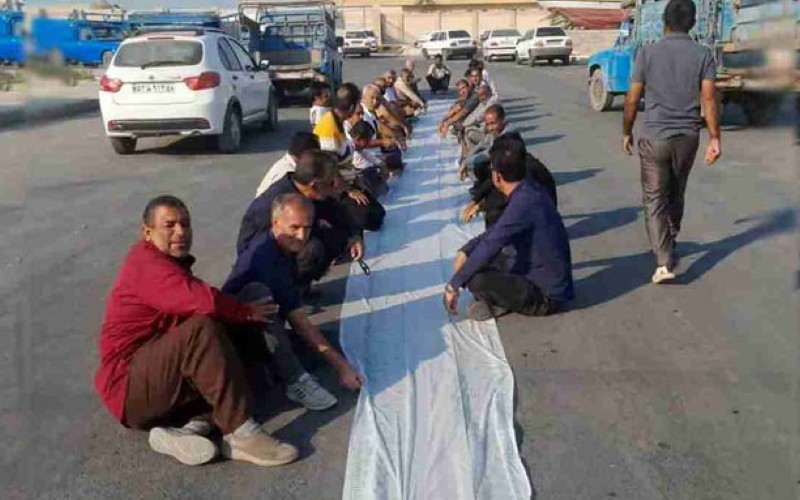

Runaway inflation, collapsing wages, and policy-driven price shocks are shrinking workers’ livelihoods while crime, suicide, and insecurity surge across Iran.
Runaway inflation and uncontrolled price hikes are relentlessly shrinking Iranian workers’ livelihoods, pushing millions into poverty and accelerating a broader social breakdown. Recent currency figures and official statistics expose the scale of an economic collapse rooted not in external shocks, but in years of structural mismanagement and destructive policies by Iran’s ruling regime.
On Thursday, December 18, the U.S. dollar reached 125,785 tomans on Iran’s currency market. At this exchange rate, the official minimum monthly wage of 10.399 million tomans is worth just $83 per month, or approximately $2.70 per day. This figure starkly illustrates the erosion of real wages and the collapse of purchasing power for Iran’s working class.
A regional comparison underscores the severity of the crisis. Minimum monthly wages stand at approximately $1,360 in the United Arab Emirates, at least $1,500 in Saudi Arabia, $620 in Turkey, $270 in Iraq, $410 in Jordan, and $235 in Azerbaijan. At $83 per month, Iranian workers have effectively become the cheapest labor force in the Middle East, a direct consequence of regime-driven inflation, currency devaluation, and policy failure.
At the same time, the price of a single gold coin in Iran has climbed to 133.78 million tomans—around 13 times the monthly wage of a worker. The contrast with historical data is revealing: in 1979, the minimum wage was 630 tomans while a gold coin cost 420 tomans, meaning a worker could purchase roughly one and a half coins with a single month’s salary. Today, that relationship has been violently reversed, exposing the depth of wage destruction under the current ruling system.
As wages collapse, field reports and labor activists describe an economy that has long surpassed the stage of a “cost-of-living crisis.” A new wave of price hikes—ranging from 12-fold increases in some essential medicines to the removal of subsidized exchange rates for rice and dairy products, and regime plans to raise fuel prices—has delivered an unprecedented blow to the livelihoods of tens of millions.
The price of Iranian rice has reached around 400,000 tomans per kilogram, meaning each grain of rice costs nearly 80 tomans. This stark calculation reflects a reality in which the food baskets of low-income families shrink daily, while official promises of “economic reform” translate into deeper deprivation.
From Empty Tables to Rising Crime
The collapse of living standards is no longer confined to household consumption. Official data indicate that economic desperation is rapidly spilling into social insecurity. Statistics from Iran’s Statistical Center show that livestock theft has doubled over the past decade, rising from around 12,000 cases in the early 2010s to more than 23,000 cases in 2023—the fastest growth rate among all categories of theft. During the same period, home burglaries increased by 76 percent and vehicle theft by 44 percent.
Provinces such as Kerman, Khuzestan, and Razavi Khorasan report the highest rates of livestock theft, a telling indicator of rural impoverishment. In many villages, a single animal represents a family’s entire livelihood. The spread of theft into these areas signals how deeply poverty has penetrated Iranian society.
According to research by the Iran Open Data Center, the number of murders in Iran has increased by 40 percent over the past decade, rising from fewer than 2,000 cases in 2011 to around 2,700 in 2023. Given the worsening economic conditions over the past two years, the real figure is likely even higher.
Suicide rates paint an equally alarming picture. Over the same period, suicides increased by 70 percent, from about 3,500 cases to more than 6,000 annually. Ilam province records the highest suicide rate at 16.8 cases per 100,000 people, followed by Kohgiluyeh and Boyer-Ahmad, Kermanshah, and Chaharmahal and Bakhtiari—regions where economic hardship, unemployment, and social neglect are acute.
Nutrition Crisis and Official Denial
The collapse of purchasing power has also triggered a silent nutrition crisis. While the price of a bottle of milk has increased roughly 35,000-fold since 1979, the head of Iran’s Dairy Products Union has acknowledged that per capita dairy consumption has fallen from 130 kilograms per year in 2010 to just 50 kilograms today. This implies that 40 to 45 million people can no longer afford basic dairy products.
A 70 percent increase in dairy production costs over the past three months and a jump in raw milk prices from 23,000 to 35,000 tomans have led to large volumes of dairy products being returned unsold—not due to lack of supply, but because consumers no longer have the means to buy them.
Despite these realities, the regime’s leadership continues to promote a narrative detached from everyday life. Recently, Iran regime’s supreme leader claimed that the country is “progressing” and that the population’s “resilience” brings honor to Islam. Official statistics and lived experience, however, directly contradict this rhetoric.
Regime-affiliated economist Hossein Raghfar has stated that at least seven million people in Iran are hungry, while 34 million live below the absolute poverty line. These figures expose the cost of governance that prioritizes ideological claims and power preservation over economic stability and human welfare.
Taken together—$83 monthly wages, unaffordable food, surging crime, rising suicides, and deepening insecurity—the data portray a society under severe strain. Poverty begins at the worker’s table, but it ultimately erodes public safety, mental health, and the foundations of social cohesion. In today’s Iran, almost every indicator is rising—except the purchasing power and dignity of the people forced to endure this system.