
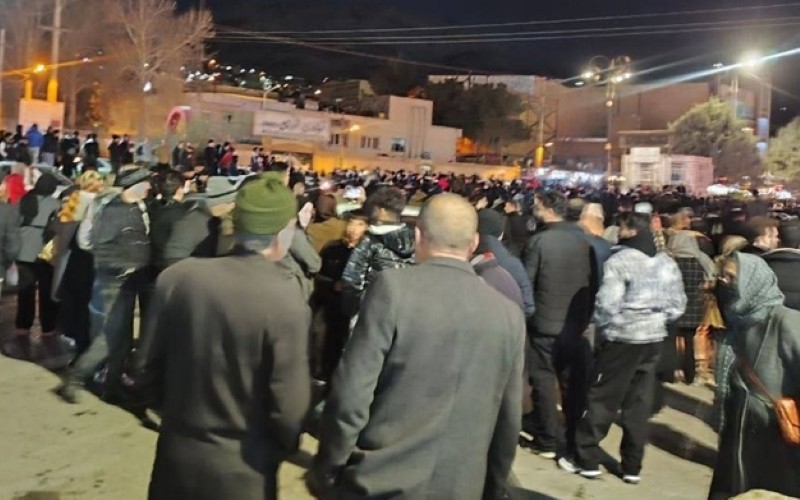


From mass funerals to direct confrontations, the sixth day of the January 2026 uprising reveals a society that has crossed the point of no return.
In Dey 1404 (January 2026), Iran’s political geography is undergoing a fundamental transformation. What began as scattered economic and social protests has rapidly evolved into a nationwide uprising with a clear objective: the overthrow of religious dictatorship. The sixth day of this historic movement, January 3, marked a decisive deepening of public anger and a strategic shift from dispersed demonstrations to direct confrontation with the regime’s apparatus of repression.
Scenes unfolding in Marvdasht, Kouhdasht, Zahedan, and Fooladshahr were not spontaneous outbursts of emotion. They reflected a nationally oriented will for structural change in Iran—an organized and determined rejection of clerical rule.
Funerals Turned into Frontlines of Resistance
One of the most defining and strategic features of the 1404 uprising has been the transformation of funerals into new arenas of struggle. The authorities, believing that violence and killings would instill fear, are now facing the opposite reality: every grave has become a trench, and every funeral procession a mass demonstration.
On the sixth day of the uprising, the funeral of Khodadad Shirvani Monfared in Marvdasht turned into an unprecedented outcry against the Supreme Leader’s rule. Thousands of enraged citizens chanted, “I will kill the one who killed my brother,” signaling that the regime has not only failed to contain the protests but has fueled them with each act of violence.
A similar dynamic unfolded in Kouhdasht during the funeral of Amirhesam Khodayari-Fard, and in Fooladshahr for Dariush Ansari Bakhtiarvand. In these cities, local traditions, tribal honor, and collective dignity merged with demands for freedom, transforming mourning rituals into renewed starting points for the continuation of the uprising.
From Protest to Direct Assault on Repression Infrastructure
Analysis indicates that the uprising has moved beyond slogan-based demonstrations into a phase of direct action against repression infrastructure. The bold attempt by protesters and resistance elements to seize Police Station No. 11 in Marvdasht on the sixth day—following the takeover of a police station in Azna on day five—sent a clear and unmistakable message: the wall of fear has collapsed.
Live ammunition fired by regime forces from rooftops of government buildings and banks failed to disperse the youth. Instead, protesters took control of large parts of Marvdasht, demonstrating a decisive shift in momentum. This phase change highlights the active role of organized elements operating nationwide, providing political direction and operational coherence to what were once localized protests.
A Nationwide Geography of Revolt
The geographic breadth of the 1404 uprising—from Zahedan in the east to Kouhdasht in the west, and from Tehran to the industrial cities of Isfahan province—reflects an unprecedented level of national cohesion. This unity has placed the already strained security forces under severe pressure, forcing the regime into a crisis over how to deploy its repressive apparatus.
In Zahedan, citizens poured into the streets immediately after leaving the mosque, chanting: “Iranian, raise your voice! Shout for your rights!” The slogan echoed the inseparable bond between different regions of the country. Longstanding regime tactics aimed at fueling ethnic and sectarian divisions have collapsed, replaced by a unified front against dictatorship.
Fear and Fragmentation Within the Regime
While the streets are increasingly controlled by the people, the regime’s power centers are gripped by fear and instability. Reports from within the regime’s parliament point to intensifying factional infighting over economic collapse and government appointments. Signs of panic are also evident in closed-door government meetings, including visible tensions reported in sessions held in Shahrekord.
Internationally, the uprising has triggered widespread reactions. Parliamentary statements in France and warnings from international officials underscore that this wave of protests is broader, deeper, and fundamentally different from previous uprisings. Global attention and explicit warnings against violent repression have created additional political space for the continuation of the movement inside Iran.
A Society Beyond the Point of Return
With the uprising entering its sixth day, it has become unmistakably clear that Iranian society has crossed a point of no return. Public demands are no longer limited to partial reforms or economic concessions. The central objective is the replacement of religious dictatorship with a democratic, pluralistic system founded on the separation of religion and state, respect for individual freedoms, and equality of rights.
The blood of those killed now serves as the banner of continuity for the uprising. Combined with the growing activity of resistance networks and nationwide solidarity, these sacrifices signal the approaching end of a dark era of repression and the dawn of freedom in Iran.
This uprising has demonstrated a fundamental truth: when the power of the masses is combined with awareness and organization, no apparatus of repression can prevail.