The banner raised at Tehran University is not propaganda, but a final confession of political collapse during Iran’s 2026 uprising
The installation of a banner bearing the chilling slogan “Either Death or Khamenei” at the entrance of Tehran University—at the height of the 2026 uprising and after the blood of thousands of citizens had already been spilled—cannot be dismissed as mere propaganda. It is a declaration of final war against society. It raises a fundamental question: how does a political system reach a point where “death” becomes the only option it can place before its people?
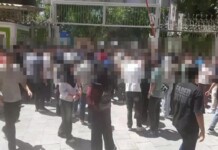
The choice of Tehran University as a location for this message was deliberate. The university has long functioned as a bastion of dissent and a historic epicenter of the chant “Death to Khamenei,” making it a persistent nightmare for the ruling establishment. Turning the gateway of this institution into a display of intimidation represents an attempt at symbolic occupation—an effort to reclaim, through coercion, a space that the regime has irreversibly lost in the realm of ideas, consciousness, and legitimacy.
This act reflects a form of sadistic indifference to public conscience. It is a response not only to the grief of the mothers of Kahrizak and other victims of repression, but also to the rage of the resistance networks that continue to challenge the state’s monopoly on fear. A regime that occupies a university in order to sanctify death is implicitly admitting that no shared political language remains between itself and a new generation—except the language of bullets, gallows, and coercion.
The slogan “Either Death or Khamenei” contains a devastating paradox. It does not emerge from a position of strength, but from absolute impasse. A system that, after killing thousands, can offer nothing to its population except death has exhausted every remaining instrument of governance. What is presented as defiance is, in reality, an admission of strategic and moral bankruptcy.
Within this logic, the “Leader” ceases to be a political figure and becomes a sacred fetish whose survival demands the annihilation of society itself. By publicly endorsing such a slogan, the regime formally declares the collapse of the state–society relationship and replaces it with a predator–prey dynamic. This is the language of a declining power that, unable to imagine a future for itself, seeks to drag the present of an entire society into darkness and negation.
“Either Death or Khamenei” is the political translation of desperation. It signals that the system has reached a stage where even the pretense of legitimacy is deemed an unnecessary cost. In political theory, when a ruling power begins to glorify the death of its opponents—or its own demise in the absence of a leader—it is effectively signing its political last will and testament.
The installation of this banner is an acknowledgment that society has slipped beyond the regime’s control and that the only remaining tool is naked terror. History demonstrates, however, that when fear reaches such levels of obscenity, it loses its deterrent effect and becomes fuel for revolutionary momentum. A society that has crossed the threshold of fear through thousands of deaths does not retreat in the face of such banners. Instead, it recognizes the hollowness and fragility of a power that must publicly beg for blood to survive.
The slogan “Either Death or Khamenei” represents the final attempt of despotism to freeze time. Yet the lived reality of the 2026 uprising shows that society has already moved beyond these threats. Tehran University, despite physical occupation, remains a living nerve center of resistance and freedom. These banners collapse first in the collective consciousness of Iranians, long before they are torn down by human hands. By shouting “death,” the regime reveals the historical fate it seeks to deny, while society advances—rooted in an irrepressible will for life and freedom—toward writing its next chapter.