Why Iran’s future cannot be built on dictatorship—old or new
In the midst of Iran’s darkest days, a long-awaited moment has finally arrived. After more than three decades of silence, compromise, and failed diplomacy, the international policy of appeasing Iran’s ruling system has reached its end. Following sustained resistance by the Iranian people—and especially after the bloodshed during recent protests—the European Union has officially designated the Islamic Revolutionary Guard Corps (IRGC) as a terrorist organization.
This is not a symbolic move. The IRGC is not just an army. It controls large parts of Iran’s economy, dominates politics behind the scenes, and acts as a “shadow government” directly loyal to the supreme leader. Labeling it a terrorist organization strikes at the very backbone of the ruling system. The cost of this designation will not be limited to one institution; it will affect the entire structure of power in Iran.
With this decision, one reality becomes clearer than ever: the world is now dealing openly with a violent, organized force that rules through fear. Both the Iranian people and the international community can no longer pretend otherwise.
A lesson from history
To understand why this moment matters, it helps to look back. Before returning to Iran in 1979, the regime’s founder Ruhollah Khomeini lived in exile in France. Sitting calmly under an apple tree, he spoke to international journalists and promised freedom—freedom of speech, political parties, a free press, women’s rights, and even tolerance for political opponents such as communists. He claimed that religious leaders would not interfere in governing.
Once in power, those promises vanished. Iran was turned into a harsh dictatorship. Executions replaced dialogue. Censorship replaced freedom. Years later, Khomeini openly admitted that he had deceived the public.
This history matters because Iran now faces a similar danger—this time from another direction.
The return of an old illusion
As the current system weakens and shows signs of demise, a new propaganda effort has emerged, centered around the son of Iran’s former Shah. Through media campaigns and aggressive supporters, this movement attempts to hijack the coming change and replace one form of absolute rule with another—turning religious dictatorship into royal dictatorship.
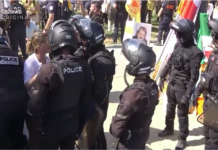
Some of its loudest supporters use intimidation, threats, and public harassment—not inside Iran, but in European cities. They attack anyone who disagrees with them, chant aggressive slogans, and even threaten the graves of political opponents from decades ago. This behavior raises a serious question: if this is how they act without power, how would they rule if they gained it?
Their slogans openly call for the return of the secret police of the monarchy era the SAVAK—an agency once responsible for torture and repression. The idea that Iranians should sacrifice their lives to dismantle today’s intelligence apparatus only to replace it with another notorious one is deeply insulting.
Dictatorship does not become democracy by changing its name
Iran’s people are under heavy pressure—not only from repression at home, but also from misleading narratives abroad. That is why it is essential to recognize authoritarian behavior even when it hides behind modern clothes, polished speeches, or nostalgic slogans. A dictator wearing a crown is no better than a dictator wearing a turban.
Before the 2022 nationwide uprising, supporters of monarchy treated the word “revolution” as taboo. When protests intensified and momentum grew, they suddenly embraced the term—attempting to ride the wave of public anger. More recently, they have added the label “national revolution” to their messaging.
But words matter. A movement is called a revolution only after it succeeds in fully dismantling a ruling system and replacing it with something fundamentally different. Calling threats, exclusion, and authoritarian ambition “national” does not make them so—especially when large parts of the population are already being labeled as enemies, traitors, or outsiders.
History shows the danger of such distortions. Even the 1953 coup—organized by foreign powers and enforced through violence—was later falsely described as a “national uprising.” Iranians paid the price for that lie for decades.
The real direction forward
From Iran’s constitutional revolution over a century ago, to the overthrow of the monarchy in 1979, and through repeated uprisings in recent years, the Iranian people have consistently shown one thing: they reject dictatorship in all forms.
What is taking shape today is not a return to the past, but the possibility of a genuine, democratic future—one that permanently removes both religious rule and royal authoritarianism from Iran’s political life.
This time, the goal is clear: a free Iran governed by its people, not by clerics, not by shahs, and not by fear.