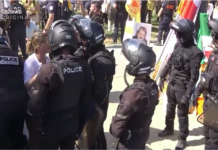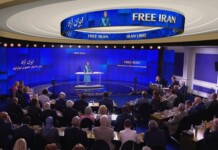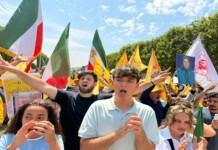
The February Berlin demonstration by freedom-loving Iranians, signals political maturity and a unified rejection of authoritarian alternatives.
On the eve of the anniversary of the 1979 anti-monarchic revolution, Berlin has emerged as more than a symbolic gathering point for Iranian expatriates. It has become a political platform where the collective will of Iranians is articulated in a clear and deliberate form.
At a moment when protests inside Iran continue under severe repression, a central question frames the significance of this mobilization: can the Berlin demonstration move beyond protest symbolism and serve as a political statement of Iran’s societal maturity in rejecting both royal and clerical authoritarianism?
The participation of Iranians traveling from all over the World—despite extreme winter conditions—reflects a level of organizational resolve rather than emotional impulse. This mobilization directly challenges the Iranian regime’s persistent efforts to downplay domestic unrest through censorship and disinformation.
The convergence of protesters from cities such as Stockholm, London, Bern, and Paris into Berlin illustrates the formation of a transnational political network, aimed at amplifying the voices of protest movements inside Iran and internationalizing their demands.
What distinguishes the Berlin demonstration from previous gatherings is the central political message articulated through the slogan “No Shah, No Mullahs.” This is not a rhetorical chant but a concise political doctrine.
Nearly five decades after the fall of the monarchy, Iranian society has accumulated sufficient historical experience to recognize that authoritarianism—whether secular or religious—cannot serve as a foundation for freedom.
The attempt to rehabilitate monarchical figures as political alternatives mirrors earlier efforts to impose leadership from above, disconnected from sustained grassroots struggle. Such projects increasingly fail to resonate with a population whose political consciousness has been shaped by direct confrontation with repression in Iran’s streets, markets, and workplaces.
The emphasis on rejecting both systems also undermines a key survival strategy of the ruling establishment. The Velayat-e Faqih system has long relied on presenting a controlled or nostalgic alternative—often rooted in Iran’s past—to external audiences, allowing it to portray genuine popular resistance as foreign-driven or inauthentic.
The emergence of organized resistance networks and decentralized protest structures inside Iran has disrupted this narrative. Political momentum today is generated not in diplomatic corridors or exile lobbying circles, but through sustained domestic resistance. The Berlin demonstration reflects this shift by aligning itself explicitly with forces rooted in internal struggle rather than externally manufactured alternatives.
The February 7 march in Berlin therefore functions as the latest link in a broader political chain—connecting street protests, labor unrest, and the endurance of political prisoners inside Iran.
Its significance lies in its clarity: the demand articulated is not for cosmetic reform or power rotation within existing frameworks, but for a fundamental transformation toward a democratic, secular republic based on political equality and popular sovereignty.
Equally important is what the demonstration rejects. By explicitly opposing both monarchy and theocracy, participants signal an awareness of how revolutionary movements have previously been diverted or appropriated.
This reflects a political learning process shaped by decades of repression, failed reforms, and imposed leadership models. The current generation of protesters demonstrates a heightened sensitivity to these risks and a determination to prevent the repetition of past outcomes.
The Berlin gathering thus sends a calculated message to both the Iranian regime and the international community: authoritarianism, regardless of form, has no place in Iran’s future. The demonstration underscores that Iran’s democratic movement is defined not by nostalgia or expediency, but by political agency grounded in lived resistance.
In this context, Berlin is not merely a host city. It is a temporary political arena where Iranians articulate a forward-looking vision—one that situates monarchy and clerical rule alike in history, not as options for the future.