

Spain’s prime minister warns that a potential succession in Tehran could accelerate militarization and deepen regional instability
A notable shift appears to be underway in Europe’s political posture toward Iran—one that is less cautious, more explicit, and increasingly shaped by concerns over what comes next in Tehran.
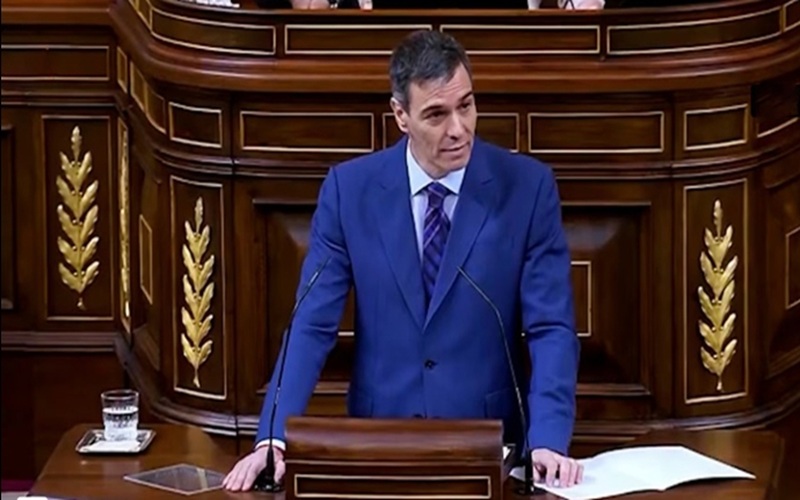
In a forceful address before the Cortes Generales, Pedro Sánchez broke with the traditionally measured tone that has long defined European rhetoric on Iran. His remarks focused not only on the present state of the regime, but on the implications of a potential transition of power at its apex.
Sánchez warned that emerging indications about succession dynamics point not toward moderation, but toward escalation. Referring to Mojtaba Khamenei, he suggested that a leadership transition could result in an even more hardline posture than that of his predecessor, Ali Khamenei.
The core of his argument was strategic, not rhetorical. According to Sánchez, intelligence and political assessments increasingly indicate that the successor may adopt a more aggressive doctrine—particularly in the nuclear domain. This marks a critical point departure from previous European assumptions, which often relied on the notion—contested though it was—that Iran’s leadership maintained internal constraints on nuclear weaponization.
By openly questioning that premise, Sánchez effectively signaled that Europe may no longer view Iran’s nuclear posture through the same lens. The implication is clear: if the regime’s new leadership abandons even the appearance of restraint, then existing diplomatic frameworks may lose their already restricted effectiveness.
Equally significant is the venue and tone of these remarks. Spain has traditionally been counted among the more moderate voices within the European Union on Middle Eastern policy. For its prime minister to adopt such direct language in a parliamentary setting suggests a broader recalibration—one that may extend beyond Madrid.
Indeed, the reaction across European diplomatic circles indicates that this is not an isolated stance. Analysts increasingly interpret such statements as part of an emerging consensus: that the era of cautious engagement with Tehran may be giving way to a more confrontational and security-driven approach.
Describing the Iranian regime’s new leader in stark moral and political terms, particularly from an official parliamentary platform, is not standard diplomatic practice. It reflects a growing willingness among European leaders to publicly articulate concerns that were previously confined to closed-door discussions.
This matters because language shapes policy. When senior officials begin to frame a leadership transition as a risk multiplier—rather than an opportunity for change—it alters the strategic calculus. Sanctions, diplomatic isolation, and coordinated international pressure become more likely tools of policy rather than contingencies.
At a deeper level, Sánchez’s remarks highlight a structural dilemma that Europe can no longer easily sidestep. For years, policy toward Iran’s regime has rested on managing behavior—through negotiations, incentives, and minor pressure—without fundamentally addressing the nature of the regime itself. But if the trajectory of leadership points toward greater militarization and ideological rigidity, that approach becomes increasingly untenable.
The question, then, is not simply who will lead Iran next. It is whether Europe is prepared to adapt its strategy to a scenario in which continuity means escalation. If Sánchez’s intervention is any indication, that adaptation may already be underway.