


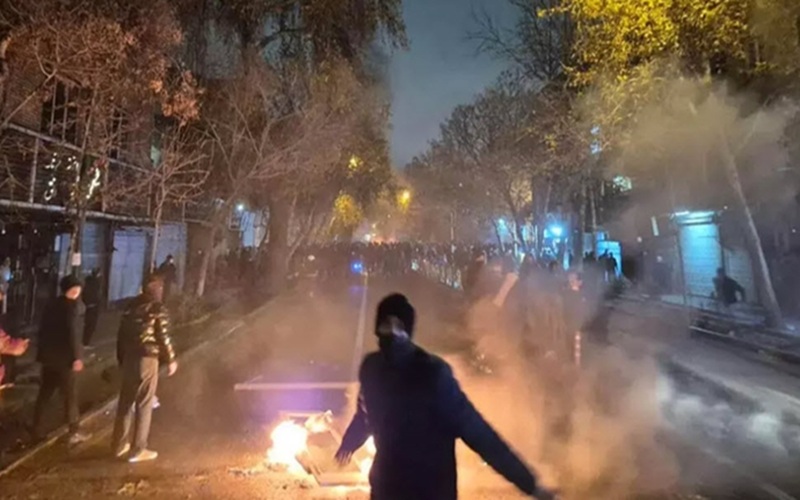

Contradictions between official narratives and field realities expose a growing crisis of control in Iran’s urban spaces
Since the outbreak of the war, Iran’s regime has worked relentlessly to project an image of resolve—mobilizing its supporters into the streets, staging rallies, and orchestrating spectacles of loyalty. Yet behind this carefully curated façade of strength lies a much more fragile reality, one increasingly at odds with the regime’s official narrative.
At the center of this contradiction stands Mohammad Bagher Ghalibaf, the Speaker of the regime’s parliament, who has presented the street as a symbol of the regime’s “social power.” In a message circulated on Telegram on March 30, 2026—the 31th day of the conflict—Ghalibaf called the streets “a mirror of social strength,” claiming that “the enemy is angered and disturbed by the presence in the streets” and urging loyalists not to withdraw.
But field reports and eyewitness accounts tell another story. Across multiple cities, Iran’s streets have become spaces of tension and confrontation between security forces and disillusioned youth. Rather than a stable display of state authority, the urban landscape has turned into a contested arena where control shifts by the hour.
In some districts, the once-visible presence of security forces has thinned. During certain night hours, local sources report stretches of empty streets, with protesters reclaiming space while regime forces hesitate to engage directly. Video footage circulating on Telegram and X shows Revolutionary Guard and Basij units sheltering under bridges, inside car parks, and behind barriers rather than maintaining open patrols—a stark departure from their traditional posture of dominance.
Meanwhile, organized resistance networks continue to expand their nighttime activity. Acts of defiance such as coordinated graffiti campaigns and flash demonstrations have eroded the regime’s claim to total control. Within security circles, this slow, creeping loss of dominance has become a source of mounting anxiety.
Ghalibaf’s own rhetoric reveals the mindset behind the state’s tightening grip. He now frames the “street” not as a space for civic expression but as an extension of the battlefield—equating it with missiles and strategic waterways as tools of national power. Analysts interpret this language as evidence that the regime sees public space primarily through a security lens rather than as the shared domain of citizens.
State-affiliated media like Tasnim News Agency echo this framing, defending street mobilization as a defensive necessity to “prevent unrest” and bolster the legitimacy of armed forces. By recasting civic presence as national security, the regime seeks to normalize its militarization of public life.
Yet this insistence on control betrays weakness, not confidence. Analysts note a shift toward fragmented patrols and reactive policing—a reflection of uncertainty more than discipline. The government’s reluctance to sustain large, visible deployments suggests fear of confrontation and the unpredictable energy of crowds that no longer believe the official script.
Public reaction to Ghalibaf’s remarks has been telling. His repeated invocation of the “enemy” to describe fellow citizens has triggered a backlash online, where users see it as proof of a growing rift between the state and society. In this dynamic, the street itself becomes the measure of legitimacy—a space where the regime’s narrative collides with lived reality.
Behind Ghalibaf’s rhetoric lies a deeper concern: the erosion of cohesion within the regime’s own ranks. Reports of waning morale among lower-level security forces hint at a system struggling to sustain internal loyalty just as its outer image of unity begins to crack.
Taken together, these trends point to a fundamental transformation. In today’s Iran, the street is no longer a neutral space—it has become a symbolic and literal battlefield between state control and social defiance. Far from demonstrating strength, the regime’s actions betray its growing insecurity.
The battle for Iran’s streets is not just about physical territory—it is about narrative, legitimacy, and the boundaries of fear. And increasingly, those boundaries are being tested in real time.