


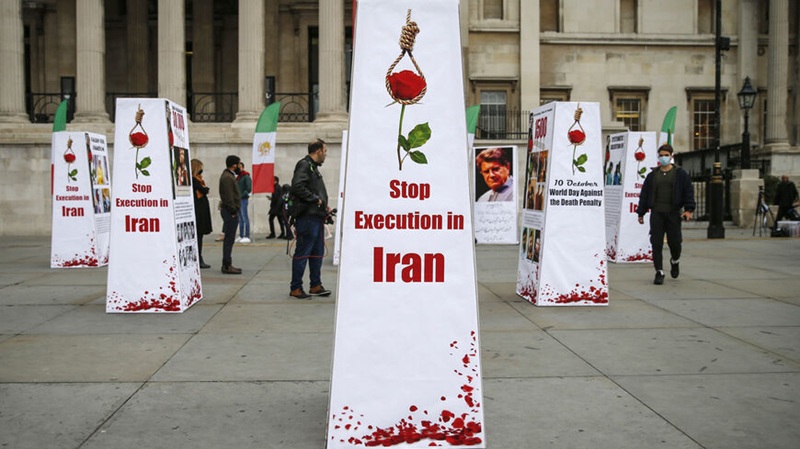

Post-war surge in executions of political prisoners revives fears of a deliberate pattern rooted in the 1988 mass killings
In the weeks following the cessation of hostilities between the United States, Israel, and Iran, a familiar and deeply troubling pattern has re-emerged: the systematic execution of political prisoners. This development is not unprecedented. It closely mirrors the events of 1988, when the Iranian regime, shortly after accepting a UN-brokered ceasefire in the Iran-Iraq War, carried out one of the most notorious mass executions of political detainees in modern history.
Today, the parallels are difficult to ignore.
A Historical Blueprint: The 1988 Mass Executions
In August 1988, immediately after Tehran accepted the UN Security Council resolution that ended the war with Iraq, thousands of political prisoners—many already serving sentences—were executed following summary proceedings. At the time, regime authorities justified the killings by pointing to a military incursion by the People’s Mojahedin Organization of Iran (PMOI/MEK).
However, the current wave of executions—occurring in the absence of any comparable external trigger—undermines that narrative. Instead, it reinforces a more structural interpretation: that such executions are a preemptive tool used by the regime during moments of perceived internal vulnerability, particularly after external conflicts subside and the risk of domestic unrest rises.
This interpretation is further supported by a July 7 editorial published by the Revolutionary Guards-affiliated Fars News Agency, explicitly titled “Why the 1988 Executions Should Be Repeated.” The article described the massacre as a “successful historical experience,” effectively endorsing the replication of that strategy under current conditions.
Post-War Executions: A Pattern Reasserted
Since the recent ceasefire, Iranian regime authorities have accelerated executions targeting political prisoners, particularly individuals accused of links to the PMOI/MEK or involvement in the January 2026 protests.
On March 30 and 31, authorities executed four political prisoners—Akbar Daneshvarkar, Mohammad Taghavi, Babak Alipour, and Pouya Ghobadi—at Ghezel Hesar Prison. All had been convicted on charges such as “membership in opposition groups” or “armed rebellion,” following trials widely criticized for lacking due process. Reports indicate that confessions were extracted under torture and that detainees were held in prolonged solitary confinement prior to execution.
Just days earlier, on March 19, three young protesters—Saleh Mohammadi, Mehdi Ghasemi, and Saeed Davoudi—were publicly executed in Qom. Their alleged crimes included participation in protests and violent confrontation with security forces during the January uprising. The timing of these executions, immediately preceding Nowruz and Eid al-Fitr, suggests an intentional effort to maximize psychological impact and deter further dissent.
The pattern continued into April. On April 20, two more political prisoners, Hamed Validi and Nima Shahi, were executed following months of disputed allegations, including claims of involvement in weapons production and espionage. Opposition sources maintain that the charges were fabricated and that both men were subjected to torture during interrogation.
In parallel, three additional young men—Mohammadamin Biglari, Shahin Vahedparast, and Ali Fahim—were executed after being accused of attempting to access military weapons during the January uprising. Their cases highlight a significant escalation: the targeting of individuals not only for dissent, but for allegedly challenging the state’s monopoly on force.
Executions as a Tool of Political Control
Taken together, these cases point to a coherent strategy rather than isolated judicial actions. The speed, timing, and scale of executions indicate a deliberate attempt to reassert control in the aftermath of both external conflict and internal unrest.
This aligns closely with the logic of 1988. Then, as now, the regime faced a convergence of pressures: the end of a costly war, a fragile political environment, and the potential for renewed domestic opposition. The response in both instances has been to eliminate perceived threats preemptively through mass executions.
Importantly, recent developments also challenge the regime’s longstanding justification for the 1988 massacre. If those executions were truly a response to an external military threat, the replication of similar measures today—without such a trigger—suggests that the underlying motive has always been internal: the suppression of dissent.
The Role of Torture and Coerced Confessions
Another consistent element across decades is the use of torture and coerced confessions as the foundation of capital cases. The death of Abbas Yavari in custody—reportedly under severe torture—underscores the persistence of these practices. Authorities claimed suicide, a familiar explanation in cases where detainees die under suspicious circumstances.
Similar allegations have been raised in nearly all recent execution cases, with detainees denied access to independent legal counsel and subjected to closed-door trials. This systematic denial of due process reinforces the argument that executions serve political, rather than judicial, purposes.
A Strategy That Risks Backfiring
While intended to instill fear, such executions often produce the opposite effect. Sociologically, they contribute to the creation of collective memory and martyrdom narratives that can strengthen opposition movements over time. The individuals executed—many of them young and associated with recent protests—are increasingly viewed by segments of society as symbols of resistance rather than criminals.
This dynamic was evident in the aftermath of the 1988 executions and appears to be re-emerging today. Each execution adds to a growing reservoir of public grievance, particularly among younger generations already disillusioned by economic hardship, political repression, and social restrictions.
Repetition as Revelation
The resurgence of political executions in Iran following the recent ceasefire is not merely a continuation of past practices—it is a revealing repetition. By echoing the events of 1988, the current wave of executions exposes a longstanding strategic doctrine: when confronted with internal instability, the regime turns to extreme repression to secure its survival.
Far from demonstrating strength, this reliance on executions signals acute vulnerability. It suggests that the primary threat perceived by the Iranian leadership is not external pressure, but internal dissent.
As history shows, however, such strategies may suppress opposition temporarily—but they rarely eliminate it.