
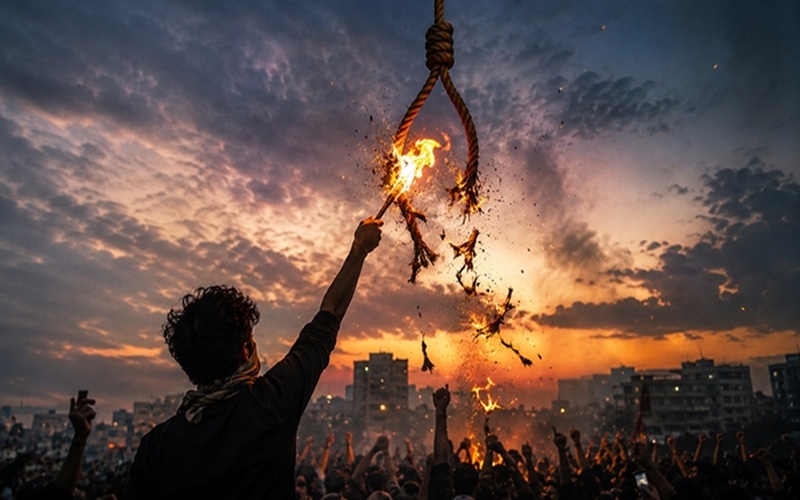

Despite intensified repression, anti-regime acts and public resistance continue to spread across Iranian cities
The Iranian regime has long relied on fear as its primary instrument of survival. Through mass surveillance, an expanding security apparatus, public executions, and relentless intimidation, Tehran believes it can silence dissent and extinguish the growing flames of unrest across the country. Yet recent events suggest the opposite may be occurring: every execution appears to deepen public anger, and every act of repression seems to generate new waves of resistance.
Authorities have flooded cities with security forces, intelligence agents, and surveillance cameras. Major intersections are increasingly connected to centralized monitoring systems designed to identify and suppress potential protests before they emerge. At the same time, executions continue at an alarming pace, with political prisoners, dissidents, and marginalized communities facing growing pressure from the judiciary and security services.
However, rather than creating stability, these measures appear to be intensifying anti-regime sentiment.
On Thursday, May 7, anti-regime activists reportedly carried out a series of coordinated actions in response to the executions of three prisoners in Mashhad — Mohammadreza Miri, Ebrahim Dowlatabadi, and Mehdi Rasouli. According to opposition reports, PMOI resistance units targeted symbols of state repression and institutions associated with the security apparatus in multiple cities.
Among the reported incidents were attacks against a Basij base in Chabahar, actions targeting facilities linked to the Islamic Revolutionary Guard Corps (IRGC) in Mashhad, and firebomb attacks against offices associated with state propaganda and ideological enforcement. Additional reports described attacks on Basij centers in Mashhad and Zahedan.
Images and banners associated with Supreme Leader Ali Khamenei were also reportedly set on fire in several cities, including Isfahan, Mashhad, Dehdasht, and Zahedan.
The following day, reports from Zahedan indicated that Baluchi youth had displayed dozens of anti-execution banners and placards across the city, openly challenging the regime’s campaign of intimidation. Some slogans condemned executions directly, while others argued that no government built on repression, torture, and fear can sustain itself indefinitely.
PMOI Resistance Units in Zahedan prove the regime’s executions have backfired
Several banners also carried statements attributed to Maryam Rajavi and Massoud Rajavi, linking the recent executions to what opposition groups describe as the regime’s growing political deadlock and fear of organized dissent.
One widely circulated slogan repeated in Zahedan read: “From Zahedan to Tehran, death to the oppressor, whether Shah or Supreme Leader,” reflecting broader frustration not only with the current regime but also with authoritarianism in all forms.
May 9—Zahedan, southeast Iran
PMOI/MEK Resistance Units resume their anti-regime activities, condemning the regime's new wave of executions and reiterating their commitment to overthrow the regime and establish a democratic republic that rejects all forms of dictatorship. pic.twitter.com/gPotRLkOsM— People's Mojahedin Organization of Iran (PMOI/MEK) (@Mojahedineng) May 9, 2026
The persistence of such public acts of defiance is significant given the scale of Iran’s current security crackdown. The regime has invested heavily in cyber-monitoring systems, expanded street patrols, and mass surveillance infrastructure in an attempt to prevent renewed nationwide protests similar to those that have shaken the country in recent years.
Yet the continued emergence of resistance activities suggests that fear alone may no longer be sufficient to contain public outrage.
"Iran’s regime is futilely trying to escape its inevitable overthrow through nonstop executions." pic.twitter.com/v9XJUholZx
— People's Mojahedin Organization of Iran (PMOI/MEK) (@Mojahedineng) May 9, 2026
For many Iranians, executions are increasingly viewed not as displays of state strength, but as signs of a government struggling to maintain control amid mounting economic hardship, political isolation, and deep social unrest. Rather than freezing society into silence, the regime’s reliance on executions risks turning each hanging into another catalyst for anger and rebellion.
As tensions continue to grow, the gap between the state’s escalating repression and society’s willingness to resist appears to be widening — raising new questions about how long the current strategy of fear can remain effective.