The Return of Authoritarian Imagery Raises New Questions About Reza Pahlavi’s Political Direction
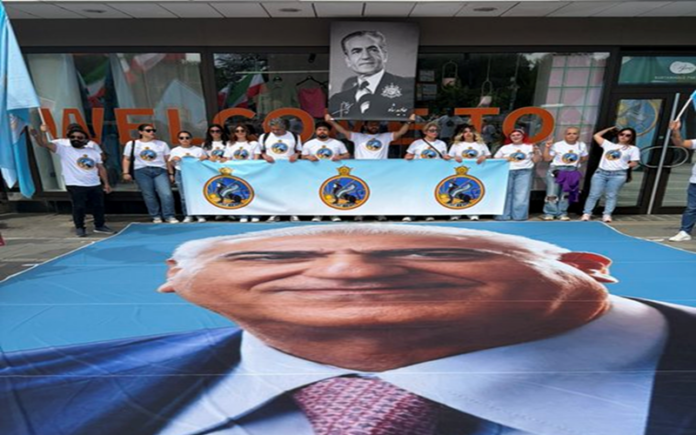
The public appearance of individuals dressed in T-shirts associated with the former Shah’s secret police, SAVAK, during a gathering of supporters of Reza Pahlavi in Germany has sparked renewed criticism of the monarchist movement and its increasingly aggressive political messaging.
For years, Reza Pahlavi has attempted to present himself internationally as a supporter of democracy, civil rights, and nonviolence. Yet the growing visibility of pro-monarchist groups openly glorifying the Shah’s security apparatus has intensified concerns that sections of his movement remain deeply attached to the authoritarian legacy of the Pahlavi dictatorship.
The use of SAVAK symbolism is particularly controversial because the organization remains synonymous in Iranian collective memory with torture, censorship, political repression, and systematic intimidation.
SAVAK: Built to Preserve Absolute Rule
SAVAK, the notorious intelligence and security organization of the Pahlavi monarchy, was established in 1957 following the 1953 coup against Prime Minister Mohammad Mosaddegh. Its primary mission was to protect the monarchy through surveillance, suppression of dissent, and elimination of political opposition.
Under the leadership of General Teymur Bakhtiar, the organization rapidly expanded into one of the most feared security institutions in the Middle East. Opposition activists, members of the National Front, leftist organizations, intellectuals, journalists, and student activists became targets of arrests, torture, and extrajudicial repression.
Ironically, Bakhtiar himself later fell out with the Shah and fled Iran. After years of conflict with the monarchy, he was ultimately assassinated in Iraq in 1970 in an operation linked to the very organization he had helped create.
Torture and Repression Under the Monarchy
Accounts from former political prisoners and historical reports describe a wide range of brutal interrogation methods employed by SAVAK. These included electric shocks, severe beatings, sleep deprivation, sexual violence, suspension torture, nail extraction, and prolonged solitary confinement.
Iranian opposition figures such as Asghar Badizadegan reportedly suffered catastrophic injuries under torture. Historical accounts describe him being burned on electric heating devices, leading to severe spinal damage and repeated surgeries before his eventual execution.
Numerous political prisoners were arrested merely for possessing banned books or distributing political literature. During the monarchy, newspapers, political parties, and independent organizing were heavily restricted, while criticism of the Shah was treated as a threat to state security.
Among the names remembered by former prisoners and opposition activists are Fatemeh Amini, Behrouz Dehghani, and Mohammad Dezyani, all cited by critics of the monarchy as victims of SAVAK-era repression.
From SAVAK to the Clerical Intelligence Apparatus
One of the most controversial historical issues surrounding the fall of the monarchy is the role former SAVAK personnel later played after the 1979 revolution. Various former intelligence and security operatives were absorbed into the emerging apparatus of Ruhollah Khomeini and assisted in the establishment of the Islamic Republic’s own security and intelligence institutions.
Critics of both dictatorships argue that the methods of repression employed under the Shah survived the revolution and were later replicated by the clerical regime. For many Iranians, this continuity represents one of the clearest warnings against romanticizing the monarchy’s security state.
Former SAVAK official Parviz Sabeti, widely accused by opponents of overseeing harsh crackdowns against dissidents, has in recent years re-emerged publicly among some monarchist circles abroad. His renewed visibility has become a major source of controversy among Iranian opposition groups.
Growing Contradictions Inside the Monarchist Movement
The appearance of individuals dressed in SAVAK symbols in Germany comes at a time when Reza Pahlavi’s political project faces mounting criticism and declining momentum among parts of the Iranian diaspora.
Opponents argue that sections of the monarchist movement increasingly rely on intimidation, personality cults, historical revisionism, and militaristic symbolism rather than presenting a democratic political alternative for Iran’s future.
Critics also point to repeated contradictions in the rhetoric of pro-monarchist networks — simultaneously denouncing organizations such as the People’s Mojahedin Organization of Iran while attempting to appropriate the sacrifices of executed political prisoners and anti-regime activists for broader opposition narratives.
The display of SAVAK imagery has therefore been interpreted not as an isolated provocation, but as part of a broader ideological crisis within factions of the monarchist current.
Authoritarian Nostalgia and Iran’s Future
For many Iranians who experienced both the Shah’s dictatorship and the current clerical regime, the return of SAVAK symbolism revives painful historical memories rather than offering hope for democratic change.
The controversy surrounding the Germany event has reinforced concerns that parts of the monarchist movement remain politically rooted in the same authoritarian structures, security mentalities, and cult-of-power traditions that contributed to the fall of the monarchy itself.
As Iran’s opposition landscape continues to evolve, the debate over authoritarian nostalgia versus democratic accountability is likely to remain one of the defining political fault lines among exile opposition groups.