


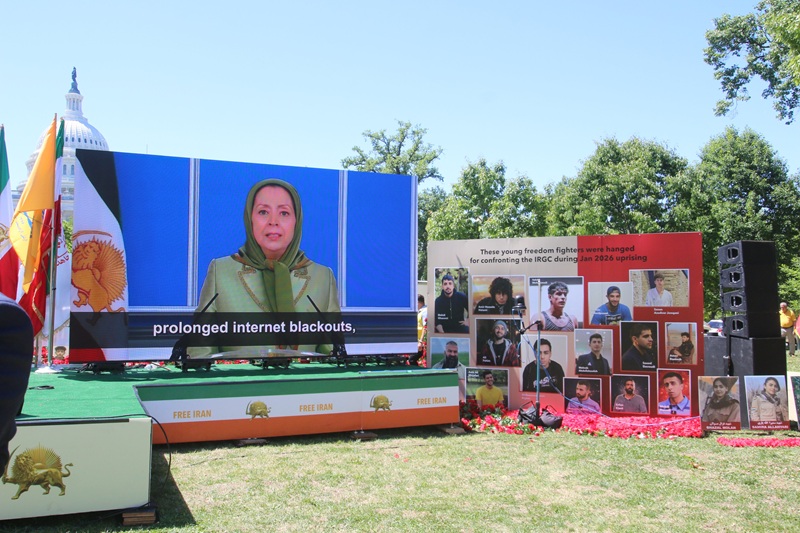

NCRI President-elect tells Washington rally that the Iranian people’s uprising and organized resistance are the only path to freedom, democracy, and lasting regional peace.
Maryam Rajavi declared that lasting peace in the Middle East can only be achieved through the overthrow of Iran’s clerical dictatorship during a major Free Iran rally in Washington, DC, on May 16, 2026.
Addressing thousands of Iranian Americans and supporters of the Iranian Resistance, Rajavi said the Iranian people and their organized resistance movement are advancing toward the overthrow of the ruling system of Velayat-e Faqih, despite intensifying repression, executions, and internet blackouts.
“Lasting peace remains unattainable without the overthrow of the warmongering, terrorist dictatorship of the Velayat-e Faqih,” Rajavi stated.
The NCRI President-elect described the rally as a message of solidarity with the Iranian people’s ongoing struggle against “religious fascism” and called on the international community to recognize the National Council of Resistance of Iran (NCRI) as the democratic alternative to the current regime.
Rajavi Says Regime Faces Historic Deadlock
Rajavi argued that the Iranian regime has entered a historic impasse following the January 2026 uprisings and subsequent nationwide repression.
“Today, the mullahs find themselves ensnared in an impasse; they can neither return to the status quo preceding the uprisings and the massacres of January 2026, nor do they have a path forward,” she said.
According to Rajavi, the regime has intensified arrests, internet shutdowns, street searches, and executions in an attempt to suppress dissent and prevent another uprising.
She condemned the executions of eight PMOI-MEK members and seventeen anti-regime protesters, describing them as part of a “strategy of the noose” aimed at terrorizing society.
However, Rajavi insisted the executions have failed to stop resistance activities.
“Despite the prevailing wartime conditions and the climate of intense repression, the operations of the Resistance Units continue unabated every single day,” she said.
Executed Prisoners Praised as Symbols of Resistance
Rajavi devoted a significant portion of her speech to honoring executed political prisoners and members of the PMOI-MEK.
She highlighted the case of Vahid BaniAmerian, who reportedly told Iran’s Supreme Leader before his execution:
“Rest assured, if you execute me and those like me, we shall only multiply.”
Rajavi said the executed prisoners represent the “vanguard of the path to victory” and accused the regime of trying unsuccessfully to force prisoners into public repentance before execution.
She also referred to six executed MEK members who sang resistance anthems in Ghezel Hesar prison before their execution.
“This anthem is the resonant voice of the Iranian people,” Rajavi said, adding that despite the killings and repression, “they have not succumbed to despair.”
“No to the Shah and No to the Mullahs”
A central theme of Rajavi’s speech was the rejection of both clerical rule and monarchy.
She warned that the Iranian people’s struggle is being undermined both by international appeasement policies and by supporters of the former monarchy seeking to exploit unrest for political gain.
“The remnants of the monarchical dictatorship dealt the movement its most significant political blow,” Rajavi said in reference to the January 2026 uprising.
She accused monarchist factions of promoting authoritarianism, suppressing ethnic minorities, and attempting to revive SAVAK, the Shah’s former secret police.
“Their ambition is to resurrect the Shah’s dreaded SAVAK,” she said.
Rajavi stressed that Iran’s future cannot return to monarchy.
“Iran will neither remain under the yoke of religious dictatorship, nor will it ever revert to a monarchical autocracy,” she declared.
“The path of Iran is the path of a Democratic Revolution.”
Call for International Support for the Iranian Resistance
Rajavi emphasized that meaningful political change in Iran will not come through foreign intervention or passive انتظار for the regime to collapse.
“We do not wait for this regime to collapse spontaneously, nor do we expect external actors to change it,” she said.
Instead, she argued that change will come through uprisings, organized resistance, and what she called the “National Liberation Army.”
Rajavi called on governments worldwide to support the Iranian people’s right to overthrow the regime and to hold Iranian leaders accountable for crimes against humanity.
Among her demands were:
- Recognition of the Iranian people’s right to resist the regime
- Expulsion of regime agents from foreign countries
- Expanded access to unrestricted internet for Iranians
- International prosecution of Iranian officials
- Making an end to executions a condition in any agreement with Tehran
She also reiterated support for a future democratic republic based on pluralism, separation of religion and state, women’s equality, and autonomy for Iran’s ethnic nationalities.
“Our people are marching toward a future defined by the ballot box,” Rajavi said.
“Closer Than Ever to Victory”
Rajavi concluded her speech by declaring that decades of resistance and sacrifice have brought the Iranian opposition closer than ever to achieving democratic change.
“We have risen to reclaim the sovereignty of the people,” she said.
“And today, after 120 years of suffering and sacrifice, this struggle is closer than ever to its ultimate victory.”
She ended her address with calls honoring the Iranian people, Resistance Units, freedom, and the Army of Liberation.