


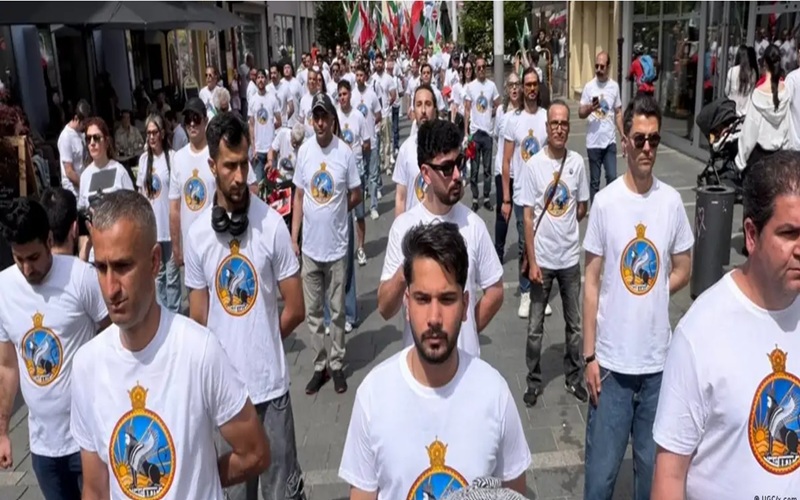

The public revival of symbols associated with Iran’s former secret police is not merely political nostalgia — it reflects the normalization of authoritarian violence under a different banner
In the quiet streets of Germany, where the memory of dictatorship and war still lingers in the political consciousness of Europe, a dark name has begun to reappear: SAVAK.
For thousands of Iranians, SAVAK was never simply an intelligence agency. It was the sound of prison doors closing in the middle of the night. It was the atmosphere of torture chambers, forced confessions, disappearances, and systematic fear. It represented a machinery designed not only to imprison bodies, but to break the human spirit long before physical destruction became necessary.
That is why the recent public appearance of SAVAK symbols, imagery, and rhetoric among some supporters of Reza Pahlavi in Europe should not be dismissed as harmless political nostalgia. The issue extends far beyond disagreement among opposition factions. What is at stake is the normalization of the language of repression itself.
Every authoritarian project begins by rehabilitating its symbols before rebuilding its institutions. Long before prisons are expanded, fear is aestheticized. Violence becomes romanticized. Torture is reframed as “order.” Secret police become symbols of “strength.” And gradually, through repetition and normalization, cruelty enters public life wearing the mask of patriotism.
Europe understands this danger better than most societies. The catastrophes of the twentieth century did not begin with tanks in the streets. They often began with symbols, slogans, myths of national salvation, and the glorification of “strong order.” History becomes deadly only after it first becomes banal — when societies stop reacting to the normalization of violence.
More dangerous than violence itself is the erasure of memory surrounding violence. Torture does not survive only in prisons and interrogation rooms; it also survives through public amnesia. Once victims disappear from collective memory, those responsible for repression are given space to reinvent themselves as defenders of stability, national pride, or salvation.
This is why defending freedom begins with defending memory.
No secret police force in history has ever reconciled itself with human dignity. Torture does not become legitimate because it is wrapped in a national flag. Fear does not become freedom because it calls itself security.
And yet, in recent years, parts of the monarchist movement surrounding Reza Pahlavi have increasingly tolerated — and at times openly encouraged — rhetoric and symbolism associated with the authoritarian machinery of the former monarchy. This development is particularly striking because Reza Pahlavi spent years presenting himself internationally as a moderate figure committed to tolerance, democracy, and nonviolence.
But political language matters less than political culture. When supporters publicly celebrate institutions associated with torture and repression, the contradiction becomes impossible to ignore.
The irony is difficult to overlook. For years, radical opposition to the current religious dictatorship was condemned by monarchist circles as “extremism.” Yet today, some of the same voices appear increasingly comfortable with rhetoric rooted in intimidation, exclusion, revenge, and authoritarian nostalgia. Even before holding any political power, elements within this movement have directed hostility not toward the ruling apparatus of the Iranian regime, but toward other opposition groups — including many who spent decades paying the price of resistance through prison, exile, torture, and execution.
This raises an uncomfortable but unavoidable question: after decades of repression under the current regime, why is the language of authoritarianism once again being rehabilitated under a different flag?
Did Iran’s history of prisons, executions, massacres, and torture teach so little that another generation now speaks casually of “purges,” “elimination,” and political cleansing?
Rather than confronting the historical legacy of SAVAK directly and acknowledging the suffering associated with it, Reza Pahlavi has often appeared more interested in marginalizing the conversation altogether — as though silence itself could erase historical trauma. But history rarely disappears on command. Suppressed memory eventually returns through the conscience of societies.
Fascism does not always arrive wearing military boots. Sometimes it arrives through nostalgia — nostalgia for “order,” for centralized authority, for obedience disguised as patriotism. From that point onward, dissent ceases to be viewed as evidence of a living society and instead becomes framed as an obstacle to “saving the nation.”
That is where freedom begins to die: first in language, then in institutions.
The core danger of extreme monarchist rhetoric lies precisely here — not in its attachment to a crown, but in its apparent inability to tolerate pluralism and dissent. The issue is not monarchy versus republic; it is authoritarianism versus freedom.
Modern Europe learned after the fall of fascism that certain symbols are not politically neutral. That is why Nazi imagery and Holocaust denial are criminalized in countries like Germany. These restrictions emerged from a painful recognition that some ideologies, if normalized, inevitably lead back to the destruction of human dignity.
The same moral logic applies to the glorification of SAVAK.
SAVAK was not merely an intelligence institution. It symbolized an organized system of fear and dehumanization. Electric shocks, flogging, nail extraction, isolation cells, psychological torture, and devices such as the notorious “Apollo” torture apparatus were not historical accidents. They reflected the logic of a state that placed power above human dignity.
The hills of Evin Prison are not merely geographic locations; they are living archives of suffering. Many Iranian families still carry the trauma of torture and disappearance not through books or museums, but through nightmares, silence, and empty spaces at the dinner table.
History, once lived, never fully ends.
That is why the public display of SAVAK symbols in Europe cannot simply be dismissed as a matter of political taste or historical interpretation. Symbols are not innocent. Every emblem carries memory. Every flag carries either liberation or suffering within it.
To normalize the symbols of repression is to gradually normalize repression itself.
Europe once understood that lesson clearly after fascism. The question now is whether that historical vigilance will remain intact when authoritarian nostalgia reappears wearing different colors and speaking a different language.
Because authoritarianism rarely returns in exactly the same form. Often, it merely changes costumes.