


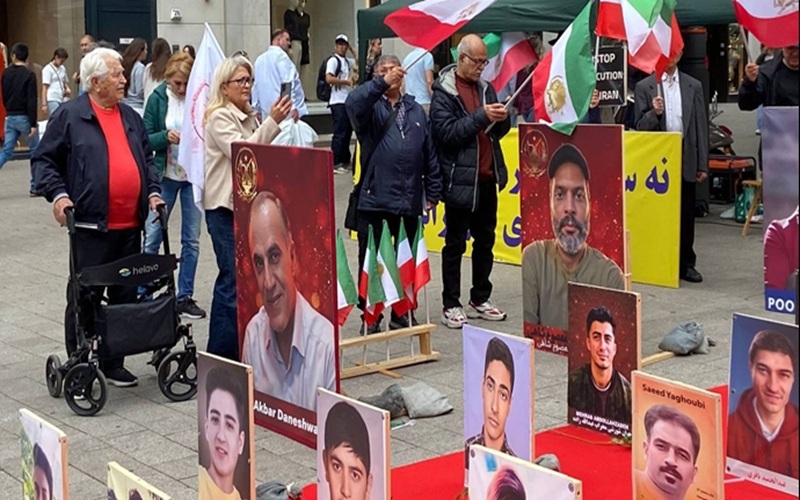

As international attention remains focused on war and diplomacy, Iran’s ruling regime is exploiting the post-war climate to intensify executions, mass arrests, and repression in an effort to prevent a new wave of nationwide unrest.
The clearest image of post-war Iran is not one of reconstruction or recovery. It is the image of prison cells filling up, execution orders multiplying, and security forces expanding their dragnet across the country.
Before the dust of war had even settled, the Iranian regime launched what can only be described as a new wave of state repression. More than 40 political and security-related executions, over 6,000 arrests, and dozens of prisoners facing imminent execution reveal a government that views fear—not reform—as its primary instrument of survival.
For months, the world’s attention has been directed toward military developments, nuclear negotiations, the Strait of Hormuz, and shifting regional alliances. Meanwhile, inside Iran, another crisis has been unfolding largely away from international headlines: the systematic expansion of the regime’s machinery of repression.
The clerical dictatorship has relied on executions for nearly five decades as a tool for eliminating opposition and preserving power. From the massacre of political prisoners in the 1980s to the bloody suppression of nationwide uprisings, the regime has consistently treated human life as expendable whenever its rule is challenged.
Today, that pattern is intensifying.
Reports from human rights organizations indicate that since the outbreak of the recent conflict, at least 40 individuals have been executed in political and security-related cases, while dozens more remain under death sentences. The pace of executions demonstrates that the regime is not responding to isolated security concerns. Rather, it is implementing a deliberate policy designed to intimidate society at a moment of exceptional vulnerability.
The timing is not accidental.
The war has left Iran facing severe economic deterioration, widespread social frustration, rising poverty, and growing public anger toward the ruling establishment. The very conditions that fueled previous nationwide uprisings remain unresolved. In many respects, they have become even more severe.
The regime understands this reality. It knows that beneath the temporary atmosphere created by external conflict lies a deeply dissatisfied society. For that reason, repression is being deployed not merely as punishment but as a preventive strategy against future protests.
More than 6,000 arrests have reportedly taken place since the beginning of the conflict. Among those targeted are protesters, journalists, lawyers, human rights defenders, artists, students, teachers, workers, members of ethnic and religious minorities, dual nationals, and families seeking justice for victims of state violence.
The message is unmistakable: no segment of society is beyond the reach of the security apparatus.
Particularly alarming is the growing use of espionage accusations. Charges of “collaboration with hostile states” and “spying” have become central tools in the regime’s effort to criminalize dissent. Such accusations provide authorities with a convenient pretext to impose severe punishments, including execution, while presenting political repression as a matter of national security.
Senior judicial officials have openly reinforced this approach. Public calls for the rapid processing and execution of security-related cases reveal a leadership eager to maximize the deterrent effect of state violence. Speed, in this context, is not about justice. It is about intimidation.
The crackdown has been accompanied by one of the most extensive internet blackouts in the country’s history. Tens of millions of citizens have experienced prolonged disruptions and censorship. Access to independent information has become increasingly restricted, while technologies such as VPNs, satellite internet, and communication with the outside world have been linked to security-related accusations.
This is not merely a technical policy. It is a political strategy.
When citizens are prevented from documenting abuses, organizing collectively, or informing the outside world, repression becomes easier to conceal. Isolation itself becomes a weapon. Fear spreads not only through arrests and executions but through uncertainty, silence, and the feeling that no one is watching.
Particularly disturbing is the targeting of young Iranians. Among those executed or sentenced in recent months are individuals barely out of adolescence. The regime’s objective appears clear: to terrorize the generation that has repeatedly taken to the streets demanding freedom and democratic change.
The authorities understand that Iran’s youth have become one of the most powerful engines of resistance. Consequently, they seek to transform executions into public warnings intended to discourage future mobilization.
Yet history suggests that repression alone cannot resolve the regime’s underlying crisis.
Executions may silence individuals, but they cannot eliminate the social realities driving public anger. Arrests may fill prisons, but they cannot erase demands for freedom, justice, and accountability. Internet blackouts may obstruct communication, but they cannot permanently suppress a population that has repeatedly demonstrated its determination to resist dictatorship.
This is why the international response matters.
The regime’s leaders have long benefited from a culture of impunity. As long as executions and human rights abuses remain secondary concerns in international diplomacy, Tehran will continue to view repression as a low-cost strategy.
The international community possesses several mechanisms to increase accountability, including international criminal investigations, universal jurisdiction prosecutions, and the creation of dedicated justice mechanisms focused on crimes committed by the regime. More importantly, human rights violations and executions must occupy a central place in any engagement with Tehran.
Ignoring the execution crisis in favor of geopolitical calculations would send a dangerous signal: that the suffering of the Iranian people can once again be subordinated to strategic interests.
For the regime, war has created a political opportunity. International attention has shifted elsewhere, and the costs of repression have diminished. The result has been an acceleration of executions, arrests, and intimidation.
If the world remains silent, the coming months may witness an even more dramatic escalation.
In today’s Iran, execution is no longer simply a judicial punishment. It has become the political language of a regime struggling to preserve its rule. Every execution is intended to raise the price of dissent. Every arrest is designed to spread fear. Every act of repression is a warning directed at a society that continues to demand change.
The question is no longer whether the regime is intensifying its crackdown. The evidence is overwhelming.
The real question is whether the international community will act before the execution machine claims even more victims.